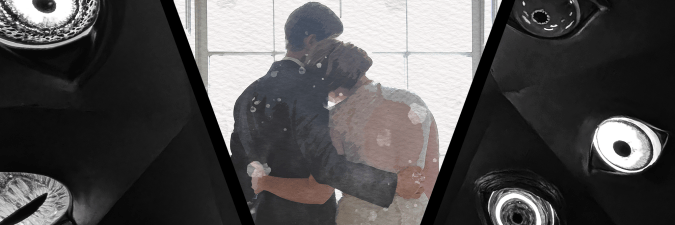
Malcolm first noticed it in the pauses.
Not the words his daughter spoke but the spaces between them, the way her sentences began to stall mid-air, looking for a place to land and finding nothing solid. Averill had always spoken quickly, words tumbling over each other, anxious to get out. Now she started and stopped, started and stopped again, as if listening to something else overlaid on top of what he could hear.
“Dad,” she said on the phone one evening, “can you turn the TV down?”
He was alone in the kitchen. The television in the living room was off.
“There’s no TV on,” he said.
A stretch of silence, so long he pulled the phone from his ear to make sure the call hadn’t dropped.
“Oh,” she said finally. “Then it must be one of the others.”
“The others?”
“The other channels.”
Before he could ask what she meant, she hung up.
Outside the kitchen window, the street looked like an advertisement for itself. Every lawn edged. Every porch light calibrated to an identical amber. Sprinklers ticked in synchronized arcs, the water catching the orange of the setting sun, breaking it into neat fragments. The cul-de-sac curved like a closing parenthesis, containing them all.
Clara stood at the counter arranging cucumbers in a glass bowl, each slice nearly translucent. “She’s just tired,” Clara said without being asked. “She’s in her last semester. Of course she’s hearing things. We all hear things when we’re tired.”
Malcolm did not say that when he was tired he didn’t hear nonexistent televisions. He did not say that his mother had started this way too, with sounds no one else heard, signals no one else could decode.
Later that week, he drove forty minutes across town to see Averill. Her apartment was in one of those low, aging buildings near the university, all beige stucco and thin exterior stairways that rattled underfoot. A rusting satellite dish jutted from the roof like something broken.
He knocked.
“Who is it?” Her voice came through the door thin and sharp, like it had been pulled taut.
“It’s me. It’s Dad.”
A pause. Then the sound of half a dozen locks being undone, locks he didn’t remember from his last visit. She cracked the door and peered out. Only when she saw his face did she open it the rest of the way.
The apartment smelled wrong. Sour, stale, with a chemical edge. The blinds were fully shut, the sliding glass door covered with a blanket duct-taped along the edges. Light leaked in around the corners, turning the room a dim, underwater gray.
“Ave,” he said. “What happened to the window?”
“Glass works both ways,” she said, moving past him into the room. She wore an oversized sweatshirt and flannel pants, despite the early heat. Her hair, once a heavy, dark sheet, had been hacked unevenly. Some places were shaved close to her scalp, others hung in ragged chunks. “It lets them see you. You think it only goes one direction, but that’s not how it works.”
“Who?”
She moved into the kitchen, ignoring him. Cups lay everywhere—mismatched mugs, plastic takeout cups, a row of rinsed glass jars lined up along the counter. Some held water. Some held nothing. One had a few pennies at the bottom.
“You have to separate it,” she said, picking up a jar with both hands and holding it at eye level. “Tap water. Bottled water. Rain.”
He followed. The sink was clogged with something hidden under a plastic grocery bag. When he reached to move it, Averill’s hand shot out, fingers gripping his wrist so tightly he gasped.
“Don’t.”
“Why?”
“They can track you through what you throw away. It’s the easiest way to do it. People think it’s their phones, but that’s just in movies. They use waste. They map you through what you think you’re done with.”
His skin prickled. She’d always been a bright child, good at science, facts, the kind of logic that reassured him. The logic was still there, he thought, but it had twisted on itself, like a ladder that had unfolded so far it fell back to the ground.
“How much are you sleeping?” he asked. He tried to modulate his voice, keep it casual, as if they were discussing her course load.
She let go of his wrist and shrugged. “They rewrite you while you sleep. The scripts you’ll follow, the pathways they lay down. You wake up and you don’t even know what’s changed. I stay up until my head buzzes, and then I lose time. That’s the same as sleeping. That’s when they get in. I tried keeping the lights on to stay awake, but they send messages through those too, the same ones that rewrite you, so it’s better to just turn everything off and sit very still.”
He looked around. All the lights were off. The only illumination was the thin, gray light seeping around the edges of the taped blanket and the glow from the microwave clock. It read 3:33, though his watch said 11:18.
“You saw Dr. Hauer before,” he said. “Do you remember him? You liked him.”
“He wrote down everything I said,” she replied. “I watched him. Every sentence, he made a mark. They share those marks. That’s how they decide what to do with you.”
“Who decides?”
She looked at him then, really looked, and a flicker of something moved through her eyes, pity, maybe, or anger, or a kind of exhausted contempt.
“You know,” she said quietly, “you’re the one who taught me about patterns.”
He had. When she was little, they’d walked the neighborhood together, counting things. Four mailboxes in a row. Six identical cars. The way the cracks in the sidewalk formed grids. He’d done it as a distraction, a way to calm her. She’d been anxious even then, easily overwhelmed by noise, by sudden movement. Patterns had soothed her—something she could rely on when everything else felt random.
Helen had done the same thing with him, once upon a time. His mother, tapping the side of his cereal bowl with a spoon: three taps, pause, three taps. “See?” she’d said. “That’s how you know it’s me. That’s our code. Three, three. Our way back to each other.”
Years later, after she’d started talking to the radio and unplugging appliances because they were “leaking thoughts,” the tapping had turned frantic. Three-three. Three-three. Three-three. Her fingers on windows, doors, his shoulders, as if reasserting the code could pull her back to where he still lived.
“Patterns help,” he said now, but his voice sounded thin in his own ears.
Averill smiled without humor. “They help them more.”
He drove home with the radio off, the highway a long gray ribbon. Every overpass looked like something that could collapse. Headlights in his rearview mirror felt too close, the beams washing through the interior of the car, making his own hands look like borrowed objects.
Clara was already in bed when he got home, their bedroom cast in the blue of the streetlamp. Their curtains were just sheer enough to let the ambient light in.
“How was she?” Clara asked, eyes closed.
He sat on the edge of the mattress. “She’s not sleeping. The apartment’s…dark. She taped blankets over the windows.”
“College kids are strange,” Clara murmured. “They go through phases.”
“She thinks they’re tracking her through the pipes.”
“Who doesn’t think that some days?” Clara sighed. “This world is crazy-making. The important thing is not to catastrophize. If you start seeing her as sick, you’ll make her sick. Self-fulfilling prophecy.”
Her words slid over him like oil on water. He remembered his father at the kitchen table, decades ago, hands wrapped around a mug gone cold. “If we don’t call it that,” his father had said, not looking at him, “then maybe it’s not.”
They never said the word schizophrenia out loud. It had been implied in bottle labels, in hushed consultations, in the way certain neighbors stopped making eye contact. Not saying it hadn’t saved anyone.
That night, Malcolm woke at 3:33 a.m., heart hammering. The digital alarm clock glowed red.
Three-three-three, he thought.
The house was very still. Then, faintly, he heard it: a whispering hiss in the walls. The air conditioner? The refrigerator? Pipes shifting?
It sounded, for a moment, like someone breathing through the drywall.
He held his own breath and listened harder, straining his ears until they rang. The sound resolved into nothing specific, just the usual house-sounds that came when everything else was quiet. He told himself that. He told himself that again over coffee in the morning, watching the sprinklers pulse in uniform increments across the neighbors’ lawns.
Days blurred. Averill’s text messages became less frequent, then more frequent but unreadable: strings full of numbers, street names, times of day, weird phrases. 11:11. HUM UNDER FLOOR. TURN OFF MAIN. HEARING BLEED.
He tried to call. Sometimes she answered and spoke in half-phrases, distracted by something he couldn’t see. Sometimes she didn’t answer at all.
He went back to her apartment, nearly two weeks later. Someone had spray-painted a crude eye on the building’s back wall. The door to her unit had another new lock, the brass still bright, fresh screw-holes pale against the weathered paint.
“Ave?” He knocked gently. “It’s me.”
“Let me hear it,” she said from the other side.
“Hear what?” His mouth had gone dry.
“The one you used to do.”
He stared at the door. His hand rose and he knocked: three, pause, three.
The quiet on the other side felt like a held breath. Then several locks turned, and the door opened.
The apartment was darker than before. She’d covered the remaining sources of light: the microwave display masked with tape, the tiny LEDs on her router blacked out. She moved through the gloom like someone used to it.
Light from the hallway sliced through the room as he entered. Before she hurried the door closed, he glanced around.
“What’s that on the walls?” he asked.
His eyes adjusted to the dark, and the graphite caught what little light bled around the blanket, the whole wall faintly silver with it. Pencil covered nearly every surface. Lines, arrows, circles, numbers. Floor plans overlaying maps, connecting points with loops and jagged strokes. Under one set of arrows he recognized their street, labeled in her careful, cramped hand. Under another, three names: HELEN. MALCOLM. AVERILL. Date ranges beneath each. The lines between them were thick, nearly carved into the drywall.
“It’s the network,” she said. “You can feel it, right? The hum. The way certain moments double themselves.”
Something in his chest clenched. “What do you mean double?”
“Like this,” she said, and walked to the window. “You stand here and you hear the siren, and you think it’s the first time, but it’s not. It’s the fifth or sixth. They loop it until you give the right reaction. The fear. Whatever they came for. I figured that out. That’s why I stopped reacting.”
“When did you last eat?”
The question sounded stupid the moment he said it, a normal question in a place where normality had already lost purchase.
She shrugged. “It’s not important. The body is just…hardware. They can swap it if they want. They did it with you.”
His stomach lurched. “With me?”
“They replaced you after the last time you left.” She said it like a fact she’d verified. “The real one would have come back sooner. The real one wouldn’t have been able to stay away.”
“I came as soon as I could.”
“You came when they told you to.” She tilted her head, studying him. In the dim light, her eyes looked too large for her face, catching any glint. “It’s not your fault.”
He wanted to argue, to insist that he was the real one, but the words stuck. His memories of recent weeks were..fogged. Had it been three days since he last visited, or ten? Had he really called every evening, or had he only meant to? The days at work had become interchangeable. Conversations with Clara drifted apart at the edges.
He wondered, suddenly, if there was a version of him somewhere else, one who had done everything right and on time, and this version was the defect.
He shook the thought away with physical effort. “I’m going to call someone,” he said. “A doctor. We can go together. Just to talk.”
“No doctors,” she said sharply. “We can’t trust them. They’re archivists. They record you until they know your most vulnerable thought. Then they send that thought back at you when you’re weakest. That’s how they break you down.”
“That’s not…”
“You know how I know?” Her voice dropped. “Because that’s what they did to her.”
He knew which her she meant. In the graphite maze of her wall, one line led to HELEN in thicker, darker strokes than the others.
“Grandma was sick,” he said. “She had an illness.”
“She had a signal,” Averill whispered. “She wasn’t sick. She was tuned to something others couldn’t hear. They tuned her wrong on purpose.”
He thought of his mother tapping three, three on everything. He thought of the way she’d stared at staticky television screens, eyes wide, as if waiting for a message to emerge from the gray. He thought of the neighbor across the street now, seventy years old, always out at 7:00 p.m. sharp to drag his garbage bins to the curb with ritual exactness.
He called the crisis line in his car after the visit. Hands slick on the wheel, he used words he’d avoided for decades: psychosis, delusion, risk. The woman on the phone was calm, asked if Averill had threatened harm to herself or others.
“She’s not sleeping,” he said. “She’s not eating much. She thinks people are tracking her through the plumbing. That they replaced me with a copy.”
“Has she made explicit threats?”
“No, but…”
“If she’s over eighteen and not an immediate danger, we can’t force an intervention. You can encourage her to seek help or call again if she expresses suicidal intent.”
He thanked her, hung up, and sat until the parking lot lights flicked off one by one, plunging the asphalt into darkness.
That night, Clara didn’t ask if he’d called anyone. Sitting on the couch, she stared at her phone, scrolling an endless feed of other people’s dinners, pets, vacations. “You get what you focus on,” she said. “If all we focus on is illness, that’s what we’re going to live inside.”
They were already inside it, he thought. It had walls and a roof and crown molding. It had an HOA and a quarterly newsletter. It had a block party every summer where everyone brought their best dish and no one mentioned the house two streets over where an ambulance had appeared at 3 a.m. and carried someone away under a white sheet.
He started waking in the night at precise times. 2:22. 3:33. 4:44. Each time, the red digits greeted him, and the house hummed, and his heart tried to beat out of sequence. He began to notice other repetitions: the same silver sedan parked at the corner every morning; the same dog bark at precisely 6:15 p.m.; the streetlamp outside his window flickering twice, pausing, then flickering twice again.
He told himself the brain was built to find patterns, that it was simply doing what it did. He’d read that somewhere, in one of the articles he’d started skimming late at night about genetic risk factors and environmental triggers, about how having a first-degree relative with schizophrenia could increase risk many times over. He read and read, the words piling up on the screen, forming a shape he refused to name.
Sometimes, the hum in the walls glitched. There would be a stutter, a tiny drop in the sound, like a heartbeat skipping. In that half-second of silence, he imagined he could feel Averill on the other end of it, like two people on either side of a door, each with a palm pressed to the wood.
When the police finally went to her apartment, it was because a neighbor had called about “strange noises” and “concerns.” Not him. He had called numbers, talked to people, been told about thresholds and rights. The neighbor had heard her shouting at three in the morning and thought, I don’t want this near me.
They took Averill to the hospital. Malcolm arrived to fluorescent lights and a waiting room television tuned to a channel no one watched. Clara refused to come, saying that if they turned this into “a whole thing,” it would be harder for Averill to return to normal.
Normal.
The psychiatrist used words like acute episode and treatment plan. Medication names with too many syllables. Recovery curve.
“She may experience disorganization, paranoia, auditory hallucinations,” the doctor said. “But with early intervention, we often see significant improvement.”
“How early is this?” Malcolm asked. His voice sounded like it was coming from the bottom of a well.
The doctor hesitated. “It can be hard to say. Often families notice changes months or even years before formal treatment begins.”
Months. Years.
He thought of the pauses in her speech. The way she’d started wearing headphones in the house at all times, even when she wasn’t listening to anything, because, she’d said, the silence was too loud. The way he’d told himself she was just introverted, just sensitive, just busy.
Averill refused medication. She signed herself out after three days. Adult. Competent. The words felt like a cruel technicality.
After that, she sank into the city like something dropped into deep water. He caught sight of her occasionally, the back of her head at a bus stop, her profile in a crowd near the grocery store, but when he blinked, whoever he’d seen dissolved into strangers. Her online posts became more fractured, then stopped altogether.
He thought, once, that he saw her in their own neighborhood. A figure two blocks away, walking slowly along the curve of the cul-de-sac, moving her hand along a row of mailboxes as if reading Braille. By the time he got his shoes on and stepped outside, the street was empty. The sprinklers on his lawn ticked on, right on schedule.
His own days grew soft around the edges. At work, he found himself staring at the photocopier, convinced its whirring lined up with his heartbeat, and that if it skipped, his heart would too. He’d stand there, hand hovering over the START button, breath shallow, until someone asked if they could use the machine, and he’d laugh, pretend he’d just drifted off.
At home, the flicker in the streetlamp began to feel personal. Two flashes, pause, two flashes. He counted the interval: six seconds. Two-six-two-six.
Three, three.
He woke one night to find himself sitting in the hallway outside his bedroom, back against the wall, knees drawn up. He had no memory of getting there. The carpet fibers had imprinted themselves into the skin of his ankles. The digital clock in the bedroom read 3:33.
Inside the walls, the hum and hiss rose and fell. For a moment, clear as a voice in the next room, he thought he heard Averill whisper his name.
He pressed his ear to the drywall. “Ave?”
Silence. Then the faint rush of air through the vents, impersonal as weather.
He started tapping again. He didn’t mean to; his fingers did it of their own accord. Three, pause, three. On the countertop, on the steering wheel, on the arm of the couch. Clara slapped his hand once, sharply, when he did it at the dinner table.
“Don’t,” she said. Her eyes were bright with something brittle. “Don’t start that.”
It was then he realized she remembered. The sound had been in their house once before. His mother’s sound. The code that hadn’t saved anyone.
“You’re worrying yourself sick,” Clara said, but her voice shook. “You need to stop reading those articles. Stop looking for patterns. She’ll come back when she’s ready.”
“Come back from where?” he asked.
But Clara had already turned away, rinsing plates, water running clear and hot over porcelain.
He thought of calling the crisis line again, telling them this time about himself, about waking in hallways, about voices in the hum. But compared to what Averill lived inside, his symptoms felt…small. Amateurish. Like a child imitating an adult’s handwriting. Besides, what would they do? Evaluate him. Ask if he intended to harm himself or others. Offer numbers to call during business hours.
It was late autumn when something in Malcolm finally gave, though nothing dramatic happened to mark it. The subdivision’s trees turned color in unremarkable unison, red and gold leaves spiraling politely to the ground. Plastic skeletons and fake cobwebs appeared on porches. There was an email about a neighborhood potluck.
He was driving home from the grocery store when he saw her.
At least, he thought he did.
She stood under the streetlamp at the entrance to their development, hands at her sides, hair a ragged halo. The light above her flickered twice, paused, flickered twice again. Her face was in shadow.
His heart slammed so hard the world narrowed. He pulled the car over so abruptly the tires scraped the curb. When he looked up, she was gone. The streetlamp hummed, its light steady.
Maybe she had walked away. Maybe she had never been there. Maybe she was everywhere now, thin as a broadcast he could almost catch if he tuned the dial exactly right.
He left the groceries in the trunk. He walked home on legs that didn’t feel quite attached.
Inside the house, Clara sat at the table with her laptop, light from the screen blanching her features. “Did you close the garage door?” she asked without looking up.
He stared at her. Her voice sounded slightly delayed, as if traveling from a great distance.
“You didn’t see her,” he said.
“See who?”
He opened his mouth to say their daughter’s name and found he could not. The word stuck like a pit in his throat. His eyes burned.
“I think I’m getting sick,” he said instead.
“Then go lie down,” Clara said. “You’re always tired lately. This is what happens when you don’t protect your energy.”
Protect your energy. Protect your thoughts. Protect your illusions.
He went to the bedroom. Sat on the edge of the bed. The alarm clock glowed 7:07. The numbers pulsed faintly, as if with breath.
He lay back without undressing and stared at the ceiling. Cracks followed the length of the room, forming an almost perfect mirrored pattern: one fracture line on his side matched by another on Clara’s. Symmetry, he thought. As above, so below.
The hum in the walls rose, then smoothed into a long, unbroken tone. It sounded, for a moment, like someone holding a note: a voice stretched past what should be possible.
In that sound, he heard everything at once: his mother’s fingers tapping three, three, Averill tracing lines on the walls in her dark apartment, Clara rinsing plates while pretending not to notice she was crying. He heard the sprinkler systems ticking on across the neighborhood in perfect time, water arcing over grass, washing away nothing at all.
His chest felt hollowed out, as if someone had reached in and unplugged something essential.
“Okay,” he whispered to the room, to the hum, to the invisible grid he’d spent his life both inhabiting and denying. “Okay. I hear you.”
He could feel himself sliding, not a drop but a tilt, a gradual redistribution of weight from one reality to another. The doctor had said early intervention. The articles had said genetic load. Clara had said phases. His father had said nothing at all.
He turned onto his side, facing the wall. His hand lifted and pressed flat against the paint, feeling for vibration.
“Three,” he whispered, barely audible even to himself. He tapped his fingers against the drywall: three, pause, three.
On the other side, somewhere in the vast tangle of wires and pipes and foundation, someone answered. Or he found his answer in the heat kicking on, the expansion of metal.
The house around him settled deeper into its own silence. Outside, the cul-de-sac lay under its orderly grid of streetlights, each perfect circle of illumination failing to touch the next. Neighbors moved behind their curtains, performing the small rituals of evening. No one looked out. No one saw a man lying in the dark, listening for his daughter in the bones of his home.
No police cars came. No doctors. No saints in white coats.
Just the hum, and the patterns, and the knowledge that somewhere, in some other dim room, a woman with uneven hair might be pressing her palm to her own wall, feeling the echo.


Trae Stewart is a poet, fiction writer, psychiatric-mental health nurse practitioner, and academic based in Las Vegas, Nevada. His creative work explores memory, identity, masculinity, grief, belonging, and the complexities of mental health, often finding moments of quiet transformation within ordinary lives. His poetry and fiction have appeared in Transition, Poetry South, Rappahannock Review, The Argyle Literary Magazine, The Sunlight Press, Defenestration, and numerous other literary journals. He is currently at work on new collections of poetry, fiction, and creative nonfiction.
Header photography and artwork by Jordan Keller-Wilson
Discover more from Vast
Subscribe to get the latest posts sent to your email.

