Crossword
Read the issue, make connections, complete the crossword.

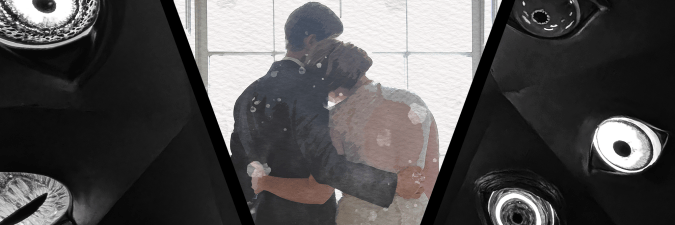
Header photograph and artwork by Jordan Keller-Wilson
Read the issue, make connections, complete the crossword.
Header photograph and artwork by Jordan Keller-Wilson
The morning after our best friends’ wedding, hungover, my husband and I are making our way to coffee and eggs, and already there’s a buzz in the streets, protesters gathering for the march across the city, and we will go too, of course we will go, but first the diner where the server, bless him, surprises us with big lollipops, the comically cartoon kind with swirls, saying Happy Halloween and my smile breaks open wide like I’m a kid again, like I’ve forgotten anything bad has ever happened.
On the bus we’re packed with sweat and people and posters, quiet and still as we wait, and when we arrive at Embarcadero Plaza, we stop at a convenience store where the cashier asks if we’re going to the march and when we nod he says take two waters on me, and we carry them with us and the people chant and the musicians sing and two nurses hold their signs high, insisting we will not go back, and a yellow butterfly drifts past like it’s riding the whole thing, the resistance and the heat and the hope.
We skip the bus home
and walk instead,
stopping for beer in the bright, oblivious sun,
and yes there’s some sadness in it,
tears like condensation on glass,
but we keep walking,
find ourselves in the backyard of some restaurant
where it’s couples and families,
and a girls’ night in bloom,
all of us making an evening of it,
and San Francisco,
listen,
San Francisco gives us one of those rare days
where the sun stays touching you
well into the night,
a gift.
In the park at golden hour little moths sprinkle bushes like something from a fairy tale and no one else is around so we let the whole display be just for us, and around the corner a group pops champagne and the cork sails through the sky, lands at our toes like the world is saying here, have this too.
At our favorite spot for wings we sit outside and a group of children are spinning and laughing, their parents inside, and one kid comes over, double dog dared, you can tell, and says to my husband Are you guys friends??? and immediately giggles because the answer doesn’t matter, the dare is the thing, and this happens three more times, each question sillier than the last, and when we get up to leave my husband drops to his knees and does this silly dance and the kids squeal, actually squeal with delight, and run around him in circles like he’s given them the world.
We walk under the trees where the sky has gone bluish black and we hear the faintest hoot, and we stop, and we listen as two owls call for one another in the darkness, and other people stop too, we strangers pausing below the trees, all of us going ooh and ahh like it’s a game of hide and seek, like we’re all in on it together.
My husband takes my hand
and finally we step onto the bus,
get off in front of our home,
walk in to start dinner,
our black cat finding us,
and I turn on all of the Halloween lights
even though it’s over a week away—
why not?—
and I look through the glow
of our small existence
and I’m thinking about it,
about our friends proclaiming their beautiful love to each other,
and the server with his lollipops
and the cashier with his water
and the champagne cork at our feet
and my husband on his knees making children laugh
and the owls calling in the dark
and all of us strangers stopping to listen,
and yes,
the present is terrifying
and the future might be worse,
but also—
I feel this—
achingly, all of this.

Katelyn Sweeney is a writer and middle school English teacher in San Francisco. Her poetry and creative nonfiction have appeared in journals including The Pinch and EcoTheo Review. She is happiest anywhere that feels a little wild and believes every walk should end with at least one good rock in her pocket.
Header photography and artwork by Jordan Keller-Wilson
On the drive to the clinic, we pass the apartment complex on Aster Street, and my husband points out the metal disc on its roof. Not for the first time, he says, “Flying saucer.” And we fall into silence for the rest of the ride.
I think he expects me to laugh. But I never laugh.
It’s January in Nashua, New Hampshire. When we get out of the car in the parking lot, we walk through the snow and past a daycare. A young boy in a puffy coat sits at the bottom of a slide clutching his leg. He wails into the cold gray air, and adults rush to him while the other kids play. The trees around us are bare.
The clinic is on the second floor of an office building behind the daycare. This is only my second time here, after what seemed like years with the previous clinic, which never went anywhere. The first time with Dr. Shaw was right before Christmas; the office had been decorated with colorful lights. A baby figurine at the front desk wore a Santa hat. This time, the decorations are gone, the desk empty.
I approach the woman in her late sixties sitting at the desk in pink scrubs, typing. She looks up at me. Her eyes dash to my husband, then back to me. She smiles warmly.
“Mr. and Mrs. Abramowicz?” She mispronounces our last name.
“Yes,” I say. “I’m here for my 3 p.m. follow-up appointment.”
“Of course, Dr. Shaw will be with you in a moment.”
We sit in the waiting room. My husband plays Candy Crush on his phone. I pick up a year-old issue of Garden Gate magazine.
I skim an article on “easy vegetables” then put the magazine back on the table. My husband notices me fidgeting, and he reaches for my hand.
A nurse opens a door and calls us back.
I get up with my husband behind me. We follow the nurse down the short hallway into a small room with a recliner covered in disposable paper. The nurse gestures for me to sit down. My husband sits on a metal stool near the recliner. I glance at the clock hanging above the door.
The nurse takes my vitals and instructs me to put on a gown. Then, Dr. Shaw steps in and pulls a chair close to the recliner. He adjusts the ultrasound machine, presses a few buttons, and nods toward the screen.
“Let’s take a look,” he says, adjusting the probe. I watch the gray, amorphous shapes flicker. He points to a small cluster. “Here, see this? It’s responding exactly as we’d hoped.”
He explains each step of the injections, demonstrating the tiny vials and needles, as if I hadn’t injected myself what felt like a million times before. But we’re trying a new experimental protocol and he has to ensure the instructions are clear
My husband leans forward, hand on mine. I listen to Dr. Shaw’s instructions, noticing how deliberate his movements are. For a moment, it feels like we are moving forward.
The next time we go to Dr. Shaw’s, my husband stays quiet about the flying saucer, but I look. This time I notice thin metal structures beneath it, like legs.
The New Hampshire air in March is cold but not biting.
We wait longer this time. My husband has stopped playing Candy Crush. He just sits, hands folded in his lap, staring at the wall. I pick up the same Garden Gate magazine. Or perhaps a different issue, I can’t tell. There’s an article about starting seedlings indoors.
When the nurse calls us back, she doesn’t even try to pronounce our names. She smiles a more polite, reserved smile.
Dr. Shaw’s office feels smaller than I remember. Even before he finishes the ultrasound, I know from his face. He’s kind about it: He uses words like “unfortunately” and “this time” and “we can adjust the protocol.” My husband asks questions I don’t fully hear. I nod when it seems appropriate.
On the drive home, I look for the flying saucer. The angle is different from this direction, and the afternoon light catches the metal legs. They’re definitely legs. I count four of them, ready to run.
When I get home, I open my laptop, login remotely, and try to get back to work. But I feel like something unnerving has taken hold of me.
Outside the window in my home office, my favorite tree has blossomed. But I keep my window closed most days.
Dr. Shaw has given me a whole new set of home procedures to support my cycle. Hormone injections, symptom tracking, oral medications. Rituals to follow every day. I’ve been through this many times before with different formulations that haven’t worked.
Each time I inject, my husband insists on being there. I rub alcohol on the injection site, carefully measure the dose. He doesn’t say anything, his jokes long gone.
Weeks blur together. Dr. Shaw says it’s too early to lose hope. My husband nods when he says this. I nod too.
On the drive home from the clinic, I look up at the saucer catching the afternoon light. I see a seam along its edge, like it might open. My husband’s eyes remain fixed on the road.
A few days later, I take a test: I am pregnant. My husband cries when I tell him. I don’t.
Weeks later, as my husband and I walk to our car to go to Dr. Shaw’s, I gently tap my husband’s shoulder.
“Let me drive.”
I take a slightly longer route, one that doesn’t go past Aster Street. No flying saucer in sight.
We arrive at the clinic ten minutes later than usual. My husband doesn’t comment on the route, but I catch him glancing at me in the waiting room. I pick up a different magazine this time, something about home decorating. I don’t read it.
When the nurse calls us back, she tries our name and gets it almost right. I smile at her, genuinely this time.
Dr. Shaw pulls up a chair and explains that today’s ultrasound is to confirm the heartbeat, to make sure everything is developing as it should. He speaks in a careful, measured tone. My husband holds my hand.
The probe is cold. I watch the familiar gray shapes on the screen, waiting for Dr. Shaw to point something out, to show me what I’m supposed to see. He’s quiet for longer than I expect. He adjusts the machine, presses harder, tries a different angle.
“Let me just…” he says, trailing off.
My husband’s hand tightens around mine.
Dr. Shaw leans back slightly, then forward again. He takes a breath. “I’m not seeing what I’d hoped to see at this stage,” he says. His voice is kind. “Sometimes development is just slower.” He pauses. “I’d like to bring you back in a few days. We’ll check again.”
For the drive home, I ask my husband to take the wheel. I sit in the passenger seat and close my eyes. When I open them again, we’re passing Aster Street. The flying saucer is there. The afternoon sun catches the metal legs. The seam along its edge looks wider than I remember, or maybe it’s just the angle.
My husband doesn’t say anything.
Three days later, Dr. Shaw confirms what we already know. The pregnancy isn’t viable. He uses the word “loss.” My husband’s hand goes slack in mine.
It’s late summer. I’ve started leaving the house to drive on my own. Not for appointments with Dr. Shaw, but to be alone.
On a drizzly night, I drive past Aster Street. The flying saucer gleams above the streetlights. I keep driving, but at the next intersection I turn around. I pass it again, slower this time. Then again.
Eventually, I pull over. Rain beads on my windshield. I can still see the metal legs, the seam along its edge. I sit there for a long time, engine running, wipers off, until the saucer is just a blur through the water on the glass.
When I get home, my husband asks where I’ve been. “Out,” I say.
We start again. September comes. The kids at the daycare near Dr. Shaw’s office are wearing tiny, knitted sweaters. I walk past the playground, averting my eyes.
When it fails, we try again in October. And then November. And then December returns, and with it, the Christmas decorations at Dr. Shaw’s office. A plush baby in a Santa hat. Colorful lights blinking in the gray waiting room.
Dr. Shaw takes us to his office, folds his hands on his desk. “I’ve reviewed all your tests,” he says. “Hormone levels, embryo quality, uterine lining. Everything looks good. There’s no medical reason this shouldn’t be working.”
“So what do we do?” My husband asks.
“We have options,” Dr. Shaw says. He talks about different medication protocols, donor eggs, possibly taking a break to let my body reset. The words start to run together. I watch his mouth move but I’m not sure what he’s saying anymore.
“Sometimes,” he says finally, “we just don’t know why.”
In the car, my husband doesn’t start the engine right away. We sit in the parking lot, heater running. Through the windshield I can see the daycare.
“I’ve been thinking,” he says. “We don’t need kids to be happy.”
The way he says it tells me he’s practiced this. Maybe for weeks.
I don’t say anything.
“We could stop,” he continues. “We could just…be us again. Travel. Fix up the house. I don’t know. Just…” He pauses. “Just not this anymore.”
I look out the window. We’re not on Aster Street, but I know where the building is from here. Two miles north, maybe less.
“I don’t want to stop,” I say.
He’s quiet for a long time. Then he starts the car.
We take the usual route. When we turn onto Aster Street, I see it immediately, lights flashing on top of the building. Not steady lights, but pulsing and rapid. The saucer seems to hover slightly, or maybe it’s just the way the lights make it look: a rhythmic gleam.
“Do you see that?” I grab his arm.
He glances up briefly. “See what?”
“The lights. On the flying saucer.”
He looks again, longer this time. Then back to the road. “I didn’t see anything.”
“It was flashing. Right there.” I point, twisting in my seat to keep watching.
“You know that was just a joke, right?” His voice has changed. “The flying saucer thing. I was just…it was just something I said to lighten the mood.”
I stare at him. “I know it was a joke.”
“Are you okay?”
“I’m fine. I saw lights. You’re telling me you didn’t see them?”
“There’s nothing there,” he says quietly. “It’s just a water tower or something. I don’t even know what it is.” He slows and stops the car. “Maybe we should talk to someone. About all of this. Not Dr. Shaw. Someone else.”
“I don’t need to talk to anyone,” I say, turning away.
He doesn’t respond.
I go alone to Dr. Shaw in January, then February. The receptionist knows my name now, pronounces it perfectly. The nurse doesn’t smile as much. Dr. Shaw talks about “diminishing returns” and “emotional toll” and “knowing when to reassess.”
At home, my husband sleeps in the guest room; says his back hurts, needs a firmer mattress. We eat dinner in front of the TV. We don’t talk about treatment. We don’t talk about much at all.
It’s early April when Dr. Shaw schedules what he calls a “consultation appointment.”
I drive alone. The morning is overcast.The flat gray light makes everything look washed out. I could take another route, avoid Aster Street entirely. But I don’t.
When I turn onto the street, I see it immediately.
I’m not sure how to describe it. It looks like it’s tilted, or perhaps hovering slightly above the roof. The metal gleams in a way that doesn’t match the dull sky. And there are lights, not flashing this time, but steady. A faint glow along the seam.
I pull over to the side of the road, put on my hazards.
The saucer sits there. But the angle is wrong. Or maybe I’ve never looked at it from exactly this spot before, at exactly this time of day, in exactly this light.
I check my phone. The appointment is in twenty minutes. Dr. Shaw will be waiting. He’ll have pamphlets, probably: information about adoption agencies, therapists who specialize in grief and loss. He’ll be kind. He’s always kind.
I turn off the engine and look back up at the saucer. The gleam along the seam is there, shining, steady and patient.

Arianna Adirim is a writer based in Maryland. She enjoys writing fiction and poetry and earned a J.D. from American University Washington College of Law and a B.A. in International Relations from Boston University. “An Untravelled World” is her first published short story.
Header photography and artwork by Jordan Keller-Wilson
My grandmother said the body remembers
what the mouth is too afraid to say.
She said the ache in her knees
was every border crossed without consent,
every history folded too small to breathe.
I believe her.
My bones hum when the news is bad.
My lungs flinch at flags.
Some nights my heart beats
like it’s trying to escape jurisdiction.
Tell me
what is a country
if not a story told loudly enough
to sound like truth?
What is obedience
if not fear dressed as loyalty?
I was taught to kneel
before I learned the names of things:
soil, spine, hunger
taught that silence was a form of cleanliness
and that pain, if borne elegantly,
might pass for virtue.
But the earth does not kneel.
It splits.
There is a sound to it
not thunder, but a long, intimate tearing,
like fabric giving up on being useful.
Like a mouth unlearning prayer.
We live over fault lines we pretend are roads.
We pour concrete over grief
and call it progress.
We teach our children to count borders
but not to listen to the ground.
I want a language that stutters on purpose,
that refuses to behave.
A language that cracks open the word home
and asks who was locked outside
to make it possible.
When I say I am here,
I do not mean safe.
I mean breathing despite.
I mean stitched together with borrowed courage
and the stubborn muscle of staying.
The chasm is not ahead of us.
It is what we fall back into
every time we choose comfort
over witness.
Still
there are hands reaching across it.
There are voices guiding us out
like ropes.
There is the radical act of looking down
and refusing to look away
If the earth asks anything of us now,
it is not forgiveness.
It is attention.
To feel the ground move
and learn to move with it.
To stop pretending stillness
is the same as peace.
To stand at the edge
and speak anyway.

Khayelihle Benghu is a South African poet based in Johannesburg. Her work explores themes such as memory, grief, faith, family, and the quiet endurance of ordinary lives. Her poems have appeared in Person of Interest, Aloka, Decolonial Passage, AKE Review, Eyes on the Telescope, and Metphrastics. She is also the author of the poetry collection The Names We Carry.
Header photography and artwork by Jordan Keller-Wilson
Malcolm first noticed it in the pauses.
Not the words his daughter spoke but the spaces between them, the way her sentences began to stall mid-air, looking for a place to land and finding nothing solid. Averill had always spoken quickly, words tumbling over each other, anxious to get out. Now she started and stopped, started and stopped again, as if listening to something else overlaid on top of what he could hear.
“Dad,” she said on the phone one evening, “can you turn the TV down?”
He was alone in the kitchen. The television in the living room was off.
“There’s no TV on,” he said.
A stretch of silence, so long he pulled the phone from his ear to make sure the call hadn’t dropped.
“Oh,” she said finally. “Then it must be one of the others.”
“The others?”
“The other channels.”
Before he could ask what she meant, she hung up.
Outside the kitchen window, the street looked like an advertisement for itself. Every lawn edged. Every porch light calibrated to an identical amber. Sprinklers ticked in synchronized arcs, the water catching the orange of the setting sun, breaking it into neat fragments. The cul-de-sac curved like a closing parenthesis, containing them all.
Clara stood at the counter arranging cucumbers in a glass bowl, each slice nearly translucent. “She’s just tired,” Clara said without being asked. “She’s in her last semester. Of course she’s hearing things. We all hear things when we’re tired.”
Malcolm did not say that when he was tired he didn’t hear nonexistent televisions. He did not say that his mother had started this way too, with sounds no one else heard, signals no one else could decode.
Later that week, he drove forty minutes across town to see Averill. Her apartment was in one of those low, aging buildings near the university, all beige stucco and thin exterior stairways that rattled underfoot. A rusting satellite dish jutted from the roof like something broken.
He knocked.
“Who is it?” Her voice came through the door thin and sharp, like it had been pulled taut.
“It’s me. It’s Dad.”
A pause. Then the sound of half a dozen locks being undone, locks he didn’t remember from his last visit. She cracked the door and peered out. Only when she saw his face did she open it the rest of the way.
The apartment smelled wrong. Sour, stale, with a chemical edge. The blinds were fully shut, the sliding glass door covered with a blanket duct-taped along the edges. Light leaked in around the corners, turning the room a dim, underwater gray.
“Ave,” he said. “What happened to the window?”
“Glass works both ways,” she said, moving past him into the room. She wore an oversized sweatshirt and flannel pants, despite the early heat. Her hair, once a heavy, dark sheet, had been hacked unevenly. Some places were shaved close to her scalp, others hung in ragged chunks. “It lets them see you. You think it only goes one direction, but that’s not how it works.”
“Who?”
She moved into the kitchen, ignoring him. Cups lay everywhere—mismatched mugs, plastic takeout cups, a row of rinsed glass jars lined up along the counter. Some held water. Some held nothing. One had a few pennies at the bottom.
“You have to separate it,” she said, picking up a jar with both hands and holding it at eye level. “Tap water. Bottled water. Rain.”
He followed. The sink was clogged with something hidden under a plastic grocery bag. When he reached to move it, Averill’s hand shot out, fingers gripping his wrist so tightly he gasped.
“Don’t.”
“Why?”
“They can track you through what you throw away. It’s the easiest way to do it. People think it’s their phones, but that’s just in movies. They use waste. They map you through what you think you’re done with.”
His skin prickled. She’d always been a bright child, good at science, facts, the kind of logic that reassured him. The logic was still there, he thought, but it had twisted on itself, like a ladder that had unfolded so far it fell back to the ground.
“How much are you sleeping?” he asked. He tried to modulate his voice, keep it casual, as if they were discussing her course load.
She let go of his wrist and shrugged. “They rewrite you while you sleep. The scripts you’ll follow, the pathways they lay down. You wake up and you don’t even know what’s changed. I stay up until my head buzzes, and then I lose time. That’s the same as sleeping. That’s when they get in. I tried keeping the lights on to stay awake, but they send messages through those too, the same ones that rewrite you, so it’s better to just turn everything off and sit very still.”
He looked around. All the lights were off. The only illumination was the thin, gray light seeping around the edges of the taped blanket and the glow from the microwave clock. It read 3:33, though his watch said 11:18.
“You saw Dr. Hauer before,” he said. “Do you remember him? You liked him.”
“He wrote down everything I said,” she replied. “I watched him. Every sentence, he made a mark. They share those marks. That’s how they decide what to do with you.”
“Who decides?”
She looked at him then, really looked, and a flicker of something moved through her eyes, pity, maybe, or anger, or a kind of exhausted contempt.
“You know,” she said quietly, “you’re the one who taught me about patterns.”
He had. When she was little, they’d walked the neighborhood together, counting things. Four mailboxes in a row. Six identical cars. The way the cracks in the sidewalk formed grids. He’d done it as a distraction, a way to calm her. She’d been anxious even then, easily overwhelmed by noise, by sudden movement. Patterns had soothed her—something she could rely on when everything else felt random.
Helen had done the same thing with him, once upon a time. His mother, tapping the side of his cereal bowl with a spoon: three taps, pause, three taps. “See?” she’d said. “That’s how you know it’s me. That’s our code. Three, three. Our way back to each other.”
Years later, after she’d started talking to the radio and unplugging appliances because they were “leaking thoughts,” the tapping had turned frantic. Three-three. Three-three. Three-three. Her fingers on windows, doors, his shoulders, as if reasserting the code could pull her back to where he still lived.
“Patterns help,” he said now, but his voice sounded thin in his own ears.
Averill smiled without humor. “They help them more.”
He drove home with the radio off, the highway a long gray ribbon. Every overpass looked like something that could collapse. Headlights in his rearview mirror felt too close, the beams washing through the interior of the car, making his own hands look like borrowed objects.
Clara was already in bed when he got home, their bedroom cast in the blue of the streetlamp. Their curtains were just sheer enough to let the ambient light in.
“How was she?” Clara asked, eyes closed.
He sat on the edge of the mattress. “She’s not sleeping. The apartment’s…dark. She taped blankets over the windows.”
“College kids are strange,” Clara murmured. “They go through phases.”
“She thinks they’re tracking her through the pipes.”
“Who doesn’t think that some days?” Clara sighed. “This world is crazy-making. The important thing is not to catastrophize. If you start seeing her as sick, you’ll make her sick. Self-fulfilling prophecy.”
Her words slid over him like oil on water. He remembered his father at the kitchen table, decades ago, hands wrapped around a mug gone cold. “If we don’t call it that,” his father had said, not looking at him, “then maybe it’s not.”
They never said the word schizophrenia out loud. It had been implied in bottle labels, in hushed consultations, in the way certain neighbors stopped making eye contact. Not saying it hadn’t saved anyone.
That night, Malcolm woke at 3:33 a.m., heart hammering. The digital alarm clock glowed red.
Three-three-three, he thought.
The house was very still. Then, faintly, he heard it: a whispering hiss in the walls. The air conditioner? The refrigerator? Pipes shifting?
It sounded, for a moment, like someone breathing through the drywall.
He held his own breath and listened harder, straining his ears until they rang. The sound resolved into nothing specific, just the usual house-sounds that came when everything else was quiet. He told himself that. He told himself that again over coffee in the morning, watching the sprinklers pulse in uniform increments across the neighbors’ lawns.
Days blurred. Averill’s text messages became less frequent, then more frequent but unreadable: strings full of numbers, street names, times of day, weird phrases. 11:11. HUM UNDER FLOOR. TURN OFF MAIN. HEARING BLEED.
He tried to call. Sometimes she answered and spoke in half-phrases, distracted by something he couldn’t see. Sometimes she didn’t answer at all.
He went back to her apartment, nearly two weeks later. Someone had spray-painted a crude eye on the building’s back wall. The door to her unit had another new lock, the brass still bright, fresh screw-holes pale against the weathered paint.
“Ave?” He knocked gently. “It’s me.”
“Let me hear it,” she said from the other side.
“Hear what?” His mouth had gone dry.
“The one you used to do.”
He stared at the door. His hand rose and he knocked: three, pause, three.
The quiet on the other side felt like a held breath. Then several locks turned, and the door opened.
The apartment was darker than before. She’d covered the remaining sources of light: the microwave display masked with tape, the tiny LEDs on her router blacked out. She moved through the gloom like someone used to it.
Light from the hallway sliced through the room as he entered. Before she hurried the door closed, he glanced around.
“What’s that on the walls?” he asked.
His eyes adjusted to the dark, and the graphite caught what little light bled around the blanket, the whole wall faintly silver with it. Pencil covered nearly every surface. Lines, arrows, circles, numbers. Floor plans overlaying maps, connecting points with loops and jagged strokes. Under one set of arrows he recognized their street, labeled in her careful, cramped hand. Under another, three names: HELEN. MALCOLM. AVERILL. Date ranges beneath each. The lines between them were thick, nearly carved into the drywall.
“It’s the network,” she said. “You can feel it, right? The hum. The way certain moments double themselves.”
Something in his chest clenched. “What do you mean double?”
“Like this,” she said, and walked to the window. “You stand here and you hear the siren, and you think it’s the first time, but it’s not. It’s the fifth or sixth. They loop it until you give the right reaction. The fear. Whatever they came for. I figured that out. That’s why I stopped reacting.”
“When did you last eat?”
The question sounded stupid the moment he said it, a normal question in a place where normality had already lost purchase.
She shrugged. “It’s not important. The body is just…hardware. They can swap it if they want. They did it with you.”
His stomach lurched. “With me?”
“They replaced you after the last time you left.” She said it like a fact she’d verified. “The real one would have come back sooner. The real one wouldn’t have been able to stay away.”
“I came as soon as I could.”
“You came when they told you to.” She tilted her head, studying him. In the dim light, her eyes looked too large for her face, catching any glint. “It’s not your fault.”
He wanted to argue, to insist that he was the real one, but the words stuck. His memories of recent weeks were..fogged. Had it been three days since he last visited, or ten? Had he really called every evening, or had he only meant to? The days at work had become interchangeable. Conversations with Clara drifted apart at the edges.
He wondered, suddenly, if there was a version of him somewhere else, one who had done everything right and on time, and this version was the defect.
He shook the thought away with physical effort. “I’m going to call someone,” he said. “A doctor. We can go together. Just to talk.”
“No doctors,” she said sharply. “We can’t trust them. They’re archivists. They record you until they know your most vulnerable thought. Then they send that thought back at you when you’re weakest. That’s how they break you down.”
“That’s not…”
“You know how I know?” Her voice dropped. “Because that’s what they did to her.”
He knew which her she meant. In the graphite maze of her wall, one line led to HELEN in thicker, darker strokes than the others.
“Grandma was sick,” he said. “She had an illness.”
“She had a signal,” Averill whispered. “She wasn’t sick. She was tuned to something others couldn’t hear. They tuned her wrong on purpose.”
He thought of his mother tapping three, three on everything. He thought of the way she’d stared at staticky television screens, eyes wide, as if waiting for a message to emerge from the gray. He thought of the neighbor across the street now, seventy years old, always out at 7:00 p.m. sharp to drag his garbage bins to the curb with ritual exactness.
He called the crisis line in his car after the visit. Hands slick on the wheel, he used words he’d avoided for decades: psychosis, delusion, risk. The woman on the phone was calm, asked if Averill had threatened harm to herself or others.
“She’s not sleeping,” he said. “She’s not eating much. She thinks people are tracking her through the plumbing. That they replaced me with a copy.”
“Has she made explicit threats?”
“No, but…”
“If she’s over eighteen and not an immediate danger, we can’t force an intervention. You can encourage her to seek help or call again if she expresses suicidal intent.”
He thanked her, hung up, and sat until the parking lot lights flicked off one by one, plunging the asphalt into darkness.
That night, Clara didn’t ask if he’d called anyone. Sitting on the couch, she stared at her phone, scrolling an endless feed of other people’s dinners, pets, vacations. “You get what you focus on,” she said. “If all we focus on is illness, that’s what we’re going to live inside.”
They were already inside it, he thought. It had walls and a roof and crown molding. It had an HOA and a quarterly newsletter. It had a block party every summer where everyone brought their best dish and no one mentioned the house two streets over where an ambulance had appeared at 3 a.m. and carried someone away under a white sheet.
He started waking in the night at precise times. 2:22. 3:33. 4:44. Each time, the red digits greeted him, and the house hummed, and his heart tried to beat out of sequence. He began to notice other repetitions: the same silver sedan parked at the corner every morning; the same dog bark at precisely 6:15 p.m.; the streetlamp outside his window flickering twice, pausing, then flickering twice again.
He told himself the brain was built to find patterns, that it was simply doing what it did. He’d read that somewhere, in one of the articles he’d started skimming late at night about genetic risk factors and environmental triggers, about how having a first-degree relative with schizophrenia could increase risk many times over. He read and read, the words piling up on the screen, forming a shape he refused to name.
Sometimes, the hum in the walls glitched. There would be a stutter, a tiny drop in the sound, like a heartbeat skipping. In that half-second of silence, he imagined he could feel Averill on the other end of it, like two people on either side of a door, each with a palm pressed to the wood.
When the police finally went to her apartment, it was because a neighbor had called about “strange noises” and “concerns.” Not him. He had called numbers, talked to people, been told about thresholds and rights. The neighbor had heard her shouting at three in the morning and thought, I don’t want this near me.
They took Averill to the hospital. Malcolm arrived to fluorescent lights and a waiting room television tuned to a channel no one watched. Clara refused to come, saying that if they turned this into “a whole thing,” it would be harder for Averill to return to normal.
Normal.
The psychiatrist used words like acute episode and treatment plan. Medication names with too many syllables. Recovery curve.
“She may experience disorganization, paranoia, auditory hallucinations,” the doctor said. “But with early intervention, we often see significant improvement.”
“How early is this?” Malcolm asked. His voice sounded like it was coming from the bottom of a well.
The doctor hesitated. “It can be hard to say. Often families notice changes months or even years before formal treatment begins.”
Months. Years.
He thought of the pauses in her speech. The way she’d started wearing headphones in the house at all times, even when she wasn’t listening to anything, because, she’d said, the silence was too loud. The way he’d told himself she was just introverted, just sensitive, just busy.
Averill refused medication. She signed herself out after three days. Adult. Competent. The words felt like a cruel technicality.
After that, she sank into the city like something dropped into deep water. He caught sight of her occasionally, the back of her head at a bus stop, her profile in a crowd near the grocery store, but when he blinked, whoever he’d seen dissolved into strangers. Her online posts became more fractured, then stopped altogether.
He thought, once, that he saw her in their own neighborhood. A figure two blocks away, walking slowly along the curve of the cul-de-sac, moving her hand along a row of mailboxes as if reading Braille. By the time he got his shoes on and stepped outside, the street was empty. The sprinklers on his lawn ticked on, right on schedule.
His own days grew soft around the edges. At work, he found himself staring at the photocopier, convinced its whirring lined up with his heartbeat, and that if it skipped, his heart would too. He’d stand there, hand hovering over the START button, breath shallow, until someone asked if they could use the machine, and he’d laugh, pretend he’d just drifted off.
At home, the flicker in the streetlamp began to feel personal. Two flashes, pause, two flashes. He counted the interval: six seconds. Two-six-two-six.
Three, three.
He woke one night to find himself sitting in the hallway outside his bedroom, back against the wall, knees drawn up. He had no memory of getting there. The carpet fibers had imprinted themselves into the skin of his ankles. The digital clock in the bedroom read 3:33.
Inside the walls, the hum and hiss rose and fell. For a moment, clear as a voice in the next room, he thought he heard Averill whisper his name.
He pressed his ear to the drywall. “Ave?”
Silence. Then the faint rush of air through the vents, impersonal as weather.
He started tapping again. He didn’t mean to; his fingers did it of their own accord. Three, pause, three. On the countertop, on the steering wheel, on the arm of the couch. Clara slapped his hand once, sharply, when he did it at the dinner table.
“Don’t,” she said. Her eyes were bright with something brittle. “Don’t start that.”
It was then he realized she remembered. The sound had been in their house once before. His mother’s sound. The code that hadn’t saved anyone.
“You’re worrying yourself sick,” Clara said, but her voice shook. “You need to stop reading those articles. Stop looking for patterns. She’ll come back when she’s ready.”
“Come back from where?” he asked.
But Clara had already turned away, rinsing plates, water running clear and hot over porcelain.
He thought of calling the crisis line again, telling them this time about himself, about waking in hallways, about voices in the hum. But compared to what Averill lived inside, his symptoms felt…small. Amateurish. Like a child imitating an adult’s handwriting. Besides, what would they do? Evaluate him. Ask if he intended to harm himself or others. Offer numbers to call during business hours.
It was late autumn when something in Malcolm finally gave, though nothing dramatic happened to mark it. The subdivision’s trees turned color in unremarkable unison, red and gold leaves spiraling politely to the ground. Plastic skeletons and fake cobwebs appeared on porches. There was an email about a neighborhood potluck.
He was driving home from the grocery store when he saw her.
At least, he thought he did.
She stood under the streetlamp at the entrance to their development, hands at her sides, hair a ragged halo. The light above her flickered twice, paused, flickered twice again. Her face was in shadow.
His heart slammed so hard the world narrowed. He pulled the car over so abruptly the tires scraped the curb. When he looked up, she was gone. The streetlamp hummed, its light steady.
Maybe she had walked away. Maybe she had never been there. Maybe she was everywhere now, thin as a broadcast he could almost catch if he tuned the dial exactly right.
He left the groceries in the trunk. He walked home on legs that didn’t feel quite attached.
Inside the house, Clara sat at the table with her laptop, light from the screen blanching her features. “Did you close the garage door?” she asked without looking up.
He stared at her. Her voice sounded slightly delayed, as if traveling from a great distance.
“You didn’t see her,” he said.
“See who?”
He opened his mouth to say their daughter’s name and found he could not. The word stuck like a pit in his throat. His eyes burned.
“I think I’m getting sick,” he said instead.
“Then go lie down,” Clara said. “You’re always tired lately. This is what happens when you don’t protect your energy.”
Protect your energy. Protect your thoughts. Protect your illusions.
He went to the bedroom. Sat on the edge of the bed. The alarm clock glowed 7:07. The numbers pulsed faintly, as if with breath.
He lay back without undressing and stared at the ceiling. Cracks followed the length of the room, forming an almost perfect mirrored pattern: one fracture line on his side matched by another on Clara’s. Symmetry, he thought. As above, so below.
The hum in the walls rose, then smoothed into a long, unbroken tone. It sounded, for a moment, like someone holding a note: a voice stretched past what should be possible.
In that sound, he heard everything at once: his mother’s fingers tapping three, three, Averill tracing lines on the walls in her dark apartment, Clara rinsing plates while pretending not to notice she was crying. He heard the sprinkler systems ticking on across the neighborhood in perfect time, water arcing over grass, washing away nothing at all.
His chest felt hollowed out, as if someone had reached in and unplugged something essential.
“Okay,” he whispered to the room, to the hum, to the invisible grid he’d spent his life both inhabiting and denying. “Okay. I hear you.”
He could feel himself sliding, not a drop but a tilt, a gradual redistribution of weight from one reality to another. The doctor had said early intervention. The articles had said genetic load. Clara had said phases. His father had said nothing at all.
He turned onto his side, facing the wall. His hand lifted and pressed flat against the paint, feeling for vibration.
“Three,” he whispered, barely audible even to himself. He tapped his fingers against the drywall: three, pause, three.
On the other side, somewhere in the vast tangle of wires and pipes and foundation, someone answered. Or he found his answer in the heat kicking on, the expansion of metal.
The house around him settled deeper into its own silence. Outside, the cul-de-sac lay under its orderly grid of streetlights, each perfect circle of illumination failing to touch the next. Neighbors moved behind their curtains, performing the small rituals of evening. No one looked out. No one saw a man lying in the dark, listening for his daughter in the bones of his home.
No police cars came. No doctors. No saints in white coats.
Just the hum, and the patterns, and the knowledge that somewhere, in some other dim room, a woman with uneven hair might be pressing her palm to her own wall, feeling the echo.

Trae Stewart is a poet, fiction writer, psychiatric-mental health nurse practitioner, and academic based in Las Vegas, Nevada. His creative work explores memory, identity, masculinity, grief, belonging, and the complexities of mental health, often finding moments of quiet transformation within ordinary lives. His poetry and fiction have appeared in Transition, Poetry South, Rappahannock Review, The Argyle Literary Magazine, The Sunlight Press, Defenestration, and numerous other literary journals. He is currently at work on new collections of poetry, fiction, and creative nonfiction.
Header photography and artwork by Jordan Keller-Wilson
Unlike the rules you set at your house, the Millers have an under-18s go phone-free policy, which means that Marcy Miller’s kid beats you and yours at Scrabble in the low kitchen light. Just you, in fact, because your thirteen-year-old abandons their turn after they are dealt the Q without a U and instead, retreats to reading a Pullman at the counter, white marble cool and threaded gray, without further explanation. A power move, one that you, her mother, would have never been brave enough to pull and it isn’t long before Marcy Miller’s kid leaves you behind with confound, a triple word score, and you’re annoyed that all your morning crosswords failed to prepare you for losing a grown-up game to a child.
This was not what you had planned when you’d mentioned the invite to your daughter who had groaned and said, It’s so boring over there, and you said something about being nice to her classmates because life was long and that she could bring a book. A mistake, you realize, because you never thought she’d make good on her threat of blatantly ignoring the rest of the room, reading in the open like that. You would rather she do something truly scandalous like eat chalk or count the ceiling tiles out loud in German or ask Marcy Miller how many units of botox she injected into her face but instead, she decides to embarrass you in the most subtle and pointed way, just as you embarrass yourself with your final tiles.
When your last turn is over with a simpering fun, six points, you observe how Marcy Miller’s rules don’t stop Marcy Miller herself from scrolling BookTok in the open, the screen’s glow hitting her cheekbones from below. Ever since you met her during her first pregnancy, at one of those all day silent meditation retreats in the heart of Cambridge, she’s had an angular bone structure, never consumed by her own flesh. You wonder if one day, those pointed bones will become cliffs from which her skin will hang, hollows that you could put a Werther’s in, but you don’t hope and so, instead, you press your fingers against the flat planes of your own face for comfort. A tactile meditation, you remember from your training and think about how you should get back into it. That maybe you could remind Marcy Miller of her experimentation with mindfulness, a passive aggressive nod to the screentime that she could bitch about later to her country club group.
Adults only, she wags her phone when she catches you looking at her, as if you don’t count, even though you’re three years older. Anyway, it’s educational. People don’t read anymore. You shrug because you’ve spent more time than her on serious content, like investigative reporting about Lime bike injuries or lead in nineteenth century houses like yours, neither of which actually stop you from cycling around the city or forgetting to pick up a filter. It’s better for her to think you’re judging the phone instead of her face.
To fill the awkward space left by a distracted fellow adult and your absorbed, daresay rude, daughter, you put the board away and, as you move around the cushioned bar stools and clear the island of letter tiles, you see Marcy Miller’s kid pantomime swiping a screen using the kitchen counter, inches from your daughter’s elbow, and your chest aches seeing the two of them next to one another, yours reading about Pullman’s stance on mortality and conscience and institutionalized religion, the other pining for a battery covered in glass. You offer something to this poor child of Marcy Miller’s because you understand.
No need to practice, you say, You’ll get the hang of it and honestly, you’re not missing much, and her kid, who has eyebrows plucked into thin, two-bar rainbows, says hotly, You’re the one who could use the practice. At least that’s what my mom says, before storming off, and you stand there, your mouth hanging open because, for the life of you, you have no idea what they mean but also know it has something to do with the fact that none of you, at the end of the day, not even Marcy Miller, want to be here.
Thankfully, Marcy Miller doesn’t notice because Marcy Miller is still scrolling vampire smut on her phone, so you live in that lonely moment, half-hurt, half-awed, and wonder if you were both talking about the same thing: about growing up, or if you’ve missed something deeper, truer, now off limits because it’s in the past.
Confound, you say aloud, because it’s fitting and prescient.
Huh? Marcy Miller replies, eyes flicking up from the screen to your face and you swear, for a moment, you see disgust there before it rearranges itself into sharp, flat planes. A muddling along, that’s what this is, a traipse through school nights with the same people in the same place, and it hits you in its dizzying repetition. What, you wonder, are any of you practicing for? What, you wonder, are any of you doing making words out of the same jumbled letters and hating each other for it? But instead of asking Marcy Miller if she only started meditating all those years ago to say she did or why won’t she just put the damn phone down and have a real conversation about the unpaid labor of childcare and the very much paid labor of tutors who went to Harvard that can’t seem to find a job in this economy, an unemployed future towards which your own expensive children are trending, you say, It’s a good word. She smiles and says something about private school entrance exam prep.
It’s never too early to start nowadays, she says, when in fact, you know it’s already too late for her and hers and maybe even for you, but at least you’re not Marcy Miller. And though you’re not sure after all, you hope that makes all the difference.

Salena Casha‘s work has appeared in over 180 publications in the last decade. She survives New England winters on good beer and black coffee. Subscribe to her substack at salenacasha.substack.com and buy her sci-fi novella at ELJ Editions.
Header photography and artwork by Jordan Keller-Wilson
He was your first real boyfriend—the type you kiss on the curb of a church parking lot. The type you don’t really like all that much but you’re eleven and reading romance novels earlier than you probably should and you’re eager for the moment where fairy tale meets reality, a high you’ll continue to chase into your twenties with the same disappointing outcome you once experienced on the curb of a church parking lot.
And he looks stable, full of promise. Nice home. Nice family. Plays football. Loves to fish. Eats dinner every night. They go to church and you like church, though they arrive as a set and you an unsupervised drop-off. And maybe you do not like church in the spiritual way of complete devotion, but you love having somewhere free to go and something free to do. You were never all that picky. You survive on crumbs to the point where one day, an eating disorder will make a blessing out of poverty. You expect and crave nothing. Your standards will stay low for too long, always coming up short and measuring well below the max height of a well-maintained Ohio lawn: eight to twelve inches. That’s an innuendo, by the way. You always worry no one will get it.
He doesn’t, and he’s literally a thirteen-year-old boy. He can’t grasp his science courses, and he’s certainly not grasping you in any substantial way. But it’s not his fault, not really. Young and dumb. Besides, he’s not the protagonist.
It was actually his mother you remember best, she was the inciting incident. When he cried over the phone to you, an indication he may have felt this was more than just something to do, he revealed how he was downtrodden because his mother believed you were distracting him from football. You thought it rather silly. First that she would say something like that to someone obviously not cut out for a football career and second that he would cry about it—you’ve always been a bit callous.
You brush off his mother’s comment. You don’t think too much about it. Why the fuck would you let something so small ruin the rest of your day? The rest of your week? The rest of your something to do?
She wore blue, that mother of his, when you met her for the first time in the church basement during a Sunday school service—or what you now call “affordable childcare.” Blue sweater, blue jeans, white sneakers with blue accents. Blue, blue, blue, blue, blue. It was the kind of color that made your stomach churn, like the ocean’s depths or the inside of a day-old bruise. You expected she’d adore you the same way your own parents and teachers did, the way they beamed when you entered a room. You’re a rule follower. You like direction. You like reading. You like manners. You’re blonde. Adults have so much to love about you.
But she looked you up and down, those thin, mulberry lips forming a tight line of disappointment, her gaze on your abdomen for what felt like a little too long. You could see disgust in the crinkle of her nose. She says, “You can’t be dating her, she’s far too small to bear children. Her hips won’t be wide enough.”
You are fresh into your eleventh year of existence. You have yet to even bleed. Her words sink into your stomach, settling somewhere low and quiet, far below the surface. You feel sick with experience, blue around the gills, and you wonder if, for a girl, there’s really a difference between breathing and drowning.
You carry the event home and the women closest to you laugh at the story, telling you not to think too much about it. Your sister calls her stupid, your mother calls her a crazy bitch. When you’re alone though, you call her right. You look in the mirror, “They are too small.” And while one could argue you still had time to develop, they’d be wrong. You remain 4’11’’ and his mother remains right.
And a few years along the way, when you’ve moved on and moved away and your time is no longer spent in church basements, that boy becomes a teen dad. You’re not surprised. Dodged that bullet.
For years, you tell the story as some audacious humorous anecdote. Just another thing some stupid, crazy bitch said to you. But you never forget the disgust of not meeting her feminine expectation. An expectation you never thought much of until someone forgets to laugh when you recall the story in a university classroom. Until someone says, “That’s not really funny.” Until another voice chimes in, “I don’t know what I’d do if someone said that to my daughter.” And all you can think at the time is, Damn, me neither.
But that doesn’t stop you from laughing and telling it again because now all you can think is Why the fuck was she wearing so much blue?

Nikki Mae Howard is an Ohio-based creative nonfiction writer with a B.A in English Literature from Wittenberg University and works as a storyteller for MemoirForMe. She is a current MFA student of creative nonfiction at Antioch University-Los Angeles. Some of her work is available for viewing at YouMightNeedToHearThis.com, Lunch Ticket, Clark State’s Voices of the Valley, and The Argyle Literary Magazine.
Header photography and artwork by Jordan Keller-Wilson

