The Love That We Have Been

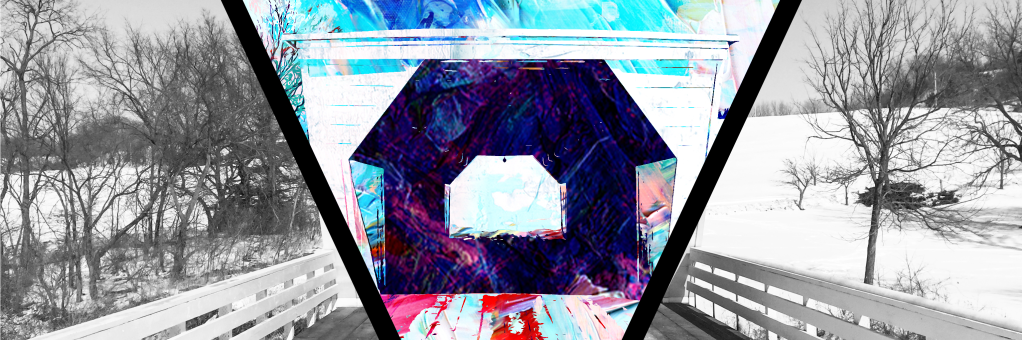
One of the bridges of Madison County, alive with brush-stroked colors, is framed in a bold V shape. Outside the V, the black and white photograph reveals the snowy landscape.

I hope you are with me
when the long sleep comes.
The thick warmth of memory
on our eyelids, like sunlight
pressed to the backs of leaves.
The faces we have known
blurring into gentle shadows.
Words, frozen like footprints
in evening snow, still
behind us in the dark valley.
The love that we have been,
rising, naked, into the air.


Jane Hahn

Jane Hahn lives and writes in the Midwestern United States. Her work has appeared or is forthcoming in Concord Ridge, Detroit Lit Mag, The Other Journal, and Theophron, among others. More can be found at janethegrey.wordpress.com.

Header photograph by Holly Pelesky
Header artwork by Jordan Keller-Wilson
Divination

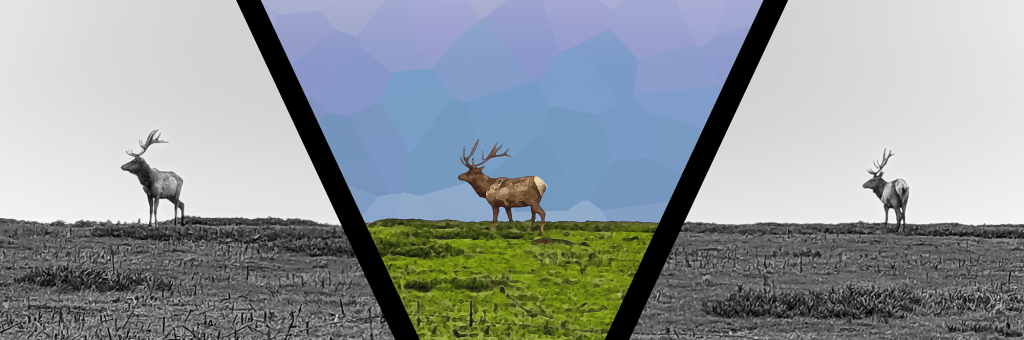
Three elk top a grassy ridge. They are evenly spaced, the one in the middle centered in a bold V shape. Within the V, the sky is crystalized into abstract shades that fade from blue at the horizon to almost pink against the upper edge of the frame.

When the world ended,

we scavenged the things we could and vowed
to become witches together. A childhood

necessity. I searched my blackened cupboard 
for the flowers we’d dried, petals bleached

with age and ash.

You’d lost your crystal ball but gathered up
all the bones nearby.

I helped you find them, little white shards,
so burnt they’d crumble to the touch

until you were left with a dozen pieces.
The resilient parts.

Now, you watch the bones clatter, pay attention
to the forms they make.

One day, I hope the world will hold up its hands,
and in its palms, beating like a frightened bird,

show you its bleeding heart.

But I don’t bother with the bones anymore.

I roam the ash, find a good spot, and toss the seeds
that will shape it all anew.

In a few years
the world will still be a wasteland, but we’ll
watch that wasteland bloom.


Ada Navarro Ulriksen

Ada Navarro Ulriksen was born in Santiago, Chile and now lives in California. Her poetry has appeared in The Deadlands as well as a few other journals.

Header photograph and artwork by Jordan Keller-Wilson

When the Ladybugs Came

Three elk top a grassy ridge. They are evenly spaced, the one in the middle centered in a bold V shape. Within the V, the sky is crystalized into abstract shades that fade from blue at the horizon to almost pink against the upper edge of the frame.

I don’t remember exactly
when the ladybugs came,
but I know that morning
the sky was clear,
until they came rolling in,
a storm of shadow
that swarmed our house.
They hummed, pulsated, trembled,
weaving a thick blanket
that drove out all the light.

When my sister cried out,
I put on the brave face
my parents taught me, a consequence
of familial love corrupted.
A love that bore down on us
like the horde of insects above our head.

I once found ladybugs beautiful,
and by themselves they were,
but together they were ominous,
a show of unexpected force,
a thing I never knew to fear.


Caitlin O’Halloran

Caitlin O’Halloran is a biracial Filipino-American poet who studies in a poetry workshop taught by Katia Kapovich. As a high school student, she attended the Sewanee Young Writers’ Conference on the poetry track. She has a Bachelor of Arts from Boston University in Philosophy and History.

Header photograph and artwork by Jordan Keller-Wilson

A Shared Language

Three elk top a grassy ridge. They are evenly spaced, the one in the middle centered in a bold V shape. Within the V, the sky is crystalized into abstract shades that fade from blue at the horizon to almost pink against the upper edge of the frame.

If you are overpowered
by the weight of
this life

If everything here
aims at the throat

Then come take a seat
with me, for I, too,
am articulate in the
dialect of grief


Abduljalal Musa Aliyu

Abduljalal Musa Aliyu is a school teacher and poet. He writes from Zaria, Nigeria. He has a chapbook, Encyclopaedia of Dolour (Chestnut Review, 2024). His work appears in Chestnut Review, Brittle Paper, Ninshar Arts, 3 of Cups anthology and elsewhere. He is the third prize winner of the inaugural Writing Ukraine Prize and PIN’s 2020 Poetically Written Prose contest. He rants on Twitter @AbduljalaalMusa.

Header photograph and artwork by Jordan Keller-Wilson

The road at the end of your street takes you there

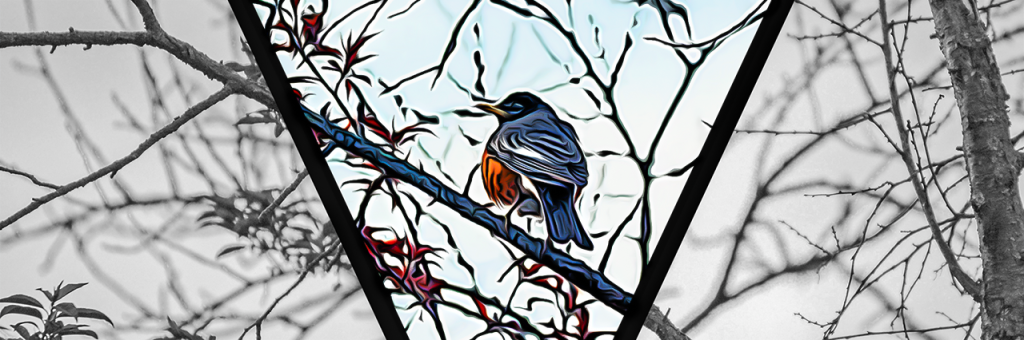
Inside a bold V shape, a bird sits on a thin branch. It appears to be painted with delicate strokes of blue and orange among a few raspberry-colored leaves. Outside the V, the image in black and white, the branches and leaves cold and muted.

It starts with wondering
which bridges would need crossing and which
direction the river curved, which four
roads you would need to get there when,
in fact, it is the same road with four different names. 

The road at the end of your street takes you
to the far side of the city, beyond where
the stalled train stops you, beyond the 
smokestack shadow and the swinging cranes above.

When you have reached the place
you set out for, you realize you can just stay
on that same road and drive, 
drive out toward all the other towns and cities,
if you don’t stop, if your car has gas,
if you have the time, if you are
unbounded.


Brian Baker

Brian Baker (he/him) is a London, Ontario poet who began writing back in the late eighties, publishing in such literary print journals as the University of Windsor Review, Dandelion, and The Antigonish Review.

Header photograph by Jen Ippensen
Header artwork by Jordan Keller-Wilson
The Vendor at the Farmers Market Honey Stall Gingerly Peels Away a Sticky Note Stuck to the Underside of the Cash Box

Inside a bold V shape, a bird sits on a thin branch. It appears to be painted with delicate strokes of blue and orange among a few raspberry-colored leaves. Outside the V, the image in black and white, the branches and leaves cold and muted.

But how to explain to you the phantoms that motivate a hunger like mine? Once I had a hankering for honey so strong I ate nothing without it for a week. Our honey jar was old, the golden insides turned cold—in some places, crystalized. You told me to just buy another jar, but I couldn’t stop thinking about the effort, the bees, all those trips back and forth to the hive. To not attempt to use it up seemed, to me, a cruelty. The night before you finally admitted there was someone else, I was contentedly working my way through the same old jar. It was late and I was tired and there were no clean knives left to scoop out the dregs, so I used a fork. When you caught me in the dim of the kitchen, I had already excavated down to the bottommost layer, where there was a surprise pocket of soft remains, a place where the crystals hadn’t yet hardened. I was only trying to salvage the last of that smoothness. Still it kept slipping through the tines.


Alyson Mosquera Dutemple

Alyson Mosquera Dutemple’s work has appeared or is forthcoming in Colorado Review, Alaska Quarterly Review, Salamander, Passages North, Arts & Letters, and Cincinnati Reviews miCRo series, among others. In 2022, her collection was a runner-up for the Flannery O’Connor Award for Short Fiction. Alyson teaches and edits in New Jersey. Find her @swellspoken and at alysondutemple.com.

Header photograph by Jen Ippensen
Header artwork by Jordan Keller-Wilson

please don’t let me vanish

Inside a bold V shape, a bird sits on a thin branch. It appears to be painted with delicate strokes of blue and orange among a few raspberry-colored leaves. Outside the V, the image in black and white, the branches and leaves cold and muted.

my body, your body, our bodies, bodies, fading in and out and in and out until suddenly we are both nothing, nothing but whispers that echo like leaves beneath our feet, nothing but whispers like the creaking of a tree on a hill, nothing but whispers like i love you to people we will never hold again 

i am in and out and in and out of love with you, with me, with your body as we tumble into bed, with my hair as i will it to grow every day, with the growing comfort of us, i love you like i love the sun after an especially cold winter, the way the sun can take away all the darkness that festers inside me, i wonder if we would fall in love again if given a chance, i wonder if we were meant to be or if we were a mistake i learned to love, i have made so many mistakes and i have never learned how to love any of them and still i wonder if you love me the same way i loved the girl i used to be

i don’t think this is a love poem, i am so scared, scared that if your eyes ever set upon this, scared that if you ever heard these words, these whispers, the faint murmuring of my voice, you would think that i don’t love you, that i don’t love you with my whole heart, when the truth is my body is made of love for you, but this isn’t a love poem, it’s an outpouring, a river from my fingertips, from my mouth, a form of love that i just don’t know how to give

time let us grow up, grow close, shed our skin for new bodies, sometimes i wonder how you can love me after everything i’ve done, after everyone i’ve been, how many people have you loved by loving me, will you continue to love me if i continue to fade, will you love me if i fade in and out and in and out, i am not a ghost but i am scared that someday i might disappear, fade away until i am only a memory of someone you could have loved


Josafina Garcia

Josafina Garcia is a writer, photographer, and zinester just trying to figure things out. She graduated from Northern Kentucky University in 2023 with a degree in Integrative Studies. Her future is unknown, but she is ready to head down whatever path lies ahead.

Header photograph by Jen Ippensen
Header artwork by Jordan Keller-Wilson
Both/And

Inside a bold V shape, a bird sits on a thin branch. It appears to be painted with delicate strokes of blue and orange among a few raspberry-colored leaves. Outside the V, the image in black and white, the branches and leaves cold and muted.

Come here.
Among the elbows 
of deciduous trees 
and lighthouse beacons 
of fireflies. 
I want you 
close enough to feel
the tightrope tension 
when I say nothing 
with a full mouth. 
My throat 
dissolves each I love you
that promises to earthquake my roots 
before it hits the pink
of my tongue. 

So stay there. 
Between mountains 
and the possibility 
we might not survive you. 
It’s too expensive to bury 
the codependency 
and broken vows 
hidden in the basement. 
Consider the black and blue
of falling for someone 
who can love you 
out loud.


James Roach

James Roach (they/he) is a queer/trans poet who currently resides in Olympia, Washington.

Header photograph by Jen Ippensen
Header artwork by Jordan Keller-Wilson
At My Grandmother’s Funeral, Mine Is the Only Head Not Bowed in Prayer

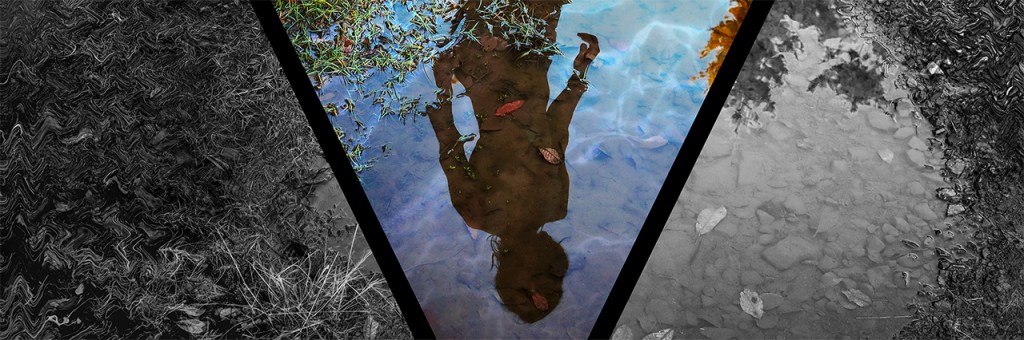
Inside a bold V shape, an inverted reflection appears in a rippling puddle with fresh green grass sprouting along one edge. Outside the V, the image is in black and white, the water still, the grass dry.

But I’m still crying, still a mess, still remembering that I’m the reason she died in a wheelchair. How, when I was still small enough to be carried, she slipped and broke her hip while holding me. Everyone is whispering amen and I am all blasphemy, a faith tied only to soil. The preacher speaks about ascension, but I’m grounded, can’t stop staring at her hands. How they look like they could reach out. How they must have held me so tight when she hit the asphalt.


Kimberly Wolf

Kimberly Wolf is a poet and parent selling books in Texas. She is often dreaming of a mountain.

Header photograph by Linds Sanders
Header artwork by Jordan Keller-Wilson
White Noise

Inside a bold V shape, an inverted reflection appears in a rippling puddle with fresh green grass sprouting along one edge. Outside the V, the image is in black and white, the water still, the grass dry.

I stood at the edge of my life
to inspect if there is a new way to begin, 

but all I found was the same familiar silence
swallowing me whole. 

My ears were bleeding white, I ran out of my body
and slid into a coffee shop. 

There is no sane way to escape

the body. The boy behind the counter offered me his teeth
and wanted my name in return. 

A boy has no name today, stranger—
I’ll carry your name as mine today. 

A cup of hot coffee on the table, 
and in it, the art of a cat letting off an atomic bomb.

I tug at my shirt, and I am the cat.
I tug at my fur and I am the bomb. 

What is there to do now? 
Why is the jukebox playing the same song

over and over,
and over, and


Animashaun Ameen

Animashaun Ameen is a poet and essayist. His works have appeared or are forthcoming in Salamander Magazine, Foglifter, Lolwe, Third Estate Magazine, Roadrunner Review, and elsewhere, and he is the author of Calling a Spade (forthcoming). He lives and writes from Lagos, Nigeria. An oddball. A butterfly.

Header photograph by Linds Sanders
Header artwork by Jordan Keller-Wilson