To the house wren that sang on my patio

A black and white New York skyline is bisected by the Vast Chasm V with a dirt path and green and gold grasses leading off toward the horizon.

I hadn’t thought “oh
I am living through an apocalypse”
until
these scorching summers,
savoring every birdsong
as if it is my last.


Dyani Sabin

Dyani Sabin is a queer author of speculative fiction, poetry, and science journalism. Her work has been published in Strange Horizons, Enchanted Conversations, Reckoning, Vastarien, as well as National Geographic, The Washington Post, and Popular Science. You can find her haunting a cornfield, chasing ghosts on the endangered species list, or at dyanisabin.com.

Header photograph and artwork by Jordan Keller-Wilson

Visiting Hours

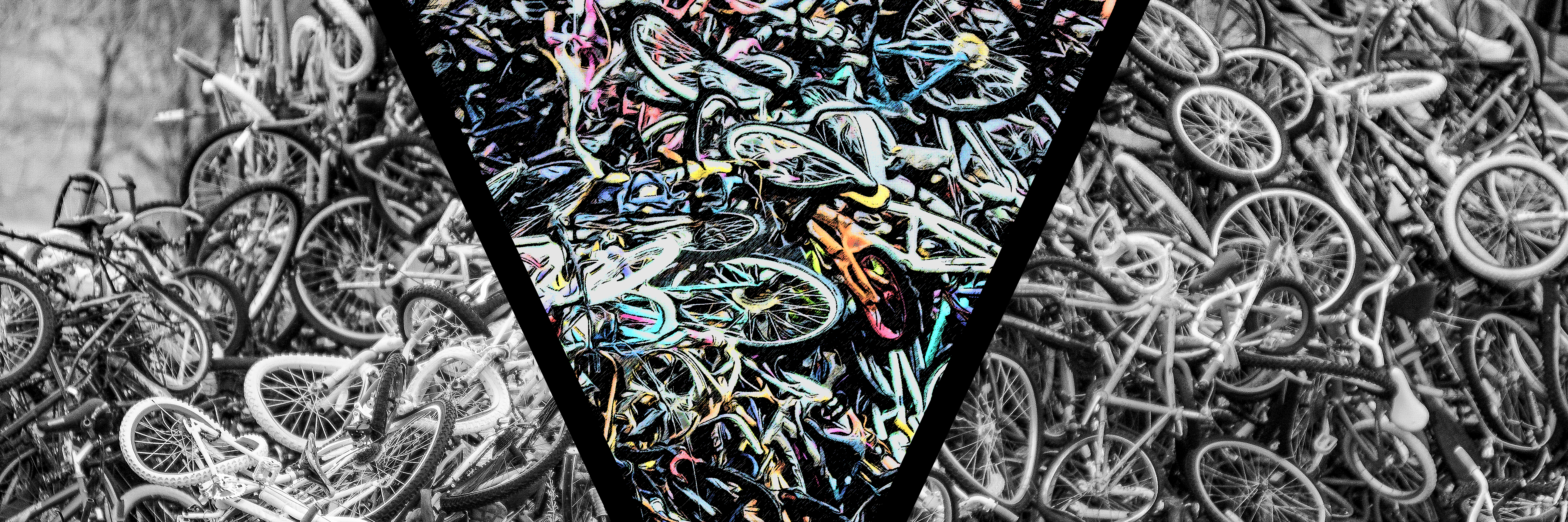
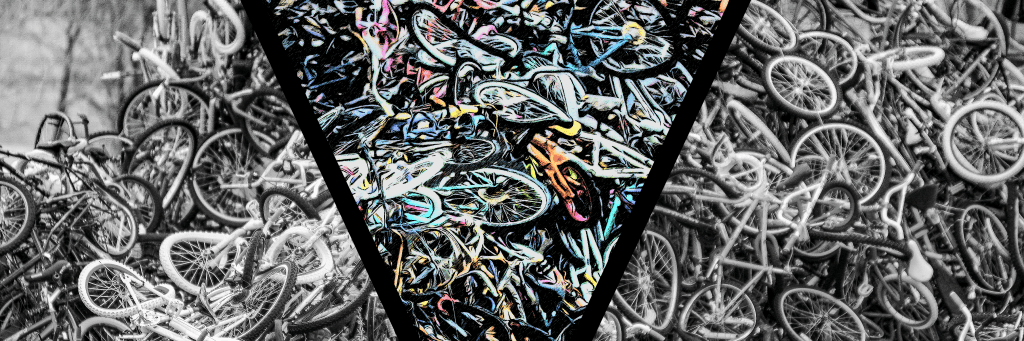
Hundreds of discarded bikes are heaped in a pile, their frames and wheels disfigured but recognizable. The image is in black and white, with a V cut through the center. Inside the V, the bikes appear to be painted in vivid colors.

Tell me a bedtime story in which I don’t float away this time. Kiss my stained glass lips and let me be young again. Don’t say that the crow will gnaw off my kite strings, that God will pump me full of helium. Tell me a story that anchors me to the roots of your laughter, to the doorknob of your attic. It doesn’t have to have a happy ending. I promise not to cry when the monsters creep out of my lungs, or scream when the climax is empty. I just want to imagine myself tethered to your vocal cords, entwined in your thick arteries like a tender knot. Only then can I fall asleep nestled safely in machinery. Only then can I wake up in the morning, and look at the milky sky with a jitter of hope. 


Elena Zhang

Elena Zhang is a Chinese American writer and mother living in Chicago. Her work can be found in HAD, Ghost Parachute, Exposition Review, Your Impossible Voice, and Gone Lawn, among other publications, and has been selected for Best Microfiction 2024. You can find her on Twitter @ezhang77.

Header photograph by Jen Ippensen
Header artwork by Jordan Keller-Wilson

Is the universe laughing with me or at me?

Hundreds of discarded bikes are heaped in a pile, their frames and wheels disfigured but recognizable. The image is in black and white, with a V cut through the center. Inside the V, the bikes appear to be painted in vivid colors.

Funny how
it was in the hospital waiting room –
the stiff seat cushions, white lights, and
September’s Women’s Health magazine –
where, despite the nurse at reception, 
I first felt like a real person.

We’ve given so much up already
and we keeping handing out more:
innocence and virginity,
bravery and youth,
teeth and hair.

These poems are lists of my grievances.
I don’t want to have been beautiful
only when in a hospital gown – or in memoriam.
We both know the gay bar is the only place
where it’s hot to have your ass out –
even for me.

Do me a favor,
tell me how beautiful I am,
in this moment, in this light, 
in this ignorance.

Funny how wounding it is
to become sick. There’s no way to recover
from something like that. I presented a piece of myself
as if I was presenting a pearl.

How funny.


Patrick Schiefen

Patrick Schiefen (he/him) is a United States writer who currently lives and writes in Argentina. His experiences as a nomadic LGBTQ+ artist informs his writing as much as music, politics, and art. His work has appeared in High Shelf Press, Ample Remains, From Whispers to Roars, Literary Shanghai, and elsewhere.

Header photograph by Jen Ippensen
Header artwork by Jordan Keller-Wilson

The Only Eternal Peace I Dream Of

Hundreds of discarded bikes are heaped in a pile, their frames and wheels disfigured but recognizable. The image is in black and white, with a V cut through the center. Inside the V, the bikes appear to be painted in vivid colors.

I want to rot.
I want to decompose.
I want the furnace of my crumbling organs to burn
so hot that it kills the grass above my grave.

Then I want it to grow back,
slowly, around the edges.

Until tender shoots nestle against the downy pelt of a rabbit.
Until velvet lips of a deer tear me out by my roots.
Until the water in my stalks dissolve into its bloodstream
and I spill through the chambers of its heart.

Thrumming as my petals unfurl and face the summer sun.
Thrumming with wild, vibrating insects harvesting the pollen from my buds,
dripping, sticky and viscous, down waxen walls.

Not the moldering sleep of the dead,
but the explosive cacophony of an afterlife.


Laura Marden

Laura Marden (she/her) is a speculative and weird fiction writer. Her work has been published in The Chamber Magazine, Creepy Podcast, and The Q&A Queerzine. Her short story “Until Prophecy’s End” can be found in the Seers and Sybils anthology from Brigids Gate Press. This is her first published poem. She lives in Maryland with her family and finds that the best time to write is when they’re all asleep.

Header photograph by Jen Ippensen
Header artwork by Jordan Keller-Wilson

When You Share a Small Town

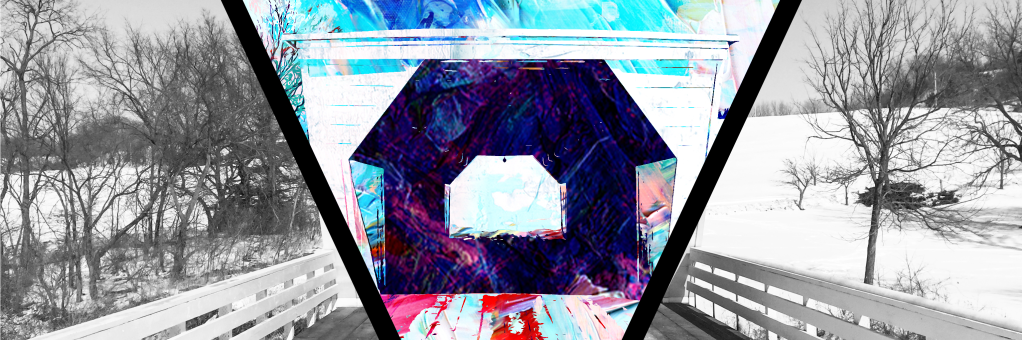
One of the bridges of Madison County, alive with brush-stroked colors, is framed in a bold V shape. Outside the V, the black and white photograph reveals the snowy landscape.

I’ve always loved the way the witch alders,
studding the bypass shoulders by the airport,
grow red in the fall, their scarlet tentacles the shade
of afternoon. It’s too bad they belong to you.

The black gum trees across from the police station
crawl like wooly tarantula legs into the pale sky,
but I rarely see them now, the way I don’t see
the fog-breathed gas station beer cave, the red sushi sign.

I have the grocery store that never had your pretzels,
the car wash with the spidering palm tree logo,
the small manmade lake near the gas company
that in late fall collects ducks like misshapen stars.

I can’t go to the bigger hardware store,
the one cottoned with spring flowers on the sidewalk
next to the Italian place. You could be there,
although you weren’t one for fixing things.

I gave up the library; you gave me the new liquor store.
I know you shop at the supermarket lined with evergreens;
you may as well live there, so I never go.
Instead I watch the sunrise, knowing the sunset will become yours.


Devon Neal

Devon Neal (he/him) is a Kentucky-based poet whose work has appeared in many publications, including HAD, Livina Press, The Storms, and The Bombay Lit Mag, and has been nominated for Best of the Net. He currently lives in Bardstown, KY with his wife and three children.

Header photograph by Holly Pelesky
Header artwork by Jordan Keller-Wilson

The Love That We Have Been

One of the bridges of Madison County, alive with brush-stroked colors, is framed in a bold V shape. Outside the V, the black and white photograph reveals the snowy landscape.

I hope you are with me
when the long sleep comes.
The thick warmth of memory
on our eyelids, like sunlight
pressed to the backs of leaves.
The faces we have known
blurring into gentle shadows.
Words, frozen like footprints
in evening snow, still
behind us in the dark valley.
The love that we have been,
rising, naked, into the air.


Jane Hahn

Jane Hahn lives and writes in the Midwestern United States. Her work has appeared or is forthcoming in Concord Ridge, Detroit Lit Mag, The Other Journal, and Theophron, among others. More can be found at janethegrey.wordpress.com.

Header photograph by Holly Pelesky
Header artwork by Jordan Keller-Wilson

Divination

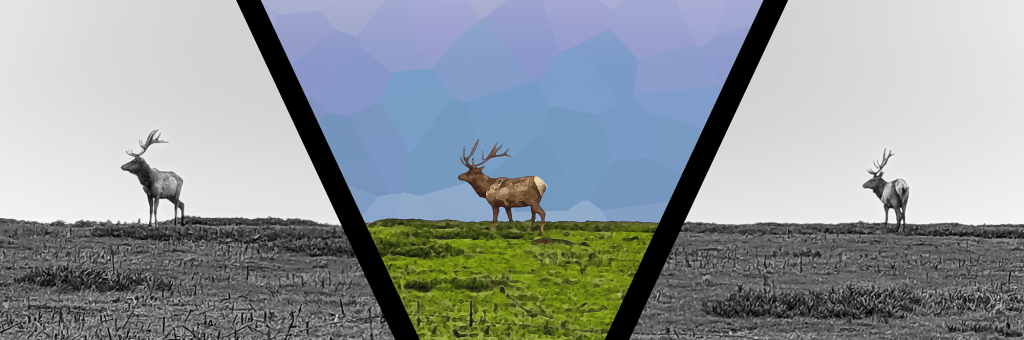
Three elk top a grassy ridge. They are evenly spaced, the one in the middle centered in a bold V shape. Within the V, the sky is crystalized into abstract shades that fade from blue at the horizon to almost pink against the upper edge of the frame.

When the world ended,

we scavenged the things we could and vowed
to become witches together. A childhood

necessity. I searched my blackened cupboard 
for the flowers we’d dried, petals bleached

with age and ash.

You’d lost your crystal ball but gathered up
all the bones nearby.

I helped you find them, little white shards,
so burnt they’d crumble to the touch

until you were left with a dozen pieces.
The resilient parts.

Now, you watch the bones clatter, pay attention
to the forms they make.

One day, I hope the world will hold up its hands,
and in its palms, beating like a frightened bird,

show you its bleeding heart.

But I don’t bother with the bones anymore.

I roam the ash, find a good spot, and toss the seeds
that will shape it all anew.

In a few years
the world will still be a wasteland, but we’ll
watch that wasteland bloom.


Ada Navarro Ulriksen

Ada Navarro Ulriksen was born in Santiago, Chile and now lives in California. Her poetry has appeared in The Deadlands as well as a few other journals.

Header photograph and artwork by Jordan Keller-Wilson

When the Ladybugs Came

Three elk top a grassy ridge. They are evenly spaced, the one in the middle centered in a bold V shape. Within the V, the sky is crystalized into abstract shades that fade from blue at the horizon to almost pink against the upper edge of the frame.

I don’t remember exactly
when the ladybugs came,
but I know that morning
the sky was clear,
until they came rolling in,
a storm of shadow
that swarmed our house.
They hummed, pulsated, trembled,
weaving a thick blanket
that drove out all the light.

When my sister cried out,
I put on the brave face
my parents taught me, a consequence
of familial love corrupted.
A love that bore down on us
like the horde of insects above our head.

I once found ladybugs beautiful,
and by themselves they were,
but together they were ominous,
a show of unexpected force,
a thing I never knew to fear.


Caitlin O’Halloran

Caitlin O’Halloran is a biracial Filipino-American poet who studies in a poetry workshop taught by Katia Kapovich. As a high school student, she attended the Sewanee Young Writers’ Conference on the poetry track. She has a Bachelor of Arts from Boston University in Philosophy and History.

Header photograph and artwork by Jordan Keller-Wilson
A Shared Language

Three elk top a grassy ridge. They are evenly spaced, the one in the middle centered in a bold V shape. Within the V, the sky is crystalized into abstract shades that fade from blue at the horizon to almost pink against the upper edge of the frame.

If you are overpowered
by the weight of
this life

If everything here
aims at the throat

Then come take a seat
with me, for I, too,
am articulate in the
dialect of grief


Abduljalal Musa Aliyu

Abduljalal Musa Aliyu is a school teacher and poet. He writes from Zaria, Nigeria. He has a chapbook, Encyclopaedia of Dolour (Chestnut Review, 2024). His work appears in Chestnut Review, Brittle Paper, Ninshar Arts, 3 of Cups anthology and elsewhere. He is the third prize winner of the inaugural Writing Ukraine Prize and PIN’s 2020 Poetically Written Prose contest. He rants on Twitter @AbduljalaalMusa.

Header photograph and artwork by Jordan Keller-Wilson

The road at the end of your street takes you there

Inside a bold V shape, a bird sits on a thin branch. It appears to be painted with delicate strokes of blue and orange among a few raspberry-colored leaves. Outside the V, the image in black and white, the branches and leaves cold and muted.

It starts with wondering
which bridges would need crossing and which
direction the river curved, which four
roads you would need to get there when,
in fact, it is the same road with four different names. 

The road at the end of your street takes you
to the far side of the city, beyond where
the stalled train stops you, beyond the 
smokestack shadow and the swinging cranes above.

When you have reached the place
you set out for, you realize you can just stay
on that same road and drive, 
drive out toward all the other towns and cities,
if you don’t stop, if your car has gas,
if you have the time, if you are
unbounded.


Brian Baker

Brian Baker (he/him) is a London, Ontario poet who began writing back in the late eighties, publishing in such literary print journals as the University of Windsor Review, Dandelion, and The Antigonish Review.

Header photograph by Jen Ippensen
Header artwork by Jordan Keller-Wilson