All of This, Still

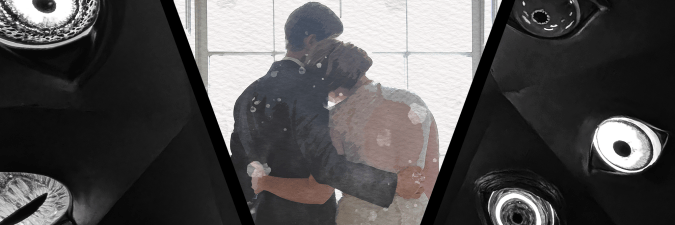
Inside the Vast V, a droplet-flecked watercolor image of a silhouetted couple in wedding dress and suit facing away from the viewer and leaning into one another. In black and white outside the V, disembodied eyes of different shapes and sizes peer toward the couple and the viewer.

The morning after our best friends’ wedding, hungover, my husband and I are making our way to coffee and eggs, and already there’s a buzz in the streets, protesters gathering for the march across the city, and we will go too, of course we will go, but first the diner where the server, bless him, surprises us with big lollipops, the comically cartoon kind with swirls, saying Happy Halloween and my smile breaks open wide like I’m a kid again, like I’ve forgotten anything bad has ever happened.

On the bus we’re packed with sweat and people and posters, quiet and still as we wait, and when we arrive at Embarcadero Plaza, we stop at a convenience store where the cashier asks if we’re going to the march and when we nod he says take two waters on me, and we carry them with us and the people chant and the musicians sing and two nurses hold their signs high, insisting we will not go back, and a yellow butterfly drifts past like it’s riding the whole thing, the resistance and the heat and the hope.

We skip the bus home 
and walk instead, 
stopping for beer in the bright, oblivious sun, 
and yes there’s some sadness in it, 
tears like condensation on glass, 
but we keep walking, 
find ourselves in the backyard of some restaurant 
where it’s couples and families,
and a girls’ night in bloom, 
all of us making an evening of it,
and San Francisco, 
listen, 
San Francisco gives us one of those rare days 
where the sun stays touching you 
well into the night, 
a gift.

In the park at golden hour little moths sprinkle bushes like something from a fairy tale and no one else is around so we let the whole display be just for us, and around the corner a group pops champagne and the cork sails through the sky, lands at our toes like the world is saying here, have this too.

At our favorite spot for wings we sit outside and a group of children are spinning and laughing, their parents inside, and one kid comes over, double dog dared, you can tell, and says to my husband Are you guys friends??? and immediately giggles because the answer doesn’t matter, the dare is the thing, and this happens three more times, each question sillier than the last, and when we get up to leave my husband drops to his knees and does this silly dance and the kids squeal, actually squeal with delight, and run around him in circles like he’s given them the world.

We walk under the trees where the sky has gone bluish black and we hear the faintest hoot, and we stop, and we listen as two owls call for one another in the darkness, and other people stop too, we strangers pausing below the trees, all of us going ooh and ahh like it’s a game of hide and seek, like we’re all in on it together.

My husband takes my hand
and finally we step onto the bus,
get off in front of our home,
walk in to start dinner,
our black cat finding us, 
and I turn on all of the Halloween lights 
even though it’s over a week away— 
why not?— 
and I look through the glow 
of our small existence 
and I’m thinking about it, 
about our friends proclaiming their beautiful love to each other, 
and the server with his lollipops 
and the cashier with his water 
and the champagne cork at our feet 
and my husband on his knees making children laugh 
and the owls calling in the dark 
and all of us strangers stopping to listen, 
and yes, 
the present is terrifying 
and the future might be worse, 
but also— 
I feel this— 
achingly, all of this.


Katelyn Sweeney

Katelyn Sweeney is a writer and middle school English teacher in San Francisco. Her poetry and creative nonfiction have appeared in journals including The Pinch and EcoTheo Review. She is happiest anywhere that feels a little wild and believes every walk should end with at least one good rock in her pocket.

Header photography and artwork by Jordan Keller-Wilson
What the Earth Asks After the Apology

Inside the Vast V, a droplet-flecked watercolor image of a silhouetted couple in wedding dress and suit facing away from the viewer and leaning into one another. In black and white outside the V, disembodied eyes of different shapes and sizes peer toward the couple and the viewer.

My grandmother said the body remembers
what the mouth is too afraid to say.
She said the ache in her knees
was every border crossed without consent,
every history folded too small to breathe.

I believe her.
My bones hum when the news is bad.
My lungs flinch at flags.
Some nights my heart beats
like it’s trying to escape jurisdiction.

Tell me
what is a country
if not a story told loudly enough
to sound like truth?
What is obedience
if not fear dressed as loyalty?

I was taught to kneel
before I learned the names of things:
soil, spine, hunger
taught that silence was a form of cleanliness
and that pain, if borne elegantly,
might pass for virtue.

But the earth does not kneel.
It splits.

There is a sound to it
not thunder, but a long, intimate tearing,
like fabric giving up on being useful.
Like a mouth unlearning prayer.

We live over fault lines we pretend are roads.
We pour concrete over grief
and call it progress.
We teach our children to count borders
but not to listen to the ground.

I want a language that stutters on purpose,
that refuses to behave.
A language that cracks open the word home
and asks who was locked outside
to make it possible.

When I say I am here,
I do not mean safe.
I mean breathing despite.
I mean stitched together with borrowed courage
and the stubborn muscle of staying.

The chasm is not ahead of us.
It is what we fall back into
every time we choose comfort
over witness.

Still
there are hands reaching across it.
There are voices guiding us out
like ropes.

There is the radical act of looking down
and refusing to look away

If the earth asks anything of us now,
it is not forgiveness.
It is attention.

To feel the ground move
and learn to move with it.
To stop pretending stillness
is the same as peace.
To stand at the edge
and speak anyway.


Khayelihle Benghu

Khayelihle Benghu is a South African poet based in Johannesburg. Her work explores themes such as memory, grief, faith, family, and the quiet endurance of ordinary lives. Her poems have appeared in Person of Interest, Aloka, Decolonial Passage, AKE Review, Eyes on the Telescope, and Metphrastics. She is also the author of the poetry collection The Names We Carry.

Header photography and artwork by Jordan Keller-Wilson
PARIS HILTON TEACHES ME ABOUT GOD

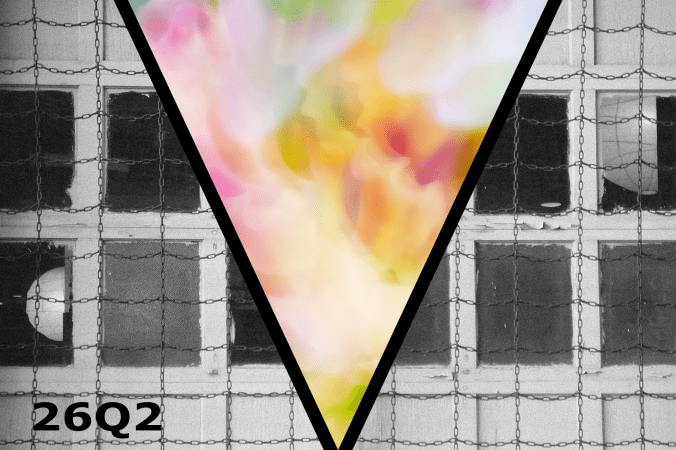
Two rows of weathered windows across a garage-like door with peeling white paint sit behind a loose chain curtain. The image is bisected by the signature Vast "V." Within the "V," a distraction from the distress: swirling colors--a mixture of bright and pastel pinks, yellows, and even a hint of green--reminiscent of flowers rendered in water-color.

In 2003, salvation has blonde extensions
and a chihuahua named Tinkerbell.

I watch her descend from the Escalade
in low-rise jeans that part the Red Sea
of paparazzi.

that’s hot
rain glitter
reign, glitter

prophecy in a Juicy tracksuit,
rosary of rhinestones

Bless my cheap gloss,
my beaded clips, my Sony Cybershot—
every pop girl who burned herself
beautiful for the lens.

We kept the light spinning.
We were the mirrorball saints—
worshipped, ridiculed, necessary.


Shae

Shae is a queer, autistic goblin interested in the intersection of disability justice and design, collecting tiny trinkets and having an unwavering devotion to Shrek as both art and ideology.

Header photography and artwork by Jordan Keller-Wilson

LOLZ

Two rows of weathered windows across a garage-like door with peeling white paint sit behind a loose chain curtain. The image is bisected by the signature Vast "V." Within the "V," a distraction from the distress: swirling colors--a mixture of bright and pastel pinks, yellows, and even a hint of green--reminiscent of flowers rendered in water-color.

I am texting you pictures of cats:
cats doing jobs, using “z” instead of “s,”
Look! Cats in frog hats, cats riding on Roombas.
I am texting you cats instead of
what I can’t bring myself to tell you:
I am sending out the save-the-date
for the unveiling of my grandmother’s
headstone. I need to shovel this morning’s snowfall and
register my children for next year’s summer camp.
I was in the emergency room with my dad last week—
trying to recite prayers I didn’t know the meaning of,
to take note of the medical words that I did—
and I just want you to see how funny this kitten is:
curled up in a pile of hay in the barn next to the lambs,
as if it belonged there.


Pam Yve Simon

Pam Yve Simon (she/her) earned her bachelor of arts in English and American literature from New York University. Her poetry and photography has appeared in various online and print publications. She was awarded the Analog Science Fiction and Fact Analytical Laboratory Award for Best Poem of 2024 for her poem “Gravity.” Say hi to her on Bluesky Social @PamYve.bsky.social or visit: pamyve.wordpress.com

Header photography and artwork by Jordan Keller-Wilson

Diamonds

In the central V, a brightly-stylized photo of a young child in motion on a rope swing. Outside the V, a background of grayscale streamers hanging from the ceiling like the portal to another world.

i would rather not
wake with arms of glue and legs of blue numb,
drowsy, reaching for hairy chest and crusted eyelashes,
swishing my palms across empty sheets

i will pick him up, drive him to his places.
he will not know mine, nor will he ask
if i changed something about my hair.
i did, it’s a half-inch shorter

we will trudge down concrete sidewalks
window shopping with empty wallets.
i will stop in front of panes of shiny glass.
voice quivering, i will say:
look at all the diamonds


Orly Berkowitz-Henkin

Orly Berkowitz-Henkin is a senior at Haverford College studying religion and creative writing. She is from Brooklyn, New York and is pursuing a Masters in Social Work. She loves writing, dogs, knitting, and going to the movies.

Header photography and artwork by Jordan Keller-Wilson

I Am the Twitch in the Family Line

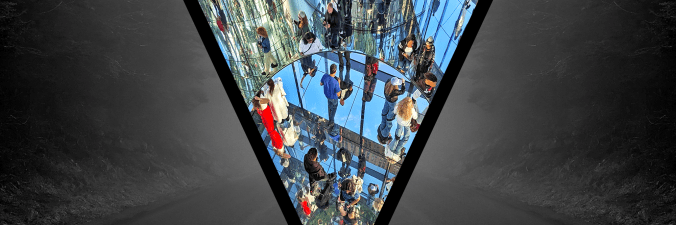
An empty road is crowded by grayscale fog and dark pines, bisected by the signature Vast "V." Within the "V" is a fractured reflection of people on their own or in small groups. They walk among reflected blue sky and shining surfaces, endlessly repeating and distorting their surroundings.

they said my great-grandmother
taught herself to read by whispering
hymns backward into a jar.
kept snakes in the stove,
sucked pennies clean for luck.
the men said she was feeble.
the women said, nervous.

i chew the same rhythm into my sleeves.
rub the fabric raw until my hands forget
the weight of being witnessed.
this is how i pray,
in repetition, in retreat,
in the hum behind electric things.

in my uncle’s trailer
there’s a buck head nailed to the fridge
and a child’s drawing of a sun
with no face.
my cousin says i blink wrong,
like a deer deciding whether to bolt.

my mother once locked me in a linen closet
because i wouldn’t stop spinning.
said she couldn’t take it anymore,
the noise, the flapping, the bright
click of me not being
like the rest of them.

when i came out,
i spoke in color
for three straight days.
she burned my drawings in a metal bowl
and told god to come collect me
if he had the stomach for it.

they call it a spectrum
but in this house it’s a curse,
a bloodline of girls who look away
when spoken to,
who name their toys after latin verbs,
who learn affection
by studying taxidermy.

the living room smells like mildew and lilac.
granny’s perfume still haunts the upholstery.
they say she went silent for twenty years
and came back speaking perfect French.
i understand.
sometimes you have to leave language
just to survive it.

i sit on the porch and stim
with a pop tab and a dead wasp.
my cousin’s boy says
i’m touched by something evil.
i tell him
so was christ.


Carrie Farrar

Carrie Farrar is a poet and musician whose work explores neurodivergence, memory, and the quiet intersections between survival and grace. Her poems have appeared in Kaleidoscope Magazine, Down in the Dirt, Flare Magazine, and The Art of Autism, among others. Blending lyrical precision with emotional candor, she writes to make sense of a world that often misunderstands difference. Her poem “I Am the Twitch in the Family Line” reflects her recurring themes of inherited pain, resilience, and the beauty of the mind’s odd wiring. She lives in California, where she continues to write toward empathy and light.

Header photography and artwork by Jordan Keller-Wilson
I’m in Our Coffee Shop

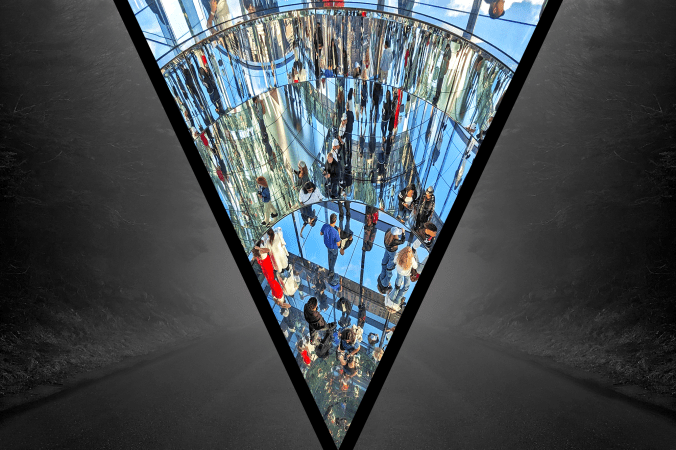
An empty road is crowded by grayscale fog and dark pines, bisected by the signature Vast "V." Within the "V" is a fractured reflection of people on their own or in small groups. They walk among reflected blue sky and shining surfaces, endlessly repeating and distorting their surroundings.

The young man at the next table is evangelizing
to another young man.
He is arguing we might live in a simulation.
Something about light not behaving intuitively.
He’s on to Lazarus and The Screwtape Letters now. 

And I didn’t bring my headphones.

Outside, I watch boys hang loose as marionettes
on a dying earth beneath a dying sun.
And I worry about war and fundamentalism.
I’m sick of dialectic dialogue.

The young man has moved on to talking about Fight Club
(which is something you’re not supposed to talk about),
misquoting the book and film,
talking about a purposeless struggle.

And I marvel at a belief system cobbled together 
hodge-podge from religious texts and pop culture.
Probably not so unlike my own.

Of course you are here.
I don’t have my headphones to block you out.

Well, you aren’t here-here (I mean, could you imagine?),
but you’re here the way I don’t notice my legs until they ache,
or my stomach until I am hungry, or my heart until it’s breaking.

You are hiding in every poem I write and every story I tell,
every journal entry and not far from every thought.
(God, now he’s talking about love and his divorce 
and I feel pangs of sympathy and guilt.)

He says to the other young man:
Let me ask you this.

But the questions are all rhetorical,
simply there to further his points.

I sip the weakest tea I’ve ever had and it hurts my stomach
as bad as the sympathy and guilt,
but the barista said she’d try better if I wanted a refill
and I’m trying not to be rude.

And of course you are here.

Textured tile covers the face of the coffee bar
and it looks inside out the longer you stare at it,
like an idea, like a simulation of a coffee bar.

And there is a father playing Go Fish with his daughter
trying to ignore the young man talking now
about the difference between the sexes
and how dating is really like sales if you think about it.

And of course you are here.


Matthew Roy

Matthew Roy (he/him) lives in the American Midwest. He’s moved from a small town to a big city, from a rambling farmhouse to a small apartment, and from a major corporation to an up-and-comer. He’s writing more. He’s making changes. He’s querying his first novel and banging away at his second. His work has appeared in Eternal Haunted Summer, Haven Spec, Illumen Magazine, Penumbric Speculative Fiction Mag, The Quarter(ly) Journal, Space & Time Magazine, The Sprawl Mag, star*line, Twenty-two Twenty-eight, untethered magazine, and So It Goes: The Literary Journal of the Kurt Vonnegut Museum and Library, among others.

Header photography and artwork by Jordan Keller-Wilson
To the Girl Working at the Tea Shop in Provincetown 

A black and white, patterned stone dome seen from below is bisected by the signature Vast "V." Within the "V" is a wooden room terminating in a worn stone doorframe. Through the doorframe we see a cave mouth opening onto distant mountains at sunset.

I asked you about the novel you were reading
and realized too late I was flirting,
despite wearing an oversized nautical sweater
and a fanny pack designed to carry
a child around my postpartum fat.

You were playing Pavement
but didn’t know the band,
and I forgave that,
looking in your pretty face as you said witchy playlist,
feeling that sense of undeniable possibility,
and underneath, the scintillating savor
of my own internalized shame.

It’s what we all dream of, right?
Witchiness, which means
taking ourselves to the forest to dance naked
away from laundry and picking up
countless old socks and half-full Coke cans—
in other words, away from men.

I’m sorry for my fantasies
of a wife, girlfriend, women,
when I outlive my husband,
sorry for breaking the illusion
when he came in with his beard and his requests,
his sense the world was made for him,
and asked to use your restroom,
to which you said no.


Harriet Weaver

Harriet Weaver is a Los Angeles–based writer with an MFA from the University of California, Irvine, and a BA from Yale University, where she studied with Harold Bloom. She was recently published in the Los Angeles Review of Books journal PubLab and has poetry forthcoming from Roanoke Review. In her previous career as actor and producer, Harriet studied under Wynn Handman and brought shows to Broadway with Blue Spruce Productions. She was an instructor of poetry and composition at UC Irvine. She grew up in Bethesda, Maryland, and Wexford, Pennsylvania, and lives in LA with her husband and toddler.

Header photography and artwork by Jordan Keller-Wilson

my southern bones

A black and white, patterned stone dome seen from below is bisected by the signature Vast "V." Within the "V" is a wooden room terminating in a worn stone doorframe. Through the doorframe we see a cave mouth opening onto distant mountains at sunset.

my mother’s family is from
the hills of tennessee—or maybe
bluegrass kentucky, i never
really knew. she always talked about
grandma’s house—another thing i
didn’t know—and how the family 
would gather there

so i guess that’s why we’re in
some state where the grass flows like
water and my voice sounds so
out of place. everyone’s eyes are
red rimmed and don’t look directly at
me, while my mother sits on the far end
of a rotted pew bench and smirks at
fake pleas to god and prayers to
save grandmama’s soul—

skeleton heads and taxidermy line
the walls of my cousin’s uncle’s
grandpa’s double wide. they pass
clear punch in solo cups while
we sit with wood panelled walls to
our backs.

my mother laughs with
coyotes and wraps snakes 
around her wrists. even her 
own family is afraid of
her predator’s gaze—i
puff my chest out with pride:
become animal.

some boy who is
related to me by blood or
skin or spit pokes at a
dark mound marring 
this southern dirt. he tells 
me it’s dead. i tell him
we all are.

i pick up 
the carcass and eat it—
picking my teeth with
the bones


Emma Townsend

Emma Townsend is a two-time children’s book author and published poet. She recently graduated from Purdue University and is now completing her Master’s degree in Library and Information Science. Emma loves poetry that connects with one’s past and typically alludes to her own life experiences in her work.

Header photography and artwork by Jordan Keller-Wilson
Self-Congratulation

A black and white, patterned stone dome seen from below is bisected by the signature Vast "V." Within the "V" is a wooden room terminating in a worn stone doorframe. Through the doorframe we see a cave mouth opening onto distant mountains at sunset.

Texas women love and curse with a fatal bless your heart. Sun-burned plains enclose them, their multi-colored bodies corralled

in branded jeans. Tender cuts on man-sized platters piled high to heaven with heaping sides of disrespect, they live to be consumed and then discarded 

like Porsha Ngumezi. Doctors wouldn’t scrape her womb and she bled out, screaming, young and Black. No charity for her, she left this world in Houston

just like Josseli Barnica, who died while Catholic and brown. The green card in her purse meant life but not liberty because heartbeats from a dying fetus mean a one-way

trip to glory. Nevaeh Crain, pretty white girl with a butterfly tattoo in a sundown town, could tell you that, if sepsis hadn’t starved the pink from all her organs.

Meanwhile hypocrites under Hippocratic oath cull women’s bones to pick their teeth in self-congratulation because in Texas, praise Jesus, the right to life abides.


M. M. Adjarian

M. M. Adjarian has published her work in The Baltimore Review, Verdad, South 85, The Missing Slate, Pif Magazine, Gravel, Glint, Grub Street, Crack the Spine, Poetry Flash, and Poetry Quarterly and is currently at work on her first poetry collection and a family memoir titled This Life That Binds. She lives in Austin.

Header photography and artwork by Jordan Keller-Wilson