What We Say For Love

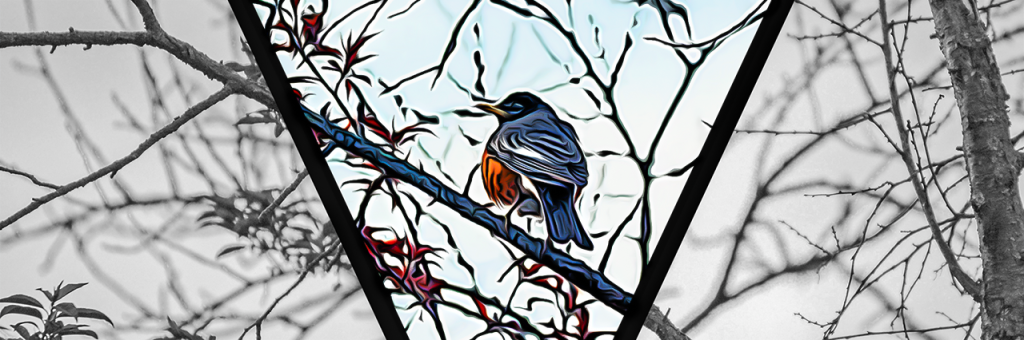
Inside a bold V shape, a bird sits on a thin branch. It appears to be painted with delicate strokes of blue and orange among a few raspberry-colored leaves. Outside the V, the image in black and white, the branches and leaves cold and muted.

My roommate thinks I’m gay, and I haven’t corrected her. I mean, sure, Kara and I met in our fashion design class, and sure, she knows I crush on Oscar Isaac, and sure, I told her fiancé as much so he wouldn’t be jealous, and sure, I might’ve kissed him when Kara was passed out on Malbec and he and I were sharing a joint, and sure, I told him—swore to him—I wouldn’t breathe a word to her.

And so I don’t. I mean, I swore on my grandmother’s grave, and maybe she’s not technically dead yet, but it’s not like he has anything to worry about. It’s not like I’m going to brag I kissed some guy with no chin and a lopsided franken-smile. I still don’t know how he got with Kara (unless it’s his trust fund; of course it’s his trust fund) because she’s way too good for him. That’s what I’ll say when she wakes, after I hand her some Gatorade and tell her to drink up. And when she says Stop, you sound jealous, I’ll let myself blush even though I’m good about hiding that sort of thing, have known how to hide it since eighth grade and that time with Jay behind the band room, but now—now I’ll let her see the desire coloring my face, turning my lips red like the time I borrowed her makeup. And I’ll want her to say she understands, to not pull away saying she needs a shower, to not shoo me out even though she’s been naked in front of me tons before, to not click the bathroom door shut so I can’t smell her body wash, leaving me on the other side thinking about my promise to her fiancé, about the word fiancé and how cloying it sounds—so fucking French and upper class—and I’ll realize they’re probably made for each other, right?

Or maybe I do tell her about the kiss, but not until she has downed her Gatorade and three Advil and is munching on the avocado toast she loves, thanking me for being such a good roommate then pausing when she sees my face darken. What is it? she’ll say. Tell me. So I’ll sit down and hold her hands and say I didn’t mean to hurt her, because isn’t that what they say in the movies? And sure, she’ll laugh at first, as if I’m fucking with her, until I tell her it was all my fault, until I insist that I’m the one to blame, and maybe I am, though of course she won’t believe that. She’s seen the warning signs for months now—not that her fiancé likes guys, but that he can’t be trusted, could never be trusted. Wasn’t he in another relationship when they first got together? Wasn’t she the other woman, maybe she’s always been the other woman? That’s what her eyes will say when she says thank you, just murmurs it, then says she needs to be alone. And I’ll realize what a stupid thing I’ve done, all over a kiss, and not a very good one—lasted only seconds with barely any tongue—and her bedroom door will click shut like it never does and there’s nothing left to do but slide the remains of her avocado toast into the trash.

Or no, I really don’t tell her, not when she wakes up the next morning, her hair smelling of weed, a string of drool plastered across her cheek. I say she looks like shit, but she hears the love in my voice, so she showers and calls me into the bathroom to tell me I simply have to join her at her bachelorette party, and I sit on the toilet and smell her cantaloupe body wash and say sure, why not, even though I’m not up for it, even though the party will end with me crammed into the corner booth at The Eagle, empty shot glasses scattered around us, and her girlfriend Tiffany next to me, insisting I switch teams for the night. And sure, I might be tempted, but it’s Tiff. Tiff, who still attends Young Republican meetings, who’s engaged to some MBA who everybody knows she’ll divorce in two years, Tiff who wears fucking body glitter—and there’s no way I’d let that rub off on me even if she is hot—so yeah, I might be tempted, but by then Kara will be crying, bawling huge drunk girl tears about whether she’s ready—really ready—and I’ll want to scream NO! but instead I’ll say Look at me girlfriend and snap my fingers in my best parody of the queen they think I am, and I’ll say You’ve got this though of course she doesn’t, none of us do. And if I let anything slip about how I kissed her fiancé, it’ll be later, to Tiff, when I lean into her mouth even though I know I shouldn’t since Tiff can’t keep a fucking secret about anything, and it won’t be out of spite, no matter what everyone says.


Joshua Jones Lofflin’s writing has appeared in The Best Microfiction, The Best Small Fictions, The Cincinnati Review, CRAFT, Fractured Lit, Moon City Review, SmokeLong Quarterly, and elsewhere. He lives in Maryland. Find him on Twitter @jjlofflin or visit his website: jjlofflin.com

Header photograph by Jen Ippensen
Header artwork by Jordan Keller-Wilson

First Off, First On

Inside a bold V shape, a bird sits on a thin branch. It appears to be painted with delicate strokes of blue and orange among a few raspberry-colored leaves. Outside the V, the image in black and white, the branches and leaves cold and muted.

He put his socks on first. I’d never seen anyone dress that way before. Standing in the middle of the wavy blue rug in front of his bed, he pulled on one after the other without losing his balance.

We lived two buildings apart in the same apartment complex, but to get here, we used Grindr. 

Once we tapped each other, he made me comfortable and horny enough with dirty talk and dick pics to walk over—I wouldn’t have gone, if he wasn’t so close—then into the bedroom, to sit on the bed and kiss me mid-sentence. 

I never knew when to shut up: You taste, like, so good.

So good that words crumbled into grunts and breaths and yelps so fast that I couldn’t stop, didn’t want to. Nor did he, until he found an angle that allowed him to finish.

When he pulled out, I didn’t feel lessened or empty or shamed, but open and relaxed and warm and—

He was dressing. After the socks, he found his underwear wadded at the foot of the bed, where I lay uncovered and easy.

“God,” I said, as he slid his tan, muscled leg into his jeans, “that was like… I don’t ever want to move.”

His shirt was on now, blotted and purple. “I’m sorry,” he said, “but I have to pack. I’m moving tomorrow.”

“Like, to another building?”

“Another state. Out west, a fifteen-hour drive.”

I felt exposed only then, the sheets around my knees, the a/c’s chilling touch at my waist. 

While I dressed, he put books into boxes and totes I hadn’t noticed earlier.

“If you don’t want to sleep alone, I’ll be just over there.” I pointed across the grassy courtyard.

He said thanks, and I walked home through the sticky, pulsating night, wondering how long he had wanted me out of there.


Lukas Tallent

Lukas Tallent is the author of The Compromising Position. His work has recently appeared in Fast Pop Lit, Door is a Jar, Maudlin House, and many other places. He writes the substack, LTXXX, and lives in New York City.

Header photograph by Jen Ippensen
Header artwork by Jordan Keller-Wilson
I’ll Sell You a Dream

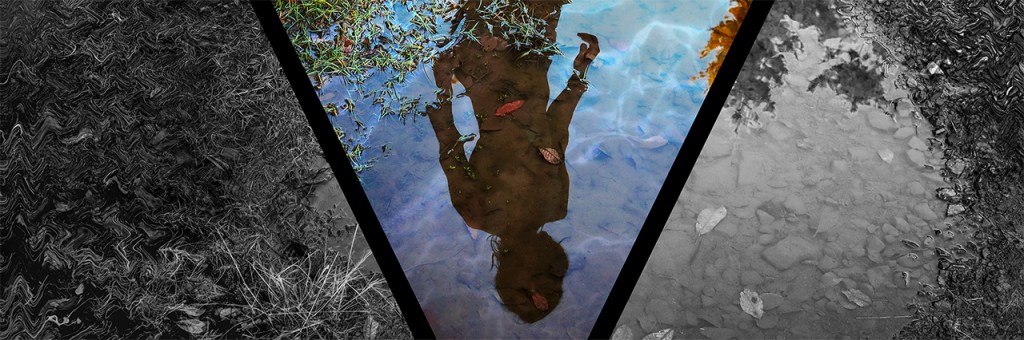
Inside a bold V shape, an inverted reflection appears in a rippling puddle with fresh green grass sprouting along one edge. Outside the V, the image is in black and white, the water still, the grass dry.

Mama always called me a lost little bird. Said my first month of life I held my mouth agape in colic, chirping for more but never getting enough. As a child, I lived with all my belongings sprawled out on the floor, preferring my drawers and closet empty, opening and shutting them endlessly, looking for something.

And so I moved through life with my breadcrumbs trailing to nowhere. I watched other people’s lives. I could tell you what petiteSami19 wore last week in every outfit video, or the story of live_luv_heal chronicling her cancer diagnosis and the exact moment she started losing her hair, or every step professorcrafter took to transform an old pair of jeans into a mini-skirt, but could I do it myself? Nope. 

What did I want in life? Perhaps if I scrolled a little more, I’d find an answer. That’s how I ended up in this drippy black-lit basement of a forgotten, boarded up house near campus.

“So what’ll it be?” Dr3amM4ker said, voice soft, almost imperceptible. A friendly painted face smiled, fluorescent in the black light. A midnight blue starburst surrounded one eye, bright pink the other.

“I’m sorry?” I said. 

“What dream do you want?” The pink eye looked at me.

“Isn’t that why I’m here? Isn’t that why I’m paying you?” My finger poked the foam through a crack in the vinyl chair.

They sighed. “When you were a kid, what did you wanna be when you grew up?”

I’ll never forget Mama’s red-hot face at career day in fifth grade. I stood before the room full of parents, lacking a costume, and proclaimed my desire to remain a child the rest of my life. I felt the heat radiating off of Mama’s face on the drive home. Her silence burned deep. 

I ripped out a piece of foam and rolled it between my fingers. “Nothing.” I said.

“Hmm.” Dr3amM4ker’s neon nails drummed the cooler top they used as a desk. The blue eye surveyed me. “That’ll cost you more. A dream from scratch. I can’t remember the last time…” 

“I’ve given you all the money I have.”

Maybe I should have listened to Mama. She told me to study pharmacy. Her feeds touted job security, decent pay, the good it will do for the aging population. She told me this while scrolling on her phone. 

She said, “You might as well do something that lets you enjoy life a bit.” 

What life? I thought. My whole life was out there already, hundreds of childhood photos Mama posted. Me at my first soccer game, huddled with the team, her caption Future Mia Hamm! But I only remembered plucking dandelions on the field, leaving with pockets full of dirt, the scent of earth lingering on my fingers. After one game, a worm escaped my pocket and crawled across the car console and onto Mama’s arm. She yelped and reached for it, but I beat her to it. I shoved the worm in my mouth. She told me to spit it out. I swallowed. 

My major remained undeclared.

The vinyl moaned beneath me as I shifted to extract my wallet. “I have meal tickets. I’ll give you my card.” 

“No. I can’t do that. What will you do with yourself then, without food?” Dr3amM4ker said.

“What will I do with myself, living a life I don’t know how to live?”

The drumming nails stopped. 

The pink eye engulfed me. 

“You dream.” 

I never told Mama I failed two classes last semester. What was the point of attending if the work only fed the entangled path of breadcrumbs that lead to nowhere? I couldn’t bear to see Mama’s red-hot face again. For her to see that I was nothing but a mockingbird, faking my way through. That I wasn’t bold and strong like the goddess Diana, as she called me, saying my moon blood would make me move tides, be fertile, bear children, change the world. 

A burden had pressed so heavily on my chest all I could do was empty my closet and crawl in. A burden that perhaps a dream, any dream would lift. 

“Occasionally, I allow an exchange of dreams but…” Dr3amM4ker drummed their nails again. 

We agreed the meal tickets would suffice. 

“Lie back now and close your eyes.”

“Will it hurt?” I asked.

“Maybe a little tingle. Although, not all dreams are painless.” They affixed tubes to my nose. The pink and blue starburst eyes shimmered in the dark.

A switch clicked. 

A machine hummed.

A warmth coursed through my body and beads of sweat dotted my skin.

“Tell me, what do you see?” They asked.

I inhaled. Let the air fill my lungs. Let it seep into my mouth and cool my tongue. The scent left me breathless. “Earthworms emerge from their winter sleep. And the rain is warm, the first of spring.”

“Good. Keep going.”

But my throat caught. Words wouldn’t form. All I could do was chirrup. Pink and blue swirled around me. I was in the air, then on the ground. I smacked my lips. I kissed the soil. An earthy taste squished in my mouth. 

I awoke to darkness. To an ache in my head that ran down my spine. I groaned and rolled over. My fingers held the scent of the earth. The moon cast pale light across my bedroom floor and to my closet. The door ajar. Standing up, I cradled my aching head in my hand and stepped carefully over my belongings scattered across the floor. I reached the door. I slid it open. What I found released from me a barking laughter, sent my belly aflutter. A single dandelion laid on the closet floor, glowing in the moonbeam like a miniature sun.


Abigail Kemske

Abigail Kemske (she/her) is a writer from the suburbs of Minneapolis, Minnesota. She finds endless inspiration for her stories wandering around the forests surrounding her home. When she isn’t writing, she can be found hiking, biking, or spending time with her spouse, two children, and their cat.

Header photograph by Linds Sanders
Header artwork by Jordan Keller-Wilson

Particles

content warning: death

Wrapped in blankets that smell like soap and soft bread, my baby comes home with me. This bundle, this speck of a thing, looms so large and heavy in my arms. Right now, mountains of expectations—to do right by him—make my breath shallow, my throat dry. 

The nurse says I must breastfeed, but I can only squeeze a few drops of colostrum, and I’m told that’s good—that’s something. But it’s not enough, and I’m drying up. They tell me to drink more water. I drink gallons. Still, nothing—and the baby screams for food. So, I express what I can, a few drops, a teaspoon maybe, but the milk is running out. 

The nurse calls every day. She tells me to keep trying—that women who resort to other things just aren’t trying hard enough—not drinking enough water. 

From my window, I see dust rise up over the mountains, entering through the tiny cracks in my house. It feels like rain, settling on my countertops, lightly coating the bathtub. I gather it in my hands and mix it with the drops I can pump, but it’s still not enough. I resort to eating the dust, mixing it with water, but nothing suffices. Water’s not the problem. It’s not the answer, either.

Each day, the dust falls thicker. It covers the floors, the windowsills, the bedsheets. The baby and I need a jacket. Not because it’s cold, but because we need shelter from the particles that keep falling. They cover our skin and make us itch, the skin flaking like more dust, our flesh raw.

Driving into town for a jacket, I see a restaurant sign that says, “Eat Big Food.” I stop in to see if more food will help because water certainly doesn’t. My tiny baby shivers and coughs while people around me shake their heads and murmur, “Poor baby. Looks like your mother doesn’t feed you.” Grease drips from their burgers while dust mounds in heaps on the floor. The plates and napkin holders on the tables are caked in it. A woman in a booth near the window chugs a carafe of water and wheezes. Two others slump at the counter, gripping empty glasses.

The wind picks up when we go outside, and the dust swirls like entire deserts set loose. I search for the horizon, but the wind and sand—all the particles of everything around me—press so hard, so compactly against my body and the one I carry. They push us, and all of the people around us, together into one tall mound, until our lungs fill with dust and each particle becomes a new cell that closes our breath. The baby crumbles. A voice in the wind whips itself around, still asking, “Did you really try?” Its hollow sound echoes, reverberating through the bones in my now-empty arms.


Cecilia Kennedy

Cecilia Kennedy (she/her) is a writer who taught English and Spanish in Ohio for 20 years before moving to Washington state with her family. Since 2017, she has published stories in international literary magazines and anthologies. Her work has appeared in Maudlin House, Tiny Molecules, Rejection Letters, Kandisha Press, Ghost Orchid Press, and others. You can follow her on Twitter @ckennedyhola.

Header photography and artwork by Jordan Keller-Wilson
How to Stop Evaporating

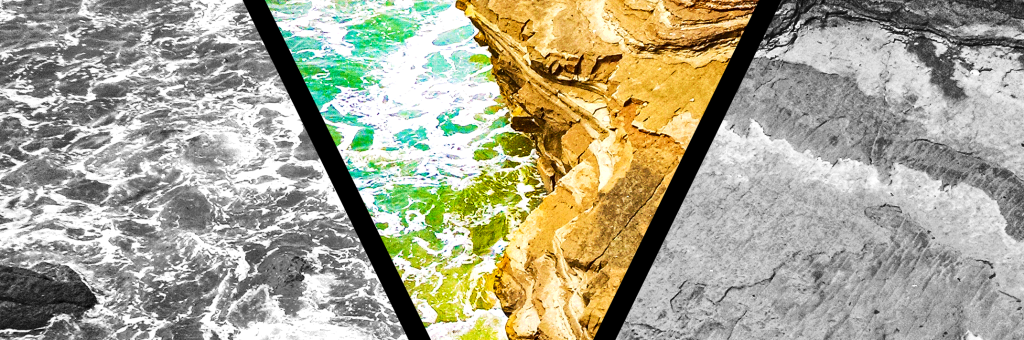
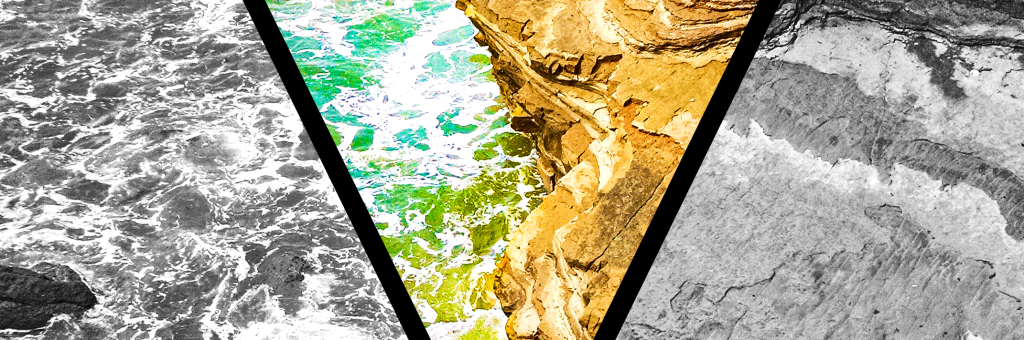
Looking down upon the dangerous place where water meets rock. The image is in black and white, with a V cut through the center. Inside the V, it springs to life and color. The rocks to the right are vibrant; to the left, the water is a swirling mix of toxic aqua blue, green, and yellow.

Wake up alone in a bed that isn’t yours with your eyeliner melted down your cheek and one false eyelash fluttering by your left ear.

Smooth the silky covers over your frizzled head. Realise you lost your sequinned dress and found some boxer shorts. Boil with embarrassment. Hope you dressed yourself.

Smell the coffee by the bed, know it’s exactly the way you take it, feel for the fizzy water and paracetamol that will be there, and drink them. Remember the time you put a fingernail through the crimson paper lampshade hanging from the ceiling.

Make it to your feet and aim for the wardrobe that’s new to you, searching for any item of your clothing. Open a drawer full of expensive lace. Under a red satin teddy, see a photo of a delicate-featured woman. Find one of your stockings from last night laddered from heel to toe. 

Know you’re supposed to drain the coffee, be grateful for the paracetamol, and evaporate into a taxi until your ex-boyfriend wants to ignore his engagement again, kiss you in an anonymous nightclub and dissolve your reclaimed self-respect.

Instead, this time, solidify your resolve. Leave your stocking in the pristine underwear drawer, grab your coat and shoes from the hallway.

Stomp down the road waving to all the neighbours you can spot, and wish, wish wish this time he won’t be able to wash you away.


Anita Goveas

Anita Goveas is British-Asian, London-based, and fueled by strong coffee and paneer jalfrezi. She was first published in the 2016 London Short Story Prize anthology, most recently by Fractured Lit. She’s on the editorial team at Flashback Fiction, an editor at Mythic Picnic’s Twitter zine, and tweets erratically @coffeeandpaneer. Her debut flash collection, Families and Other Natural Disasters, is available from Reflex Press, and links to her stories are at https://coffeeandpaneer.wordpress.com

Header photograph and artwork by Jordan Keller-Wilson

The Four of Us, Girls

Looking down upon the dangerous place where water meets rock. The image is in black and white, with a V cut through the center. Inside the V, it springs to life and color. The rocks to the right are vibrant; to the left, the water is a swirling mix of toxic aqua blue, green, and yellow.

I did most of the driving, from New Jersey to Niagara and on to Ontario; Nora in the passenger seat shuffling MapQuest printouts; Amy in the back, kicking her feet, Harrah to her right, rolling her window up and down. 

“Stop farting,” Harrah told Amy, who kept farting, probably because she wanted to, not because she had to, probably because she liked making Harrah wrinkle her nose. That’s how Amy was back then, how they both were. They were still getting used to one another. I was trying to keep the car straight on the shiny, wet roads. 

Nora kept forgetting to give directions, kept fiddling with the CD player instead. We listened to “Two Step” by Dave Matthews Band probably 36 times. It was playing as we crossed the border. And Canada must have hated it, hated us, I think, because the second my car rolled in, so did this cold front. Frost creeping up the windows, rain turning to sleet, and this wind, loud and strong. I thought, for sure, we’d go over a guard rail. 

But there was a pirate ship. I mean, there couldn’t have been, but, yeah, there was. This tourist attraction or something. Nora remembers it, too. A giant pirate ship: four thick masts and a candy-colored hull. Dark but pillowed sails. I figured, well, OK, fuck the wind and the sleet (and the black ice), because if the car flipped over, we’d probably just land, unscathed, on that ship’s bow. So, Nora turned down the music and Harrah rolled up the windows and Amy, well, she kept on kicking, and I sped up and we got through the windstorm. 

And then, yeah, we were in Toronto. And we did some stuff. Shivered on top of a space needle and thawed out (kind of) at an aquarium. Went to bars that served us beer, even though we were only 19. But Nora and I had miscalculated, because, sure, we wanted to drink on Spring Break (hence, Canada). We just hadn’t expected Toronto to be so damn cold. Hadn’t expected Amy would keep farting. Hadn’t expected Harrah wouldn’t un-wrinkle her now runny and red nose. 

“What did you invite her for?” Harrah kept whispering to Nora, even though she knew that’s how Nora was. (That’s how Nora still is.) Always giving out invitations she assumed people would turn down.

And that’s how the trip was. Icy, I mean, right until that last night when we were too hungover to do anything other than hang out in the chain restaurant next to our hotel. And there were these dudes there, these older men. They were around 30 or 40 or something. And these guys, they kept sending over shots and pointing at their whiskey glasses, like that would make us drink up, like drinking up meant we should talk to them.

Nora and I hid our faces behind some laminated dessert menus, so those creepers couldn’t see us smile, couldn’t see us laugh. Because it was funny, I guess. It was weird, too. It felt weirder later. Like, I don’t know, that pirate ship, so big, so bright, so blunt, a port in the storm. For a while, it was mostly funny, at least until, four whiskeys later, the oldest guy came over, put his hand on the small of Harrah’s back and said, “I sell bonds. Does that mean anything to you?”

And Amy stood up, made like she was going to throw her hands. “You see this fist?” She said to the guy. And Harrah, who liked decorum almost as much as a reason to break it, stood up, too, held out an elbow and threatened to ram its point into the fleshy part of that guy’s temple. Told him if she did, she’d feel so gratified.

And the guy started swearing and his friends were still leering, so Nora stopped laughing, started gathering our coats, and I paid the bill, because it felt like something was about to come due. And I was scared, until we tumbled outside—me grabbing Harrah, Nora grabbing Amy, Harrah and Amy linking arms—because it was cold, so cold that no one followed us, so cold that no one could be bothered to bother us, so cold that we could trick ourselves into feeling safe and warm.


Jeanine Skowronski

Jeanine Skowronski is a writer based in N.J. Her work has appeared or is forthcoming in Lost Balloon, Janus Literary, X-R-A-Y Lit, Tiny Molecules, Five on the Fifth, (mac)ro(mic), Complete Sentence, Crow & Cross Keys, Fewer Than 500 and more. She placed 2nd in Reflex Fiction’s 2021 Winter Flash Fiction competition.

Header photograph and artwork by Jordan Keller-Wilson

Death by Opossum

Looking down upon the dangerous place where water meets rock. The image is in black and white, with a V cut through the center. Inside the V, it springs to life and color. The rocks to the right are vibrant; to the left, the water is a swirling mix of toxic aqua blue, green, and yellow.

I schlepped all the way out to Houston to see the Oracle. Not Houston, Texas—Houston, Mississippi. In Chickasaw County. It’s not an easy journey: six hours by road from our farm if you’re lucky, then eight miles through the brush to the Oracle’s godforsaken shack, which reeks of incense and smoked pig. You get one question for her every three decades. I don’t make the rules, that’s just how her powers work. Eileen and I had recently quit our teaching jobs to start the farm we’d dreamt about for years. I was there to ask whether we’d be able to hack it, whether we’d made the best or worst decision of our lives. I needed to know even if knowing wouldn’t change a thing. So I worked up the courage to ask my question, voice breaking like a prepubescent teen. 

The Oracle went into that little trance she goes into, followed by the convulsions. At the end she stared at me, her eyes going pure white before settling back to brown. She composed herself, smoothing down her headscarf, and asked quietly if I wanted to know how I’ll die, her voice timid in comparison to her omniscience. 

I frowned. “That’s not what I came here for.”

“I understand,” she said. “But that’s what I saw.”

“Okay,” I said, figuring it’d be better to prepare for that long night rather than crash headlong into it. “Tell me.”

“You’ll be killed by roving opossums,” she said, betraying no emotion. Just stating facts.

The words didn’t quite make sense given the context. Opossums? Roving? I asked her to repeat herself, which she did. I’d heard it right.

“What does it mean to be roving?” I asked.

“From what I could tell, the opossums were transient. They didn’t have a home. Maybe that’s why they go after you,” she said. “They’re lost and scared.”

It seemed like such a random way to go. No meaning to it at all. “So, I just want to double check,” I said. “There’s nothing I can do to stop it from happening?” 

“No,” she said. “It’s fated.”

“Dang.” 

I went home to tell Eileen the bad news. 

She was horrified, worried about me, about living in fear of opossums around every corner. I suggested we plant some trees, give them a home.

“Why?” she asked. “It won’t do you any good.”

She wasn’t wrong. My death was preordained and the Oracle never flubbed a prediction.

“It just feels right,” I said. “I can’t explain it.”

Eileen sighed, perhaps more willing to deal with my whims given the revelation. “Okay,” she said, finally. “If it’ll make you feel better.”

Next morning, we brought home some oak seedlings from the farmer’s market. Oaks, I felt, were a particularly beautiful tree when fully grown. They had heavy graceful limbs that draped down shade, turning a hot day into a pleasant one. Any opossums in the area would surely appreciate these oaks—years from now. Maybe I’d even get to see them grown by the time the opossums came for me. 

In the weeks that followed, I learned more about my eventual executioners. I came to respect them. Opossums are wily creatures. When they’re down and out, they mimic the look and scent of a dead animal. They wouldn’t be hoodwinked if I tried to play dead. 

Over lunch one afternoon I asked Eileen, “Would it be macabre if we started a opossum sanctuary?”

“It would be ironic,” she said. “But I’m game.”

We made our farm as opossum-friendly as possible. Planted more oaks. Removed all the barbed wire fencing from our land. We kept an eye out for stray opossums, injured opossums caught in traps, baby opossums abandoned by their mothers, and took them back to our place. Once the opossums got here, we mostly let them be. But Eileen did have a favorite that she’d named Daisy, a rescue we’d found wandering alone down a highway a few hundred feet away from her mother’s flattened body. Eileen had sat up all night with Daisy—opossums being nocturnal—stroking her fur and feeding her blueberries until it was morning and they were both asleep. 

Years later, we sat out on the porch with cold glasses of water and a bowl of fresh-picked blueberries, looking out over the beautiful things we’d grown. Daisy had nestled into Eileen’s lap, having grown accustomed to daily head rubs. The weather was warm and lovely, a gentle breeze going by every so often, and the sun was just beginning to set below the trees, painting the sky an otherworldly pink and lavender. We could hear bugs chirping or humming or whatever it is they do. I put my arm around Eileen and brushed her cheek. It was wet. I think I knew why she was crying. I kissed away the tears as the opossums skittered in the trees, our lives rich with possibility, our fates assured.


Matt Goldberg

Matt Goldberg‘s fiction has appeared in SmokeLong Quarterly, The Normal School, Porter House Review, and Bending Genres, among others. His work has also been anthologized in Coolest American Stories 2022 and won first place for the 2021 Uncharted Magazine Sci-Fi and Fantasy Short Story Award. He earned his MFA from Temple University and lives with his partner in Philadelphia, PA. Find him on Twitter @mattmgoldberg.

Header photograph and artwork by Jordan Keller-Wilson

When I Wassssss Young

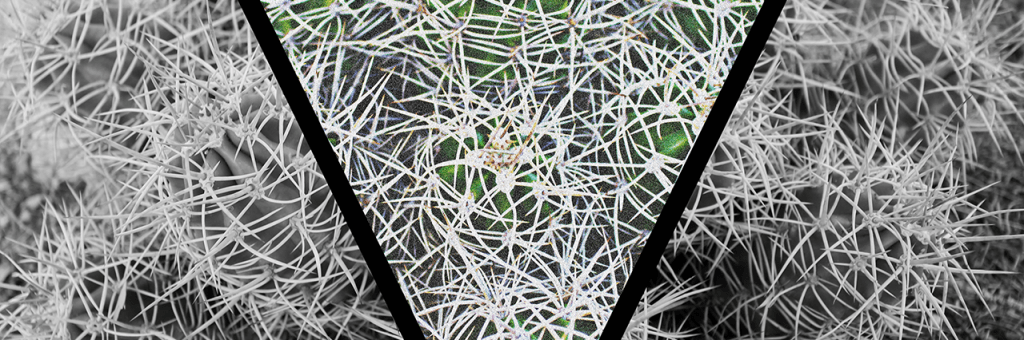
A cluster of barrel cacti dominated by their spiky spines. The image is split with a black V shape and the center of the V is in full color with the sides remaining in black and white.

(content warning: childhood trauma, strangulation, snakes)

When I was young, I loved minerals. My favorite corner of our local natural science museum was home to the gem vault and its glass cases full of sparkling stones. I was so small in the beginning that I had to stand on tiptoe just to catch a glimpse of them on my own. My second favorite place was the gift shop where miniature synthetic replicas were sold. Each time we visited, I was allowed to buy one, until soon I had my own collection at home in a tiny, clear plastic container. I liked the way their bright colors jumbled together. I liked the rattling sound they made when I gave the box a gentle shake.


When I was young, I had beautiful hair. At least, that’s what everyone on the playground always told me. My long locks were straight, shiny, silky, and blacker than a bottomless hole. All the popular girls, who would never acknowledge me otherwise, came up to ask whether I washed with kids’ shampoo or shared a bottle with my mother. As if those were the only two options. I told them the tangled truth, that neither theory was correct.


When I was young, my best friend tried to strangle me with her bare hands. She did so repeatedly, each time taking me to what felt like the brink of death. I didn’t understand then what I’d done to provoke her. I didn’t understand then that I was only a stand-in for monsters at home that she herself was too young to fight. Most of all, I didn’t understand then why I never even considered confronting her until her family had moved away and left me without the option. I never saw her again, though later, much later, I desperately wished I could.


When I was young, I was afraid of snakes. My father and I regularly took weekend walks down by the creek behind our house, during which we’d swap stories about our weekday lives. On one excursion, he pointed out the dark, cylindrical shapes near the water, like coil pots made of unbaked clay. “Snakes in hibernation,” he warned me. Five poisonous varieties roamed our region, so we had to stay vigilant: “Remember, by the time you hear that telltale rattle, it’s already too late.” I wasn’t afraid of their venom, though. I wasn’t afraid of their fangs. I was afraid of their entire bodies, the way they looked like they could wind themselves around my neck like a garrote, stealing both my breath and my voice in one swift movement.


When I was young, I started losing my beautiful hair. At first, I only found a few stray strands curled around my hair elastics, or little nests in the drain strainer of my bathtub. But by ninth grade, I had a bald spot the size of a half dollar on top of my head. I began parting my hair to the other side. Instead of spending weekends at birthday parties, I spent them at doctors’ offices. Everyone there told me I was perfectly healthy. They wondered aloud if maybe I was putting too much pressure on myself. “Relax, Medusa,” they said. “You are young. You have nothing to worry about.”


When I was young, we dissected earthworms in Biology class before moving on to larger, more anatomically complex animals. I tried not to think about their snake-like bodies as I ran the blade of my scalpel down their cold bellies. In that classroom, my hair continued to betray me. My lab experiments were often tainted by wayward strands. I became so notorious for this dubious feat that if the same problem befell anyone else, our teacher would call it “pulling a Medusa,” and she always watched with a crooked smile as my cheeks burned at the taunting remark.


When I was young, that same teacher informed us that she could tell whether a girl was a virgin just by looking at her fully clothed. She uttered this proclamation in front of the boys in our class, too. They spent the rest of the semester ogling us girls from each and every angle, their x-ray gazes hunting for the key that unlocked the puzzle box of our bodies. My hair only grew thinner after that. I began wrapping a scarf around my head to hide the patches of exposed scalp. No one ever called those thinning tresses beautiful anymore.


When I was young, I woke up one morning to the soothing sound of sibilant voices inviting me back from the depths of sleep. “It’sss almosssst noon, Medusssssa,” they hissed, in a Greek chorus of collective sighs. Earnest. Filled with expectations. I opened my eyes to find myself face-to-face-to-face-to-face-to-face with a seemingly endless parade of rattlesnake heads crowding my personal space. I thought I must be dreaming. I thought I was trapped in my worst nightmare. But I couldn’t wake up because I was already awake. I scrambled out from under the covers to escape the hotbed of slithering creatures that must have somehow invaded my pillow during the night. But when I did, they followed. Because, I quickly realized, they had sprouted from the back of my head the way my hair once had. I screamed.


When I was young, I thought this new development was a punishment. A punishment for my vanity. My fear. My ssexuality. Some cruel act of puberty. I avoided mirrorss, refussed to look at what was right in front of me. Until an amazing thing happened: I opened my lidss in the middle of Biology classss and found my teacher sstaring back. As ssoon as she made eye contact, she turned to ssstone. Gemssstone, to be exact. Not a ssstatue, but a perfectly sssmooth pebble of mottled green-and-black ssserpentine that rocked gently in the ssspot where she once ssstood. The whole classssss ssscreamed.


When I wassss older, I realized my new head of hair wassss actually a gift. Because of it, I was eventually able to overcome my fear of baldnessssssss, of ssssnakessss, of humanssss and their threatening pressssencessss. I managed to ssssusssstain fulfilling relationshipssss without face-to-face communication. But ssssometimessss I encountered people who reminded me of that teacher, thosssse boyssss, my childhood friend. When these unfortunate souls looked me in the eyessss, I wassss still richly rewarded. With ssssstunning cutsssss of authentic amber, opal, sssssapphire, aquamarine, onyx, garnet, emerald, amethyssssst, and cubic zirconia. Very sssssoon, I had to find a much bigger box for my ssssstonesssss. And the delicioussssss sssssssound they produced when agitated echoed like the ghosssssstssssss of my new friendssssss’ missssssssssssing tailssssss.


Susan L. Lin

Susan L. Lin is a Taiwanese American storyteller who hails from southeast Texas and holds an MFA in Writing from California College of the Arts. Her novella Goodbye to the Ocean won the 2022 Etchings Press novella prize and is now available to purchase at susanllin.wordpress.com, where you can also find more of her published work. In her spare time, she enjoys sewing summer dresses, dancing to ’90s hits, reading mystery thrillers, and streaming TV.

Header photograph and artwork by Jordan Keller-Wilson
Another Successful Social Interaction

A cluster of barrel cacti dominated by their spiky spines. The image is split with a black V shape and the center of the V is in full color with the sides remaining in black and white.

you enter the scene and nobody gives a shit. you don’t make a big show, but you do make a little one—clear your throat as you walk in, raise your eyebrows and your hands, try to say, “Hey, what’s up? I’m here!” but the first word barely comes out, and when it does your voice cracks so it’s mostly a whisper that sounds like, “heAYyywha…”

the door’s open to everybody, but you brought an invite anyway. you grab it from your pocket and pull the host aside to show them. they barely even look at it but they’re like, “Dude, where did you even get an invite anyway? Door’s open to everybody,” so then you say something fucking stupid like, “yeah, i know, i just thought it would be funny to make one because i’m fucking stupid,” and that’s a pretty big buzz kill even though you said it like it was a joke—because it was—but your sense of humor is all Big Sad and Big Weird and everyone else’s is Just Normal, so the host pats you on the shoulder and mutters something about mingling before leaving you standing alone in the middle of the room like a weirdo.

you shove the stupid paper back into your pocket and tap your foot to the ground a few times, checking its structural integrity, and decide that right here is probably as good a spot as any to pop a squat. sitting criss-cross applesauce on the bare wood floor hurts your ass, but it’s fine because life is basically always a little uncomfortable. 

some guy who’s into weird chicks spots you. you can tell he’s into weird chicks because he’s got several buttons pinned to his denim jacket and facial hair that looks the way a piece of velcro does when you accidentally drop it on the floor and then pick it up and go, “eww there’s hair on it,” and anyway, you just heard him say to the person next to him that he’s into weird chicks before immediately turning his attention on you.

he stands stupid close with his knees near your eyeballs, hands you a drink, then looks down at you and says, “We’re sitting indian style, huh?” so you take the drink and look back up at him and say, “no, we’re not,” because we are not doing anything and you are very clearly sitting criss-cross applesauce, so then the two of you just look at each other for too long. way too long. so long that you have time to wonder if he thinks you’re as a strange as everyone else does or if bitchy women get him off; then you’re imagining that he’s imagining falling in love with you, and you’re getting grossed out by the way you’re imagining him imagining your life, and your marriage, and your old wrinkled hand cupping his sagging balls 40 years from now, and now so much time has passed since you first started this staring contest that you think you should probably just get up and leave but your ass has fallen asleep, and anyway, you were here first, so you decide to commit to the power move and not move. the situation diffuses when he spots some other weird chick doing weird chick shit and goes to see if maybe she’ll let him smell her armpits. 

you pull the handmade invite from your pocket and try not to look at your name scrawled across the front like it even has any business being there in the first place. you fold it into a little origami canoe because that’s the only origami you ever learned how to make, then you flip it upside down and wear it like a hat. the host catches your eye from across the room, probably wondering why you’re sitting on the floor in the middle of the party wearing a paper hat, so you tip it gingerly in their direction before moving your eyes to literally anything else. sipping from your solo cup, you think: in another life, that boat could have been folded up itsy-bitsy-teeny-tiny into an even smaller version of itself and been placed right inside that cup; it could float on that liquid and ride your next sip into the cavern of your mouth, crashing against the great and gnarled rocks of your teeth before dropping down the waterfall of your esophagus and into the vat of toxic acid at the bottom to be digested and dissolved. but today, it’s a hat.


Sara Watkins

Sara Watkins (she/her) is an editor, author, UCTD-haver, and editor-in-chief of Spoonie Press (www.spooniepress.com), which is devoted to publishing work by chronically ill, disabled, and neurodivergent creators. She is the winner of the 2022 MASKS Literary Magazine Story Award. Recent publications include work in Wordgathering, Unlikely Stories Mark V, and Bitchin’ Kitsch. Contact: www.sarawatkins.net or @saranadebooks on Twitter and Instagram.

Header photograph and artwork by Jordan Keller-Wilson

Confessions

A cluster of barrel cacti dominated by their spiky spines. The image is split with a black V shape and the center of the V is in full color with the sides remaining in black and white.

I like confessing things that aren’t completely true. Like the other day, a friend of mine asked where I’d been the last few months. I said, “You’ll never believe it but…” He waited for me to finish, and what I meant to say was, “Mason and I aren’t together anymore,” which was true, but halfway through, I chose this instead: “…Mason met another guy.” 

My buddy groaned. “Shit, really?”

Yeah, really. Mason met another guy. 

But the truth was I’d met one first.

When I saw Mason, weeks after we broke up, he was arm in arm with a man I’d seen a few times—okay, a thousand—at the grocery store, the gym, the park with his little dog, everywhere. Our town was hardly more than a few hundred people and a pizza parlor, so it was hard not to see him if you tied your curtains back.

Honestly, it didn’t feel great when I saw them spending a day together, but I couldn’t let them know that. So we smiled and said, “How are you?” and of all the things to lie about, I thought, that’s the biggest of them all, smiling when a tiny piece of you is dying inside.

“Man,” my friend said, “weren’t you guys engaged?”

Kind of—Mason and I bought each other ring pops at a movie theater and drunkenly posted, “Engaged!!!!!!” with six exclamation points and it was easier to click “like” on every phony comment than to let the world in on our joke. 

“That’s what makes it so hard.”

My buddy sighed. “He tell you why or anything?”

I thought about what I’d told Mason. “He just said—sometimes you find someone else who fits you better.”

“Ugh.”

“It doesn’t mean they always will. It’s just about where you are right now.”

“Gross.”

“I know,” I said.

When I’d said these words to Mason, he cried. I’d never heard him cry before. We’d been together for two years, left Philly to find some place smaller, slower, where we could “lay down our roots” as if we couldn’t find a crack in the city streets to grow together. We drove an hour out and started looking, had our things packed into the back of his father’s pickup, found a one-road-town where the storefronts needed paint and unloaded our shit on the front step of a duplex that faced the main drag and called it “home.” 

For months, we shared our little two-bedroom half-house, unbothered by the things we hadn’t known till then—like how the sink miraculously clogged each time he shaved or the way he slurped his soup when it was just the two of us—among smaller things we pretended not to see, like the unmatched socks he left on his bureau for so long he must have known any hope of reuniting the pairs was gone, dead, finito, and I wondered how anyone got along—I mean, to the point they could actually live together—unless they closed one eye and covered one ear and pinched a goddamned nostril shut because the sad, lonely truth of it all was no one needs to be seen completely, and to this day I wonder what kind of tears I’d have gotten if I told him this instead.

“Well,” said my buddy, clearly having done enough consoling for one night, “you need anything, you let me know.”

“Of course,” I said. And alone on my couch, I thought of the man I’d left Mason for. The one I’d seen at the bar, when I drove the hour back to Philly. He was on his second Manhattan, so I asked, “A Manhattan in Philly?” not knowing if this was funny. It wasn’t.

“Hey—” I leaned in toward him. “You think I’d like the total you?”

“The what?” he asked.

“If we moved in together. And I had to step over your smelly clothes and listen to you laugh at inane comedies and watch you bite your nails when you’ve got nothing to even stress about—you think I’d like you then?”

The man shrugged coolly. “I don’t do any of that.”

“Tell me then. What do you do?”

He considered it a moment, squinting at the row of TVs. “Sometimes I drive with one knee.”

“You mean if the traffic’s slow?”

He shook his head. “On the highway.”

“That would literally fucking kill me.”

The man searched my eyes, so I shut one.

“What about you?”

I shrugged.

“Come on. Name one thing that would drive me nuts.”

I didn’t know where to begin. So I started in as good a place as any: “When I get to know somebody, I run.” 

“Is that it?”

“Or when someone gets to know me. I’m running from a man right now. He doesn’t even know it. But when I tell him, he’ll wonder who the hell I am. And for a moment, I’ll love him again. I’ll love him when he thinks about the signs he missed. I’ll love him when he wonders if we knew each other. I’ll love him when he passes our old house and—for the very first time—sees how the windows slope north, how the red brick fades by the roof.”


Matt Barrett

Matt Barrett holds an MFA in Fiction from UNC-Greensboro, and his stories and poems have appeared or are forthcoming in The Sun, Best Microfiction 2022, SmokeLong Quarterly, River Teeth, The Minnesota Review, Pithead Chapel, The Forge, Contrary, and Wigleaf, among others. He lives in Pennsylvania with his wife and their two sons and teaches creative writing at his undergraduate alma mater, Gettysburg College.


Header photography and artwork by Jordan Keller-Wilson