The Number of the Beast

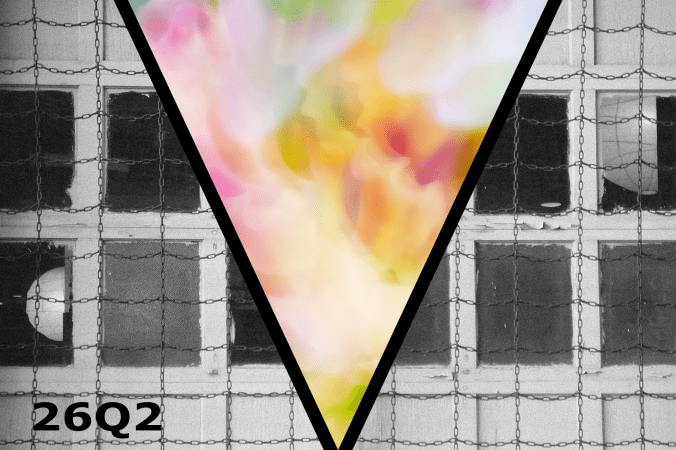
Two rows of weathered windows across a garage-like door with peeling white paint sit behind a loose chain curtain. The image is bisected by the signature Vast "V." Within the "V," a distraction from the distress: swirling colors--a mixture of bright and pastel pinks, yellows, and even a hint of green--reminiscent of flowers rendered in water-color.

I met this girl named Sally at an Iron Maiden concert and took her to a Waffle House off Peachtree after the show. Late night, early morning—we’d had so much beer it was all a bit hazy. Waffle House seemed like a cop out for a first date, but since it was the only place still open and I’d paid for Sally’s beers and tour T-shirt, I thought I’d earned the right to be a little sloppy. It wasn’t like I expected anything—she’d been pretty goddamn clear about going to the airport as soon as we got done eating—but I figured what the hell. We were both hungry, and I thought I might as well be a gentleman and pour plenty of syrup on her waffles because I’m a nice guy and, well, just in case.

I gotta be honest, things got shitty pretty quick. The Waffle House parking lot looked like a ghost town and gave me the creeps. Inside, the pasty griddle kid and two hags ragging the counter were doing their damnedest to put the grave into the graveyard shift. The place already smelled like cooking oil and cheap cigarettes and piss, so none of the workers batted an eye when we rolled in with the stench of stale beer, hot dogs, and second-hand pot smoke. I sat down with Sally on some bar stools at the counter and handed her a menu. Sally looked at the menu and handed it back. She said where she was from, they didn’t have Waffle House.

That’s odd, I said. Then I asked her, Where ya from?

Upstate New York, Sally said.

I said, Long way down to Atlanta. You must really like Maiden.

Sally said, Uh-huh.

So what’d ya do Upstate? I put my hands in my lap to keep from touching this place I’ve got on my neck below my Adam’s apple. It’s not too big, maybe the size of a raisin, but my doctor says I shouldn’t touch it. He says it’s not cancer but I should leave it alone. He says it’s called a sebaceous cyst.

Different gigs, Sally said. Art and stuff. Freelance mostly, but I get by. You?

I’m a teacher, I said. Full time.

Sally said, You don’t look like a teacher. She twirled her fingers in her hair, which had these cotton-candy-pink-and-blue highlights I really dug. What subject?

All subjects, I said, and sat up a little straighter. I’m a substitute. 

Huh, said Sally.

I didn’t care much for the opening band, I said. I tried to remember what they were called but had already forgotten. 

Sally shrugged. Meh.

I said, So you like waffles?

Sally said, Dunno. Never had one.

I said, Really? That’s crazy.

Sally said, I guess I’m just not a waffle kind of person.

I said, You’ll never know until you try.

When the grill kid, whose nametag said Doug, took our orders, I got each of us the All-Star Special: two fried eggs, cheese grits, sausage patties, raisin toast, and of course a fucking waffle. I ate all of mine plus Sally’s untouched waffle and grits. Sally picked at her sausage and took the rest to go. I paid the bill in cash. Come to find out, Doug the griddle kid wasn’t quite the deadbeat I’d assumed. He even gave us free coffee when I told him we’d just seen Maiden. He said he was originally from Augusta, had Rob Zombie’s face tattooed on his ass, and liked metal. He said the opening band was the shit. Sally said he was sweet and patted his hand. 

On the way to the airport in my Solara, I sipped my shitty coffee from the too-hot styrofoam and said, I thought you didn’t like the opening band.

Sally said, I changed my mind.

I said, Where’s my hand pat?

Sally said, I just met you.

I put on a mixtape with some real angry bangers by Megadeth and Exodus and Tool and didn’t say much after that.

Just after three AM, I pulled up to the South Terminal drop-off at Hartsfield-Jackson. I parked my car, flicked on the flashers, and touched Sally’s arm. Listen, I said. I don’t even have your number.

I’m not giving it, Sally said, pulling away.

I said, No sweat; here’s mine. I took a No. 2 pencil and yellow Post-It from the console, jotted down my number, and handed Sally the note. Sally handed it back. I said, Can we at least be Facebook friends?

Sally opened her door. I don’t want to miss my flight.

I said, Snapchat?

Sally said, Your palms are sweaty and that place on your neck is distracting, but I left you my sausage and toast. Then she got out of the car.

It took me a moment to realize what Sally meant, and by that time, she’d already gone. I watched her disappear into the crowd through the tall glass doors. On my stereo, which I’d never turned off, Dave Mustaine squealed and whined like a love-sick cat.

I exited the terminal and drove around until I found a Golden Pantry with all the lights off. There was a dead squirrel in the parking lot. Somewhere nearby, a dog barked. I dialed up the music and opened the doggy bag with Sally’s leftovers. The bag felt warm and moist between my legs and smelled good. I realized I was still hungry. I sat there in my car until the sun came up and ate all of it, thinking about music and teaching and my cyst. It was kinda peaceful, actually: head ringing from the music, ears swimming with the sound, watching the planes float up in pinpoints of bright red light.


Colin Bishoff

Colin Bishoff lives and writes in Hull (basically Athens), Georgia. He has an MFA in fiction writing from Georgia College and State University and is a PhD student in the creative writing program at the University of Georgia.

Header photography and artwork by Jordan Keller-Wilson
Lawn Maintenance and Care

Two rows of weathered windows across a garage-like door with peeling white paint sit behind a loose chain curtain. The image is bisected by the signature Vast "V." Within the "V," a distraction from the distress: swirling colors--a mixture of bright and pastel pinks, yellows, and even a hint of green--reminiscent of flowers rendered in water-color.

He tells her that one must water the lawn once or twice a week, deeply, but infrequently. Give it enough to quench the thirst, but not enough to drown it, to spoil it, just enough to keep it wanting. Those blades of grass will grow higher, forever reaching for more sustenance, more water, more, more, more.

When summer comes, she stands on the lawn, barefoot with blades of grass coming up between her toes, and as he holds the hose and aims the nozzle, as streams of water arc into the air, she lies down and becomes the grass. She feels the slopes of the earth under her, the open cavities where the worms travel beneath her, and she lets the water wash over her and into her and under her. 

He doesn’t notice, he’s too focused on the weeds. Tricky bastards, they come up slowly, one or two at first, and then you look away and back and the soft brown soil is littered with jagged leaves of green, working their way out. She’s got weeds for brains, she knows it, has always known it, she can feel them growing up through her head, and he is here on his knees, bending  over her, and then his hands are in there, fingers probing and pulling.

He does this over and over, waters and weeds, until fall when he moves on to the leaves. He rakes them with care, into a tidy pile, covering her completely. From underneath she can see the leaves, really see them, the veins of each one, and for a moment it’s all so beautiful, and she is everything, the leaves and the grass and the dirt, but then she sees the tiny holes where bugs have eaten through, and where the edges are yellow and curling inward, and he is yanking on the mower cord until it comes to life.


Lindsay McDonald

Lindsay McDonald (she/her) writes poetry, flash fiction, and short stories. She is also working on her first novel. Her work is forthcoming/has appeared in Agnes and True, Dishsoap Quarterly, HAD, and Flash Fiction Magazine. She lives in Barrie, Ontario, Canada and her instagram handle is @lindsaymcdonaldauthor

Header photography and artwork by Jordan Keller-Wilson
Love at the End of the World

Two rows of weathered windows across a garage-like door with peeling white paint sit behind a loose chain curtain. The image is bisected by the signature Vast "V." Within the "V," a distraction from the distress: swirling colors--a mixture of bright and pastel pinks, yellows, and even a hint of green--reminiscent of flowers rendered in water-color.

While the world was ending, James and Capriz were falling in love—guiltily, joyously, recklessly in love. With a love like theirs, young and sticky, it was hard not to see the fall of democracy with rose-tinted glasses.

“The great minds are leaving,” Capriz said to James. 

“A brain-drain means I’ll be eligible for tenure,” said James.

“You’ll be censored,” said Capriz.

“But I’ll have tenure,” said James. “We could live close to campus in an old brick home with historic tile.”

He knew she loved historic tile. This was a part of his new collection of fun facts about Capriz. He was flexing his love muscles, showing her he could put a finger on her quirks and melt her. It was working.

Potholes opened up in the road, untended. The schools were getting violent with scuffles here and there, plus, shootings. All the while, Capriz was memorizing the tiny details of her lover’s body, the small hairs on the back of his shoulder blades, the scar on his inner thigh, the rough red pads of his feet. Capriz’s life as a middle school English teacher wasn’t easy, but James texted her short love notes during the day. Memes of kittens and his favorite song lyrics.

Capriz promised her friends, who stayed up late, crying over this trial or that trial; this ruling or that ruling; she promised them, she was sad, too. But she wasn’t. Capriz and James talked till dawn then fell asleep folded into each other on the couch. Reruns of Friends ran on Netflix as they made lazy bacon-filled plans for breakfast.

James’s woven tapestries, rejected in art school as prosaic, culturally appropriative, banal …possibly problematic—were trending. He made long quilts of opposites: black and white; toddler sparkles and millennial gray; neon yarn and undyed organic fibers. It turned out, people wanted a soft, colored thing to hold, here at the end of the world. They hung his masterpieces on their builder-grade walls. They asked for his commentary on polarization. Everyone wanted his swing state opinion. Many of the art galleries were boarded up, as downtown became a sea of broken glass. Certain outlets weren’t publishing anymore. He tried to be bothered by the anti-elitism of it all, but the truth was his work was having a real moment.

James asked Capriz to meet his family over the holidays. The usual places were on fire, but they rented an Air B&B an hour outside the city. There, in a humble cabin by a lake, Capriz asked James about kids and money—big, terrifying future questions, but he took it all with a grin, depositing tiny, precious kisses on her wrists and forearms.

They were so, so, so in love, even as the occasional execution ruined their toast and eggs. The market’s ups and downs made them jittery, and James’s favorite book of poems—sad but tersely masculine—was cast into the Jesus-loving flames. And yet, they read to each other from old copies of banned books, danced in their kitchen to shake-off their nerves, and laughed about the paltry balances of their 401(k)s. They were looking at progressive churches to get married in. A refuge for their dissenting sort. The things they were getting used to! And still, they delighted in the surprise of each other.

The early fall weather dawned bright and glorious on the day of their wedding. An unseasonably warm October had flowers bursting into bloom well into the autumn. It was impossible not to giggle like idiots as they stood, side by side, in the church garden. The officiant proclaimed theirs a union of hope.

It wasn’t that it didn’t sting, when the political party they’d been loyal to for decades splintered and collapsed. It’s not that it wasn’t upsetting—seeing the radicals take the stage and hearing the water cannons, then the rifle fire, as police rounded on the protestors. Capriz might have been out there herself, protesting, but James convinced her not to risk it with a baby on the way.

Capriz found herself distracted with the baby. There were incentives for her to stay home, and she couldn’t teach anymore, anway—she pretended that it was enough to keep their home a little refuge with books, paints, and an old piano. Without the news, there was more time for quiet nights reading and walks in the neighborhood. After the first baby, the second was a foregone conclusion, and soon both Capriz and James were too tired for protests. They meant to keep up with the latest threats—who had been arrested, who disappeared, what dissenters like them were supposed to be boycotting—but their two little boys kept them sleep-deprived, and there was so much they needed to do at home. 

Capriz and the boys sent care packages to friends who had been deported. They helped clean up after swastikas were spray-painted on their neighbor’s garage. It was sad to see so many people move away. Every passing month it became harder and harder to keep in touch with those who were gone, especially since the children were growing so quickly. Some people vanished literally overnight, the doors of their homes left open.

James took a more conservative job, leaving the community art school for a tenure track position at the newly restructured public university. Being a father meant helping to keep a roof over their heads and compromises had to be made. James learned to keep his societal criticism vague and abstract. Capriz would put a hand on his shoulder whenever he spoke too loudly at university dinner parties. She loved his rebel streak, but a wife and a mother has to be practical about these things. Their home was too precious, too soft and delicate. Their sons, too young and sensitive to risk. 

James missed the loud-mouthed faculty and student activists, but his new campus was still beautiful, still full of blood-red brick shining in the sun. Students still learned. Textiles were still crafted, one careful strand at a time, woven cautiously but methodically in the art building. Here he made blankets for his own children, and sat about nesting with Capriz, building a little cotton cocoon for the end of the world.


Diana Fenves

Diana Fenves is a speculative writer and artist whose work has appeared in The Chestnut Review, Bloodletter Magazine, Wildscape Literary Journal, and Lilith Magazine. Her story “Baby Talk” was nominated for the 2026 Best Small Fictions anthology. She works a couple of jobs and lives in NC with her husband and two young children.

Header photography and artwork by Jordan Keller-Wilson

King Breaker

In the central V, a brightly-stylized photo of a young child in motion on a rope swing. Outside the V, a background of grayscale streamers hanging from the ceiling like the portal to another world.

Wake before the sun. Slip unnoticed past the hiss of your father’s snore. Past the mildew smell inside the closed-up caravan, the floor cold under your socks. Pull the curtain aside. Fog sticks to the windows like breath. Don’t think.

But you do. Just for a minute. No more. About your new friends and if this is what you want. Sneakers caked with dried mud. Hoodie thin at the elbows. Wheels thudding as you drop off the porch.

The road’s quiet. Gravel and split pavement. You push off, coast. The skateboard’s your ticket out of morning silence. Bearings whining. Wind slicing your eyes.

At the harborfront, the ships sleep heavy in their slips. Rusted cranes crane nothing. Gulls wheel overhead, stirred and angry. And there they are—the Kings.

Wren’s perched on the edge of a shipping container, laces undone, hoodie unzipped like he owns the air. “Took your time, Caravan.”

They all call you that. The boy from the trailers. The kid with the off-brand board and hand-me-down smirk. You try to look unbothered. 

They nod at you. You’re in. Mostly.

The Kings run the breakers—the rusted-out zone where sea meets metal and salt. They tag containers—rushed crowns, sloppy letters—and bomb the makeshift skate bowl behind the warehouses. Tell stories about cracking bones and breaking rules. You listen, sketch your own tags across a notebook’s pages. Laugh when they do. But sometimes the laughter sticks in your throat. Sometimes you wonder if they’d leave you broken, too.

This morning, it’s a schoolboy in the park. Backpack too big. Shoes too clean. Head down.

Wren steps into his path. “Hey. What’ve you got?”

The kid blinks. Doesn’t run. Doesn’t speak. Just waits like something worse is coming.

“C’mon,” says one of the others. “Be quick.”

The boy opens his bag with both hands like he’s afraid it’ll bite. Pulls out a sandwich wrapped in wax paper. A five-dollar bill. His fingers shake.

You watch. Your chest feels tight. Like it’s laced wrong. Like something inside you wants to get out. You see yourself—before the Kings—walking home with a too-big pack and no one to step in. You remember your father staring at the TV while the world pushed you around.

The bill flutters to the ground. Wren steps on it.

You don’t move. Not at first.

Then you speak. “Leave him.”

Wren laughs. “You serious?”

You nod. Your voice cracks, but not like breaking—like cutting. “I’m done.”

Silence. Salt wind. A gull screeching somewhere above.

“You quit?” Wren says, spitting the word like it tastes bad.

You swallow. The wind slices harder now. You nod, knowing what it costs—your place, your shield, maybe more.

You bend down, pick up the five, hand it to the boy. He takes it without a word. Just looks at you, like you’re a twist he didn’t expect.

The boy hurries away and you push off. Back toward the road. The board rattles under you, steadying. Behind you, no one follows.

Back at the caravan, you don’t bother going in to see Dad still asleep, the TV flickering on mute.

You head to the back of the trailer, where the aluminum skin’s dented and forgotten. You stand there a moment, shoulders loose, breath even. Then you reach into your backpack and take out a Sharpie.

You draw a crown, your hand steady. Lines sharp. You step back. The crown broken. Tilting.


Mathieu Parsy

Mathieu Parsy has work published or forthcoming in The Offing, JMWW, The Journal of Compressed Creative Arts, Flash Frog, and elsewhere. His stories have been nominated for Best Microfiction, Best Short Fiction, and the Pushcart Prize. Follow him on Instagram: @mathieu_parsy.

Header photography and artwork by Jordan Keller-Wilson
Swamp Pie

In the central V, a brightly-stylized photo of a young child in motion on a rope swing. Outside the V, a background of grayscale streamers hanging from the ceiling like the portal to another world.

Daddy always said our house was a lemon: all waxy and yellow out front but rotten in the back. We had mold on the porch, black widows under the stairs, and water moccasins in the yard where my brother and I played alligator, slithering through the overgrown weeds with both hands poised like jaws, ready to snap at any second. If our mother dared venture across the yard to pick wild berries, we would chomp down on her elbows until she fed us: warm fruit fresh off the vine, old ginger snaps turned to mush in the humidity. One time, the fridge broke down, and she fed us one improbable thing after another: a pickled herring and green bean casserole, mini pizzas made of ketchup and saltines, and something called “swamp pie,” where she whisked up the remaining milk and eggs into a custard, then poured it into a half-baked raspberry pie. We watched it bubble and set in the oven, our alligator hands eager to clamp down on the bloody-looking fruit. It tasted like that pint of ice cream we accidentally left out on the porch one night: all warm and goopy, so sweet we thought it would turn our teeth soft.

We were insatiable after that. Every new disaster was the perfect excuse for swamp pie. If a hard rain turned the backyard to soup, swamp pie. If a storm snapped the top off a pine tree and dropped it through my bedroom window, swamp pie. If Daddy got drunk one night and drove his pickup into the side of the house, doing himself no lasting damage but cracking the foundation in such a way that the basement flooded not all at once but slowly, over months, until we had to bail the mud out through the window, passing buckets down a line while mosquitoes swarmed around us, injecting their filthy saliva into our faces every chance they got, you bet we demanded swamp pie. We ate it at the tiny kitchen table, alternating between scooping up its innards and scratching our bug bites while mean-mugging Daddy through the window. He was talking to a contractor about prices. What we could afford and what we would just have to endure. We put our basement junk up on cinder blocks, made a game of chasing the silverfish and salamanders that wriggled in wet corners, their tails flashing in the slick.

Then the pipes burst. First flooding the bathroom with the cracked tile and the drain flies dotting the ceiling, their wings pasted in place by steam, then the kitchen, under the sink, while the pie shell was par-baking and my brother and I were crouched in front of the oven, alligator hands at the ready. We squealed when the water seeped out of the cupboard and in between our toes, the grimy nooks and crannies where we sometimes forgot to scrub. Daddy was still upstairs, banging around the bathroom, spitting swear words like sinkwater, so Mama tried to fix it herself, turning taps on and off, on and off, to locate the leak: that place where the pipe was rusted and swollen, the metal flaking off like pastry. My brother scrunched his nose up and said, P.U., P.U., while she wrapped the pipe up like a baby that just kept wetting itself. I splashed him with the floor puddle, kicking water toward him in gritty little waves polluted with bread crumbs and onion scraps, and he fought back, using his cupped hands to aim the water at my face. This would’ve escalated into all-out war if the faucet hadn’t exploded.

Water rained down around us like it did that one summer a neighbor tapped a hydrant and let all the children run through the spray until the sun sank down behind the sweetgum and fireflies popped up out of the bluegrass, their butts so bright we thought they looked like candies. Mama hollered for Daddy to get down here before the whole house flooded. My brother and I screamed with joy, slipping and sliding around the kitchen like it was our own private water park. We filled our bargain basket squirt guns with sinkwater, dammed the crack under the basement door with old beach towels, and held umbrellas over the counters so Mama could whisk up the custard and pour it in the pie pan. Once everything was in the oven, we started chanting, “Swamp pie! Swamp pie!” and waving the giant umbrellas around like shields, as if they could protect us.

When Daddy hollered at us to shut our goddamn traps already, my brother said we should build a fort with the umbrellas, layering the translucent panels over each other, until we were like two caterpillars in a cocoon, wondering what the world would look like once we emerged. Mama said something like, I told you not to yell at the kids anymore, and Daddy muttered, Maybe if you stopped coddling them I wouldn’t have to shout to be heard, then she snapped at him, Oh, we can all hear you just fine; everyone in town knows our business thanks to you, but I lost track of their argument because a glittery beetle with a back like an emerald crawled up my brother’s leg, seeking shelter from the flood. I wanted to trap it and put it in a jar, but my brother shielded it from me as if the beetle were a part of himself, one of the little tender bits we only let each other see when our parents were fighting, so I relented and told the beetle not to worry—we would shield it from the storm. When this was all over, we would go out and hide in the jewel grass, wait for the other beetles to rise up out of the muck and grace the world with their beauty.

Any minute now, I said. The pie was almost ready.


Ruth Joffre

Ruth Joffre is the author of the story collection Night Beast. Her work has been shortlisted for the Creative Capital Awards, longlisted for The Story Prize, and supported by residencies at the Virginia Center for the Creative Arts, Lighthouse Works, and The Arctic Circle. Her writing has appeared or is forthcoming in more than 100 publications, including Lightspeed, Pleiades, TriQuarterly, Reckoning, Wigleaf, and the anthologies Not Your Papi’s Utopia and Latin American Shared Stories.

Header photography and artwork by Jordan Keller-Wilson

When the Sky Tumbled Down

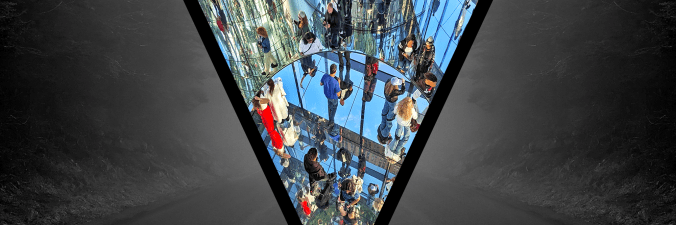
An empty road is crowded by grayscale fog and dark pines, bisected by the signature Vast "V." Within the "V" is a fractured reflection of people on their own or in small groups. They walk among reflected blue sky and shining surfaces, endlessly repeating and distorting their surroundings.

First came the birds, flapping in the same futile way I do when I swim—unable to make headway against the inexorable pull of a strange, incomprehensible physics. I ached to help them, but my manager screeched at me, gesturing toward a lineup of customers who couldn’t serve themselves. The birds couldn’t help themselves either, and unlike my classmate James they didn’t have jobs or rich parents, no money to draw people’s attention.

After the birds fell, the whoosh of fuselage through clouds heralded the plummeting airplanes. Unlike their feathered cousins, these loud metal birds roused people to action, even making a rubber-necking spectator out of my manager. The customers trailed into the road after him, and my shuffling feet now echoed through the store as if it were a museum on a sunny Tuesday afternoon. As much as I wanted to, I hesitated to follow my manager outside, for his favorite adage—one shared with my father—whispered in my ear: “Do as I say, not as I do.”

Next came the raindrops, holding hands in neat formation, dragged from their cloudy homes before they were ready. Their cries on the pavement stirred my heart, because I, too, never felt ready—certainly not ready for the sky’s antics today or I would have skipped this horrid shift and held hands with my family too. When customers returned to the store, seeking shelter, I went looking for my manager in hopes I’d glimpse a toppling rainbow slicing through him.

Instead, I was greeted by the cool touch of descending clouds, demoted from their lofty perch. I recalled how James had gushed on and on about flying amongst the clouds, in business class no less, and now maybe I would experience that too. James had a nice smile and arm muscles that reflected his summers spent on his uncle’s farm. But, even though he had promised to work this job with me, he spent his time chasing Jenny, whose gorgeous nails attracted magpies and boys alike. In this dreamlike world, fine droplets obscured all the nice smiles, strong arms, and expensive nails, and who’s to say it’s not better off this way?

The sky compressed around my feet and my head finally pierced through the clouds as the air rarefied, transforming Earth into a spaceship, the vastness of our galaxy hurtling past me. The forgotten five-year-old within me cheered, as my astronaut dreams escaped from under the heel of my father and careened into the unknown. The vanishing oxygen didn’t bother me, for we had all—me and James and even Jenny—become equally tiny under the stars.


Ian Li

Ian Li (he/him) is a Chinese-Canadian economist, developer, writer, and poet, who started writing in late 2023 after a lifetime of believing he could never be creative. He also enjoys spreadsheets, statistical curiosities, and brain teasers. Find his work published in Nightmare Magazine, Small Wonders, and Strange Horizons, among other venues.

Header photography and artwork by Jordan Keller-Wilson

I Love You, God, But This is the Last Time I’m Asking

A black and white, patterned stone dome seen from below is bisected by the signature Vast "V." Within the "V" is a wooden room terminating in a worn stone doorframe. Through the doorframe we see a cave mouth opening onto distant mountains at sunset.

The first time I ask God for a sign, He leaves a dead mouse on the sidewalk. 

I see it, curled up next to Mom’s wilting dahlias, on my way to the school bus. At first I think it’s a gray rock. Then, as I get closer, a miniature stuffed animal. But there are flies buzzing all around it. Its perfect, tiny paws are drawn up near its face. It doesn’t smell, at least.

Okay? I say, my hands steepled together, but God has His Do Not Disturb sign up.

I don’t know why God would leave me such a disgusting message. I don’t need rabies, or scurvy, or whatever it is dead mice can give you. And I don’t need a reminder that the flowers Mom and I spent hours planting last summer are already dying. I just need to know if Mom will be okay. And yes, I’ve heard all about His Mysterious Ways, I know He’s not supposed to hand out easy answers, but it’s not like my question affects nations, or important people, or the fate of the world. It’s just my mother. And isn’t God allowed to break the rules when He wants to? 

After school, while Dad slices an apple, I ask him if God has ever talked to him. Not just the in-your-heart bullshit, but actual words.

Dad says to watch my language. He explains that God doesn’t talk like that. Not His style. 

“Remember that story?” he says, referring to the one single time he, not Mom, made me wear a flowery dress and dragged me to Sunday school. “After the Ark landed on the mountain and all the people and animals came out onto solid ground, God put a rainbow in the sky. It was His way of promising that He would never destroy the world with a flood again.”

“Is that real?” I ask.

“Of course rainbows are real.”

“No, I mean the story.” 

Dad doesn’t answer, but he does give me cheese cubes with the apple.  

A few days later, God leaves me something else: a deer track in the mud. I wasn’t supposed to cut through the park, and now I wish I hadn’t. What am I supposed to do with a deer track? At least the mouse was a real thing. A deer track is just a hollow. An emptiness.

But then again, who am I to question God? I hold my breath, listening for the snap of a twig. Looking for a flash of tan fur. Maybe this is a good sign, after all. When Mom was healthy, she loved seeing deer wander through our yard, even though she complained that they bit the heads off our zinnias and brought ticks. 

But I don’t see a thing. Only trees and more trees. Dad says deer spook easily, but Mom always used to find them. Also snakes, painted turtles, and birds zooming overhead. She taught me the difference between cranes and herons and geese and swans. 

“Cranes migrate south for winter,” Mom told me, when I was eight and she was someone who told me things, “but they always come back. They nest in the same spot every time.” 

I squint at the deer track and try to figure out what it looks like—a coffee bean, or two tadpoles, or a heart split down the middle.  

Does this mean Mom will wake up early tomorrow and make coffee and be waiting at the kitchen table when I come downstairs, smiling like sunshine, her tortoiseshell glasses on, hair piled up in a fluffy bun like a puffball mushroom? Does it mean her heart is broken forever?

God, I plead, be more specific, please.

And maybe He’s finally listening. Because at dinnertime, Mom comes downstairs and makes soup. She walks to the corner store to buy fresh bread, and the three of us share tomato bisque and bread and softened butter. Mom cuts another slice of bread, lays it on my plate, and I think of the story of the fishes and the loaves. When she brushes her hand against the back of my neck, a shiver crisscrosses my whole body. 

“You need a trim,” she says softly. “Should we do a haircut tomorrow?”

I don’t say anything—I don’t want to spook her. I don’t want her to pull her hand away.

“See?” Dad says, wiping a spatter of red from his chin. “Look at you, up and at ‘em.”

Mom smiles in a way that makes me think of dead prairie grass.

That night, I hear her crying—not loud, not angry. She sounds like a kitten trapped under a basket. Dad’s voice rumbles through the floorboards, but I can’t hear what he’s saying. I press both fists to my eyelids and try to picture her smiling—the way her eyes used to sparkle—but all I can see is that stupid deer track. I hope the deer is smart enough to stay off the road. 

The next morning, Mom stays in bed, the floral comforter drawn over her like a garden. She tells me she won’t be able to cut my hair today. She tells me she’s sorry.

I crawl into bed with her. She pulls me close and lets me stay there, even though I’ll be late to school, even though she probably just wants to sleep. Something taps against the window—a long, pointed beak, or a twig, or an arrow. Maybe this is the sign I’ve been waiting for. Maybe there’s a rainbow stretching across the sky, a promise that He will never again destroy my mother in this particular way, and I only need to look up to believe it. 

I close my eyes and burrow under the blankets. I can feel my mother breathing next to me, our bodies rising and falling like the flood. 


Lindy Biller

Lindy Biller is a writer based in Wisconsin. Her work has appeared in Best Small Fictions, Best Microfiction, and the Wigleaf Top 50. Her chapbook, Love at the End of the World, was published by The Masters Review in 2023.

Header photography and artwork by Jordan Keller-Wilson

The Visible Death of Stars

Inside the v-shaped foreground, a blooming pink flower overlays a bright campfire. In the background grayscale water meets a clouded sky.

Analena stepped around the tangle of vines and leaves. For nearly thirty years, she’d tended this garden’s dark and fertile soil. She bent and selected a summer squash, yellow and plump, lying heavy on the earth. Its skin felt hard, ripe. She used her knife with a practiced hand to cut the fruit loose from its vine. Maybe Javi would eat this. She’d cook its flesh soft, mash it with a fork.

She pulled carrots from the garden then reached for the peas. Later, she would add these into the skillet before stirring in arroz. In the past, she would have included pork. Her husband liked meat, but chewing was difficult now. There would be enough for the hospice worker to take a plate home. He had caring eyes, and Analena appreciated the help he’d given in securing the new medical equipment for Javi.

Analena stepped toward the tomato plants and caught sight of the strange light glimmering in the indigo sky. A second sun, Betelgeuse. The dying star had appeared a few months ago, on an icy morning in May; every day since then, it rose above the horizon to lead the sun across the sky. Its cold light was as bright as the moon’s, though it lacked the lunar softness. It shone with focus and violence, an unshakeable, judgmental gaze.

Analena pulled two ripe tomatoes from their vine and placed them into the metal bowl she used to collect vegetables. A buzzing rose from the zucchini leaves, a patch of green along the wooden fence that separated her yard from the next. Analena cocked her head and listened. Kneeling on the earth, she pushed aside clutches of leaves to find a tomato had fallen and rolled there. The torn and gnawed flesh lay open and exposed. Ants probed the tear and picked away the paler parts along the circumference. The buzzing grew louder, lifting from the sick decay.

Analena peered into the tomato’s cavity at a wasp half hidden and dying there. With the dull edge of her knife, she nudged the insect, and its wings flared into an angry blur, unable to fly. Bent at its tender thorax, it slipped farther into the fleshy cavern. Analena thought about ending its suffering with a quick flick of her blade, but when its wings beat again, she didn’t have the heart to kill it.

“Hi, Ana.” A voice at the fence startled her, and she steadied herself with one hand in the dirt.

Colleen, her neighbor, peered above the wooden slats; she gave a small laugh. “Sorry, I didn’t mean to scare you.”

Analena grabbed the fence rail and used it to stand up. Embarrassed, she glanced at Colleen. “It’s all right. I’m just collecting vegetables for Javi’s lunch.”

Colleen disappeared for a moment, and Analena heard her place a step stool against the fence. Colleen stepped up and gazed down into Analena’s garden, scanning the rows of radishes and carrots, the vines heavy with tomatoes and runner beans.

“Your garden is coming along.”

Analena’s eyes moved over the plants. “Javi still loves the smell of fresh food cooking.”

Colleen nodded. “It’s hard to get used to, isn’t it?”

Analena glanced toward the bedroom window where her husband slept. Inside, Javi’s rattling breaths pushed back against the morning light. It was hard, watching the man she loved for forty years fade into the darkness of that room. Analena had stepped into the yard eager to work with her hands, thirsty for daylight.

“The supernova, I mean.” Colleen tilted her head toward the star. “Sometimes it feels like we’re not even on Earth anymore. Like we’re on some alien planet.”

Analena nodded. The star’s relentlessness frightened her. “I wish it wasn’t there.”

“You don’t have to be worried about it, Ana. It’s too far away to hurt us.”

“I know.” She spoke softly. Her face flushed, and she turned to look back at her tomato plants. She shouldn’t have shared her worries. Colleen had a habit of talking down to her like she was too old to make sense of the world around her. Analena watched the same news as everyone else. The scientists explained how incredibly lucky they all were to be alive during such an event. No one had seen a supernova with the naked eye since 1604; in truth, it was the vastness of those centuries spilling toward them that scared Analena more than the thought of any star exploding.

A stifling silence lay thick between the two women. Analena shifted her weight and lightly brushed an ant from her arm. Behind her, the buzz of the dying wasp rose from the leaves.

“How is Javi doing?” asked Colleen, breaking the silence.

“He’s in bed now. I called hospice last Monday.”

“I’m sorry to hear that, Ana. Javi’s a good man. I feel bad that Jerry and I haven’t been able to visit more. We had to move my mother into assisted living, and Jerry’s been picking up extra hours at work.” She gave a light laugh. “Life’s a bit hectic in our house these days.”

“It’s all right, Colleen. Thank you for thinking of us.”

“Have you thought about what you’re going to do with the house? It’s a lot of room for just one person.”

Analena felt her breath catch in the warming air. She looked up at Betelgeuse, burning in protest of its own death. They said it was over ten million years old.

“I’m sure you could sell this place easily if that’s what you wanted. My cousin’s a realtor. I can call her when you’re ready.”

Anger flared within Analena, rising from her throat as the words burst out. She glowered up at her neighbor. “Javi’s still alive, Colleen.”

She stepped back from the garden. Her mind screamed to look away, to turn and run into the house. Instead, she fixed Colleen with an unshakable gaze. She would not crawl away and hide from this.

“Of course,” said Colleen, “but…”

“No. Javi is lying in there trying to breathe. I won’t bury him while he’s still fighting for life.”

“I’m sorry, Ana. I didn’t mean…” Colleen’s face flushed and her jaw clenched.

Analena would not look away, not this time. 

Colleen glanced back toward her own house. “We’re thawing elk meat from Jerry’s hunt last fall. I know Javi likes venison. We’d like to bring some of the meat over early next week and visit him.”

Next week would be too late. She wanted to grab this woman and force her to gaze into the darkness of that bedroom, wanted her to see the sick shadows cast by that dying light in the sky. Instead, she only nodded, letting Colleen turn and slip back behind the fence.

In the tree branches above Analena, a blackbird flitted and rustled the leaves. Morning shadows were giving way to harsher sunlight. Analena stood at the edge of her garden and felt the summer creaking past her. She gazed up at Betelgeuse. Yes, she thought. Next week would be too late.

This star had existed for an eternity, watching the first sailors cross vast oceans, witnessing ancient rituals offered to long-forgotten gods. Betelgeuse had a right to burn with anger, to light up the heavens, and die with conspicuous outrage.

Living things are different, she thought. They crawl into caves and hide under leaves to die. Going to ground, her father used to say. They curl themselves around their hearts, knees to chests, as if ashamed by the brevity of their existence. Here then gone. 

The wasp buzzed from the leaves behind her, a final effort to lift itself from the rotting fruit.

Javi would wake soon. She should go inside to sit beside him. But she wasn’t ready to let go of this moment. Not yet. The sun’s warmth caressed her skin, and her shadow glazed the leaves on the ground beneath her. Analena exhaled a long breath and lifted her face toward the sun, as if she might hold onto its light.


Sam W. Pisciotta

Sam W. Pisciotta is a writer and visual artist. He earned an M.A. in Literary Studies from the University of Colorado at Denver, and he’s a graduate of the Odyssey writing workshop. Find his fiction in publications such as Flash Fiction Online (forthcoming), Nightmare Magazine, and Asimov’s. Connect at www.silo34.com and @silo34 on Instagram, and @swpisciotta on Bluesky Social.

Header photograph and artwork by Jordan Keller-Wilson
The Day I T-Boned Troy’s Truck

A hand holds a cone of orange ice cream shaped like a flower in front of a distant background of exploding fireworks.

In the time it took for Troy to realize I was truly pissed and finally leaving him, I’d already rammed my car into the side of his brand-new, jacked-up, man-confirming, white-knuckle Dodge Ram. 

In the second it took to dent the passenger-side door hiding the purple-lace thong I’d found wadded into the seat crack where I thought I’d find my lip gloss, Troy screamed like I was actually cutting off his balls. His hands clawed at his face, which was as red as a boiled lobster, and I never craved tender flesh so bad in my life. 

In the moments it took for me to back up and crash into that truck again, gravel rocketing like bullets off the wheels of my car, Troy had sworn at me using all those names women are called when they have a mind to do what they want. But those names were nothing I hadn’t heard before. None I hadn’t heard him call me before. But I didn’t stop. I kept battering that door, waiting for him to jump off the porch and throw himself between me and his truck, desperate to save what was left of everything I’d ever done for him—loaning him thousands for some crazy get-rich-quick bullshit scheme after I worked overtime cleaning rooms at the roach motel out on the highway, all while saving up so I could go to school to be an x-ray tech; covering for him when the cops wanted his whereabouts the night enough Oxys were stolen from the local pharmacy to drown everyone in that godforsaken town; cutting off Daddy when he asked me to come back home, telling him I needed to make my own choices, even though I knew I was making all the wrong ones, and Daddy knew it too. 

In the minute it took for me to do enough damage to that truck to get Troy’s grease monkey buddies riled up when they saw, I imagined all those dented edges fighting them, white flakes peeling off in ribbons like Troy’s sun-burnt skin when he went blast fishing with those assholes, those self-professed good ol’ boys who drank beer in our living room and ordered me to get them another cold one during commercials starring better looking versions of themselves. They’d have to work real hard to hammer and suck my rage out of the body of that truck. But they’d try. And they’d probably imagine me as they did it, blaming me for their failure, calling me all those names again, names that made me want to trash everything Troy ever owned or cared about. When I drove away, I saw him in my rear-view mirror kneeling beside twisted metal like he was praying at an altar for some kind of miracle, bargaining to take it all back. Like somehow, he’d become a better man.

In the hour it took for me to get my shit together in the Dairy Queen parking lot, I’d jerry-rigged my bumper back on and sat on the trunk of my cherry-red Chevy Cavalier dreaming of going home, of starting over and living up to that potential everyone told me I had, and I realized I’d had in me all along, regardless of what Troy and every other boyfriend tried to convince me of. I guzzled that peanut-butter milkshake like I was dying of thirst. Because I was. For salt, for sugar, for piercing cold. For that brain-freezing focus. For that thick creamy fat on my tongue. It all melted into such warmth, such sweetness, that I couldn’t help feeling a tiny bit like me again.


Melanie Maggard

Melanie Maggard is a flash and poetic prose writer who loves dribbles and drabbles. She has published in Cotton Xenomorph, The Dribble Drabble Review, X-R-A-Y Magazine, Five Minute Lit, and others. She can be found online at www.melaniemaggard.com and @WriterMMaggard.

Header photograph and artwork by Jordan Keller-Wilson

I Teach Pompeii

A hand holds a cone of orange ice cream shaped like a flower in front of a distant background of exploding fireworks.

The kids want to know what it feels like to be killed by lava. 

I tell them many would have retreated to the countryside, or run to the sea, thinking it wouldn’t reach them there. I tell them most would have suffocated before the lava reached them. 

I point at an image on the screen, What’s this?

A statue!

I affect a grimace, Not a statue.

They cock their heads, thinking. Murmurs travel through the classroom; I tune into one, Dead body.

I nod, This is a person frozen by lava. I don’t have better words. Mummified by lava? Fossilized?

One boy gets back from the toilet and looks over his shoulder at the white board, God, what’s that! I tell him to tuck his shirt in and take a seat.

They ask if any animals died too, so I close out of the slideshow and Google the Pompeii dog. I tell them to cover their eyes if they don’t want to see something too sad. 

They erupt, they ask, Why does it look like that!

It’s contorted into a ring shape, limbs flailing and mouth open just enough.

Because it was in pain.

They squirm. They don’t want to look at the dog anymore. I return to the original slideshow, where we see the face of the “statue” turned to the black sky and its knees gathered to its chest, a final protective gesture.


Madeline Crawford

Madeline Crawford lives, teaches Latin, and writes in London. Her poetry and fiction have appeared in or are forthcoming from Paloma Magazine, The Mantelpiece, Vast Chasm, and Die Quieter Please, among others. She has worked as a reader and editorial assistant for A Public Space. She went to Hunter College and received her MA in Classics from University College London. 

Header photograph and artwork by Jordan Keller-Wilson