Beyond the Cocoon
There’s a lot of world out there. Explore this issue and start seeing beyond your cocoon, then test your memory with these interactive pieces

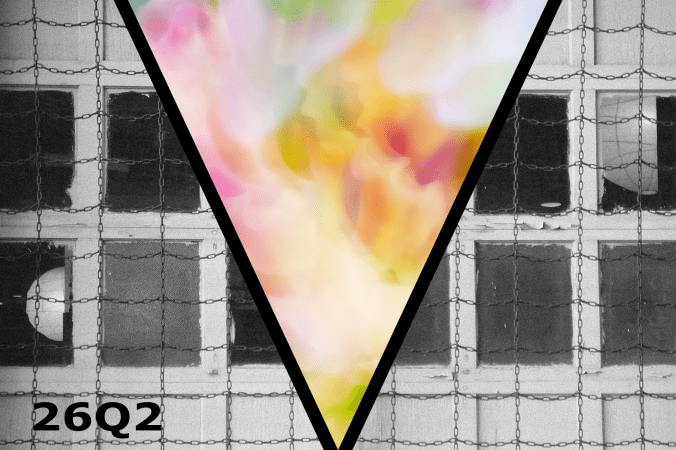
Header photograph and artwork Jordan Keller-Wilson
Beyond the Cocoon
There’s a lot of world out there. Explore this issue and start seeing beyond your cocoon, then test your memory with these interactive pieces
Header photograph and artwork Jordan Keller-Wilson
In 2003, salvation has blonde extensions
and a chihuahua named Tinkerbell.
I watch her descend from the Escalade
in low-rise jeans that part the Red Sea
of paparazzi.
that’s hot
rain glitter
reign, glitter
prophecy in a Juicy tracksuit,
rosary of rhinestones
Bless my cheap gloss,
my beaded clips, my Sony Cybershot—
every pop girl who burned herself
beautiful for the lens.
We kept the light spinning.
We were the mirrorball saints—
worshipped, ridiculed, necessary.

Shae is a queer, autistic goblin interested in the intersection of disability justice and design, collecting tiny trinkets and having an unwavering devotion to Shrek as both art and ideology.
Header photography and artwork by Jordan Keller-Wilson
I met this girl named Sally at an Iron Maiden concert and took her to a Waffle House off Peachtree after the show. Late night, early morning—we’d had so much beer it was all a bit hazy. Waffle House seemed like a cop out for a first date, but since it was the only place still open and I’d paid for Sally’s beers and tour T-shirt, I thought I’d earned the right to be a little sloppy. It wasn’t like I expected anything—she’d been pretty goddamn clear about going to the airport as soon as we got done eating—but I figured what the hell. We were both hungry, and I thought I might as well be a gentleman and pour plenty of syrup on her waffles because I’m a nice guy and, well, just in case.
I gotta be honest, things got shitty pretty quick. The Waffle House parking lot looked like a ghost town and gave me the creeps. Inside, the pasty griddle kid and two hags ragging the counter were doing their damnedest to put the grave into the graveyard shift. The place already smelled like cooking oil and cheap cigarettes and piss, so none of the workers batted an eye when we rolled in with the stench of stale beer, hot dogs, and second-hand pot smoke. I sat down with Sally on some bar stools at the counter and handed her a menu. Sally looked at the menu and handed it back. She said where she was from, they didn’t have Waffle House.
That’s odd, I said. Then I asked her, Where ya from?
Upstate New York, Sally said.
I said, Long way down to Atlanta. You must really like Maiden.
Sally said, Uh-huh.
So what’d ya do Upstate? I put my hands in my lap to keep from touching this place I’ve got on my neck below my Adam’s apple. It’s not too big, maybe the size of a raisin, but my doctor says I shouldn’t touch it. He says it’s not cancer but I should leave it alone. He says it’s called a sebaceous cyst.
Different gigs, Sally said. Art and stuff. Freelance mostly, but I get by. You?
I’m a teacher, I said. Full time.
Sally said, You don’t look like a teacher. She twirled her fingers in her hair, which had these cotton-candy-pink-and-blue highlights I really dug. What subject?
All subjects, I said, and sat up a little straighter. I’m a substitute.
Huh, said Sally.
I didn’t care much for the opening band, I said. I tried to remember what they were called but had already forgotten.
Sally shrugged. Meh.
I said, So you like waffles?
Sally said, Dunno. Never had one.
I said, Really? That’s crazy.
Sally said, I guess I’m just not a waffle kind of person.
I said, You’ll never know until you try.
When the grill kid, whose nametag said Doug, took our orders, I got each of us the All-Star Special: two fried eggs, cheese grits, sausage patties, raisin toast, and of course a fucking waffle. I ate all of mine plus Sally’s untouched waffle and grits. Sally picked at her sausage and took the rest to go. I paid the bill in cash. Come to find out, Doug the griddle kid wasn’t quite the deadbeat I’d assumed. He even gave us free coffee when I told him we’d just seen Maiden. He said he was originally from Augusta, had Rob Zombie’s face tattooed on his ass, and liked metal. He said the opening band was the shit. Sally said he was sweet and patted his hand.
On the way to the airport in my Solara, I sipped my shitty coffee from the too-hot styrofoam and said, I thought you didn’t like the opening band.
Sally said, I changed my mind.
I said, Where’s my hand pat?
Sally said, I just met you.
I put on a mixtape with some real angry bangers by Megadeth and Exodus and Tool and didn’t say much after that.
Just after three AM, I pulled up to the South Terminal drop-off at Hartsfield-Jackson. I parked my car, flicked on the flashers, and touched Sally’s arm. Listen, I said. I don’t even have your number.
I’m not giving it, Sally said, pulling away.
I said, No sweat; here’s mine. I took a No. 2 pencil and yellow Post-It from the console, jotted down my number, and handed Sally the note. Sally handed it back. I said, Can we at least be Facebook friends?
Sally opened her door. I don’t want to miss my flight.
I said, Snapchat?
Sally said, Your palms are sweaty and that place on your neck is distracting, but I left you my sausage and toast. Then she got out of the car.
It took me a moment to realize what Sally meant, and by that time, she’d already gone. I watched her disappear into the crowd through the tall glass doors. On my stereo, which I’d never turned off, Dave Mustaine squealed and whined like a love-sick cat.
I exited the terminal and drove around until I found a Golden Pantry with all the lights off. There was a dead squirrel in the parking lot. Somewhere nearby, a dog barked. I dialed up the music and opened the doggy bag with Sally’s leftovers. The bag felt warm and moist between my legs and smelled good. I realized I was still hungry. I sat there in my car until the sun came up and ate all of it, thinking about music and teaching and my cyst. It was kinda peaceful, actually: head ringing from the music, ears swimming with the sound, watching the planes float up in pinpoints of bright red light.
Colin Bishoff lives and writes in Hull (basically Athens), Georgia. He has an MFA in fiction writing from Georgia College and State University and is a PhD student in the creative writing program at the University of Georgia.
Header photography and artwork by Jordan Keller-Wilson
He tells her that one must water the lawn once or twice a week, deeply, but infrequently. Give it enough to quench the thirst, but not enough to drown it, to spoil it, just enough to keep it wanting. Those blades of grass will grow higher, forever reaching for more sustenance, more water, more, more, more.
When summer comes, she stands on the lawn, barefoot with blades of grass coming up between her toes, and as he holds the hose and aims the nozzle, as streams of water arc into the air, she lies down and becomes the grass. She feels the slopes of the earth under her, the open cavities where the worms travel beneath her, and she lets the water wash over her and into her and under her.
He doesn’t notice, he’s too focused on the weeds. Tricky bastards, they come up slowly, one or two at first, and then you look away and back and the soft brown soil is littered with jagged leaves of green, working their way out. She’s got weeds for brains, she knows it, has always known it, she can feel them growing up through her head, and he is here on his knees, bending over her, and then his hands are in there, fingers probing and pulling.
He does this over and over, waters and weeds, until fall when he moves on to the leaves. He rakes them with care, into a tidy pile, covering her completely. From underneath she can see the leaves, really see them, the veins of each one, and for a moment it’s all so beautiful, and she is everything, the leaves and the grass and the dirt, but then she sees the tiny holes where bugs have eaten through, and where the edges are yellow and curling inward, and he is yanking on the mower cord until it comes to life.
Lindsay McDonald (she/her) writes poetry, flash fiction, and short stories. She is also working on her first novel. Her work is forthcoming/has appeared in Agnes and True, Dishsoap Quarterly, HAD, and Flash Fiction Magazine. She lives in Barrie, Ontario, Canada and her instagram handle is @lindsaymcdonaldauthor
Header photography and artwork by Jordan Keller-Wilson
when you are fat in middle school, your doctors tell you to join a sport. when you get cut from softball for never having played softball—every soft lob whipping past your swinging bat and racing heart, every careless toss slipping through your borrowed glove—your teachers tell you to run cross country. when you get bullied out of cross country, your parents tell you to walk. so you walk. you tell yourself you’re cute, that deep down, the cuteness of you that no one sees is worth everything, and you tape a black satin bow to a black plastic headband and wear it to remind yourself.
you don’t have a phone, but you’re just in your neighborhood, the same old neighborhood where the same old people live. the adults tell you to be positive, so you walk, crunching sun-baked leaves, slipping fingers through the scaly fronds of cypresses lining the yard of a girl who used to be your friend. cold shadows spear onto the crumbling asphalt like teeth, and the din of your thoughts obscures the crackling of tires.
a boxy brown car rolls to a stop beside you. you pause, curious. you are a girl scout, trained to listen and help. the window sinks down into the door. cigarette smoke wafts out.
he’s college age, brown hair, varsity jacket, tired eyes. he doesn’t say hi or i’m looking for… or can you give me directions to... he asks, do you want a ride?
the upholstery is red leather, cracked but clean, no crushed soda cans or crumpled fast food wrappers. just a blanket folded in the backseat. you take far too long to think, to wonder how you look to him, to scramble for a reason not to get in the car—the car of the only person who has ever, maybe, probably-not-even hit on you. yes, you want to get traumatized on red leather; yes, you want the touch of the hand that adjusts his side mirror too nonchalantly and the vein standing out on the back of that hand and the blood inside that vein; yes, you regret it immediately when you shake your head.
where do you live? he asks. you point beyond the cypresses at your once-friend’s house. she is thin and cute and never home. she has a boyfriend.
leaning an elbow out the car’s window, he frowns, disappointed, even pitiful. or perhaps that’s your reflection in the flake of the car’s paint, and he’s just reading your lie back to you, waiting for you to realize: this will be your only chance. a stranger in an old car at dusk. a scratchy blanket and nicotine-stained fingers and whatever violence he wants to enact on you, whatever cruelty, whatever pretend love. this is your chance, while you still hold the barest possibility that you are or ever were cute. no one actually thinks you’ll get any prettier; they make you try because they can’t stand to look at you.
so you don’t want a ride? he confirms, and you try to convince yourself his impatience is tenderness.
no, you say, and rush up your once-friend’s driveway, your black satin bow slipping. you stumble into a crouch in the drainage rocks behind her house, and it falls. you grab it and hold it to your heaving chest. it was supposed to make you cute; it worked in the worst way possible.
he sits there for a moment, tapping his steering wheel. he knows you’re lying. you know you’re missing your chance. if he gets out of the car and grabs you, drags you by your frizzy hair, you both know you’ll surrender.
the car squeaks as he pulls away. tears press against your eyelids. perhaps they’ll say you’re making progress, that your miniscule reluctance to be kidnapped is indicative of self-esteem, or bravery, or whatever other basic virtue they like to pretend pumps through the chambers of your preposterous heart. in reality, the only argument you can find against running back into the road, bow in hand, is this: whatever he wanted to do to you, you didn’t even deserve that.
EA Kane is a multidisciplinary artist living in New England. Their work has been published in Black Warrior Review, The Sandy River Review, and Exist Otherwise, among others. To view more of their visual and literary art, visit eakartist.wordpress.com
Header photography and artwork by Jordan Keller-Wilson
I am texting you pictures of cats:
cats doing jobs, using “z” instead of “s,”
Look! Cats in frog hats, cats riding on Roombas.
I am texting you cats instead of
what I can’t bring myself to tell you:
I am sending out the save-the-date
for the unveiling of my grandmother’s
headstone. I need to shovel this morning’s snowfall and
register my children for next year’s summer camp.
I was in the emergency room with my dad last week—
trying to recite prayers I didn’t know the meaning of,
to take note of the medical words that I did—
and I just want you to see how funny this kitten is:
curled up in a pile of hay in the barn next to the lambs,
as if it belonged there.

Pam Yve Simon (she/her) earned her bachelor of arts in English and American literature from New York University. Her poetry and photography has appeared in various online and print publications. She was awarded the Analog Science Fiction and Fact Analytical Laboratory Award for Best Poem of 2024 for her poem “Gravity.” Say hi to her on Bluesky Social @PamYve.bsky.social or visit: pamyve.wordpress.com
Header photography and artwork by Jordan Keller-Wilson
While the world was ending, James and Capriz were falling in love—guiltily, joyously, recklessly in love. With a love like theirs, young and sticky, it was hard not to see the fall of democracy with rose-tinted glasses.
“The great minds are leaving,” Capriz said to James.
“A brain-drain means I’ll be eligible for tenure,” said James.
“You’ll be censored,” said Capriz.
“But I’ll have tenure,” said James. “We could live close to campus in an old brick home with historic tile.”
He knew she loved historic tile. This was a part of his new collection of fun facts about Capriz. He was flexing his love muscles, showing her he could put a finger on her quirks and melt her. It was working.
Potholes opened up in the road, untended. The schools were getting violent with scuffles here and there, plus, shootings. All the while, Capriz was memorizing the tiny details of her lover’s body, the small hairs on the back of his shoulder blades, the scar on his inner thigh, the rough red pads of his feet. Capriz’s life as a middle school English teacher wasn’t easy, but James texted her short love notes during the day. Memes of kittens and his favorite song lyrics.
Capriz promised her friends, who stayed up late, crying over this trial or that trial; this ruling or that ruling; she promised them, she was sad, too. But she wasn’t. Capriz and James talked till dawn then fell asleep folded into each other on the couch. Reruns of Friends ran on Netflix as they made lazy bacon-filled plans for breakfast.
James’s woven tapestries, rejected in art school as prosaic, culturally appropriative, banal …possibly problematic—were trending. He made long quilts of opposites: black and white; toddler sparkles and millennial gray; neon yarn and undyed organic fibers. It turned out, people wanted a soft, colored thing to hold, here at the end of the world. They hung his masterpieces on their builder-grade walls. They asked for his commentary on polarization. Everyone wanted his swing state opinion. Many of the art galleries were boarded up, as downtown became a sea of broken glass. Certain outlets weren’t publishing anymore. He tried to be bothered by the anti-elitism of it all, but the truth was his work was having a real moment.
James asked Capriz to meet his family over the holidays. The usual places were on fire, but they rented an Air B&B an hour outside the city. There, in a humble cabin by a lake, Capriz asked James about kids and money—big, terrifying future questions, but he took it all with a grin, depositing tiny, precious kisses on her wrists and forearms.
They were so, so, so in love, even as the occasional execution ruined their toast and eggs. The market’s ups and downs made them jittery, and James’s favorite book of poems—sad but tersely masculine—was cast into the Jesus-loving flames. And yet, they read to each other from old copies of banned books, danced in their kitchen to shake-off their nerves, and laughed about the paltry balances of their 401(k)s. They were looking at progressive churches to get married in. A refuge for their dissenting sort. The things they were getting used to! And still, they delighted in the surprise of each other.
The early fall weather dawned bright and glorious on the day of their wedding. An unseasonably warm October had flowers bursting into bloom well into the autumn. It was impossible not to giggle like idiots as they stood, side by side, in the church garden. The officiant proclaimed theirs a union of hope.
It wasn’t that it didn’t sting, when the political party they’d been loyal to for decades splintered and collapsed. It’s not that it wasn’t upsetting—seeing the radicals take the stage and hearing the water cannons, then the rifle fire, as police rounded on the protestors. Capriz might have been out there herself, protesting, but James convinced her not to risk it with a baby on the way.
Capriz found herself distracted with the baby. There were incentives for her to stay home, and she couldn’t teach anymore, anway—she pretended that it was enough to keep their home a little refuge with books, paints, and an old piano. Without the news, there was more time for quiet nights reading and walks in the neighborhood. After the first baby, the second was a foregone conclusion, and soon both Capriz and James were too tired for protests. They meant to keep up with the latest threats—who had been arrested, who disappeared, what dissenters like them were supposed to be boycotting—but their two little boys kept them sleep-deprived, and there was so much they needed to do at home.
Capriz and the boys sent care packages to friends who had been deported. They helped clean up after swastikas were spray-painted on their neighbor’s garage. It was sad to see so many people move away. Every passing month it became harder and harder to keep in touch with those who were gone, especially since the children were growing so quickly. Some people vanished literally overnight, the doors of their homes left open.
James took a more conservative job, leaving the community art school for a tenure track position at the newly restructured public university. Being a father meant helping to keep a roof over their heads and compromises had to be made. James learned to keep his societal criticism vague and abstract. Capriz would put a hand on his shoulder whenever he spoke too loudly at university dinner parties. She loved his rebel streak, but a wife and a mother has to be practical about these things. Their home was too precious, too soft and delicate. Their sons, too young and sensitive to risk.
James missed the loud-mouthed faculty and student activists, but his new campus was still beautiful, still full of blood-red brick shining in the sun. Students still learned. Textiles were still crafted, one careful strand at a time, woven cautiously but methodically in the art building. Here he made blankets for his own children, and sat about nesting with Capriz, building a little cotton cocoon for the end of the world.
Diana Fenves is a speculative writer and artist whose work has appeared in The Chestnut Review, Bloodletter Magazine, Wildscape Literary Journal, and Lilith Magazine. Her story “Baby Talk” was nominated for the 2026 Best Small Fictions anthology. She works a couple of jobs and lives in NC with her husband and two young children.
Header photography and artwork by Jordan Keller-Wilson