Fill in the gaps! Explore the spaces between by dropping your own words into this story that combines sentences from every piece in this issue.

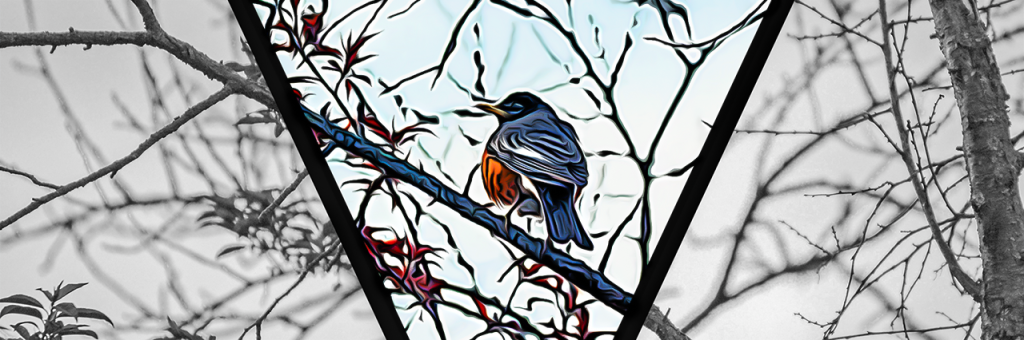
Header photograph by Jen Ippensen
Header artwork by Jordan Keller-Wilson
Fill in the gaps! Explore the spaces between by dropping your own words into this story that combines sentences from every piece in this issue.
Header photograph by Jen Ippensen
Header artwork by Jordan Keller-Wilson
It starts with wondering
which bridges would need crossing and which
direction the river curved, which four
roads you would need to get there when,
in fact, it is the same road with four different names.
The road at the end of your street takes you
to the far side of the city, beyond where
the stalled train stops you, beyond the
smokestack shadow and the swinging cranes above.
When you have reached the place
you set out for, you realize you can just stay
on that same road and drive,
drive out toward all the other towns and cities,
if you don’t stop, if your car has gas,
if you have the time, if you are
unbounded.

Brian Baker (he/him) is a London, Ontario poet who began writing back in the late eighties, publishing in such literary print journals as the University of Windsor Review, Dandelion, and The Antigonish Review.
Header photograph by Jen Ippensen
Header artwork by Jordan Keller-Wilson
My father stands at the center of distant summers woven from spruce trees and knee-high weeds and sizzling streaks of honeybees. Alone.
I see the sapphire sky, his greying stubble, his scalp studded with sweat. I hear his voice in the prairie silence. Monosyllabic in most settings, he brims with words in the bee yard, unsolicited lectures on the curative effects of propolis, the difference between capped and brood cells, burr and bridge comb.
I nod through his lessons. He knows I’m not listening.
He lights the edge of a newspaper and furls it into a cone that he blows down, making it puff like an herbal healer’s pipe. He slips it into the smoker, followed by a handful of cedar shavings. The shavings cling to the fissures between his bratwurst fingers. His hands are graceless in any context but this.
He puffs the smoker three times. The leather bellows rasp. The spout groans cedar smoke that rises warm and sweet over the abandoned Philpott yard, where he keeps thirty-two beehives, and where he brought me today to see a queen.
I hate the Philpott house. The windows are smashed. The paint and shingles have peeled. Canola grows in the fields the family once owned, and my father’s bees pollinate their loss.
He comforts me. “Don’t worry. They were an ordinary family. Nothing tragic about them.”
“So why’d they leave?”
“Who knows? Maybe they needed a fresh start.”
Three boxes make a beehive, and there are nine frames to a box. Stitches of wax hold each frame tight to the wood, and bee glue turns the boxes into a single tower that he methodically deconstructs. Unbroken focus at every step. Never a centimetre off. An almost reverent precision that I wish my mother could see when he forgets their anniversary, or lets slip an off-colour remark he doesn’t apologize for, or coughs in movie theaters, or nods impatiently at check-out tills, or when she complains that he only married her because of her looks.
A flutter of cedar smoke. The bees grow louder. He assures me they’re calm, and I believe him. His word is as true as the maneuvers that clear away the excess wax and pry each frame from its container. He never wears gloves. When stung on the hand, he uses his metal hive tool to pinch out the venom sac without spilling a drop, a sober exactness that amazes me every time I see it.
Six frames in, he smiles behind his veil. “Here she is.” He pushes his index finger into the fizzing rectangle of bees. “She’s a beauty,” my father whispers. “See her?”
I see her. She’s marked on the head with a dollop of pink paint. While the drones vibrate madly, she strolls through them with elegance, hauling a thorax twice as long as theirs. Sunlight hits her back and spins a radial of gold that looks like a wedding ring, evaporating.

Owen Schalk is a writer from rural Manitoba. He is a columnist at Canadian Dimension magazine and has contributed to non-fiction publications including Jacobin, Liberated Texts, and Monthly Review. His fiction work has appeared in Quagmire Literary Magazine, antilang., Fairlight Books, and others. His book on Canada’s role in the war in Afghanistan will be published by Lorimer Books in September 2023.
Header photograph by Jen Ippensen
Header artwork by Jordan Keller-Wilson
Leave the office. Get in the elevator. Hold your breath as you feel your stomach lurch into your throat. Make a dash for the exit. In the car, wait for the traffic to move. Collapse on the sofa with a glass of wine. Try to let your mind go blank. It’ll be okay. Your therapist said things are getting better. The anxiety attacks, the mad runs to the toilet every few hours to throw up, they are beginning to subside. You are getting better. You are getting better.
Each day stretches into the next without much distinction. What few hours of sleep you do manage are plagued by scenes of faceless men drowning in a darkness that persists into wakefulness. Todd will be coming round soon. You tried to distance yourself, the unread messages stacking up on your hardly-used phone, but still he turns up each week: husband from a life you’ve left behind, now returning with guilt and flowers. It’s not him, you think. It’s the hayfever. It’s the stress of work.
You haven’t broken up. Not technically. You just can’t seem to remember where he fits within the chaos that your life has become. He moved out a week after your brother died. Wanted to give you space, as he put it, and the gap has simply never been closed. Now he is here again, unable to stay away when the only thing you need is time alone, and you have to remind yourself how to smile.
You take the flowers and, when he’s not looking, dump them in the trash. The smell of wilted roses masked by rotting fruit. He asks how things are going, and you say they’re getting better. The hallucinations have stopped, and you are beginning to picture your brother in a better light. Before the bridge. Before the water took his body.
”That’s good,” Todd says. You want to punch him. You want to grab him and tell him everything you’re feeling, and then you want him to fuck you just like he’s talked about fucking countless other women. You remember how alive they had sounded in his stories. The women back at uni with blond hair and big tits and a solid grasp of reality, abandoning themselves to the moment. How far removed they seem from your own attempts at a subdued life.
Could that really have been you? The makeup and expensive dinners. The countless dates while Todd pleaded for your attention. Those years existed, of course, hidden somewhere amongst the naivety of blossoming romance, but now they hardly seem real. As if you’re remembering a fiction of a life, played out on a theatre screen to an empty room.
You sit there listening to him talk, or rather not listening but imagining the two of you upstairs in the bed you’ve hardly used. ”I have tickets to a play,” he says, and you’re not paying attention, so you nod. ”It’s a date.” He seems happier after that. As if this alone is proof of your recovery. He tells you about a piece he’s working on—a new take on Cheval—and for once you can understand. It’s getting dark now, but he doesn’t make any move to leave. It’s okay. You weren’t planning on sleeping anyway.
Two days pass in a whirlwind of toilet stalls and terror. You long for the day you can find the mundanity in it all. The day when the world comes crashing down around you, and instead of filling you with blackness, it takes you with it, and you look back with every ounce of clarity that has been taken from you.
When it’s time to meet Todd, you think about backing out. But he’ll only come and find you. ”It’s for your own good,” he’ll say, and you won’t have the heart to say no, won’t have the guts.
You wish he would stop trying to help. He believes he can control everything around him. Every problem he sees, including you, is something to be fixed. How blissful it would be to live in such ignorance.
It’s cold out, and you find him smoking at the back of the queue.
”You look nice,” he says, and although you know it’s not true, you manage to smile awkwardly.
”I thought of you as soon as I saw the advert,” he says, ”it’s about a girl who grows up on a remote island. When she comes to the mainland, she has a breakdown and has to be sectioned.”
Is he joking? He must be joking. You were just telling him how much better you’re doing. Why would he put that in jeopardy now? But you don’t have the nerve to leave and so you slowly inch along until you’re sitting in the theater and the play’s about to start.
He was right, of course. You could see yourself in the girl on stage. You could see yourself in the tired way she moved, and the heavy bags under her eyes. You could see yourself in the countless times she had been through the same performance, repeated ad nauseam until everything lost its meaning. You are comforted in this way. Knowing that there are other people out there, forced into the same endless cycles, all trying to appear sane.
You try to tell him this, to thank him for bringing you, but he doesn’t understand. He thinks you’re disparaging the play.
”I knew it was a mistake,” he says. ”I should never have brought you.”
There is no point arguing, so you keep quiet, and then the two of you are back at your flat. He’s put a record on, and you’re drinking another bottle of Bordeaux. The sound and taste of all the sophistication that has lost its appeal. You try to remember a time long ago, when he was still young and the madness had not yet set in. It’s like trying to climb a pole submerged in tar. Unfamiliar faces appear, teasing you with memories that are not, and perhaps never were your own.
You’re in the bedroom now. The sheets crack with starch as he climbs in after you. You no longer want him as you did the other night. Passion and lust are now concepts made vague by a much deeper desire that has arisen within you. Peace.
Despite this, you do not protest as he climbs on top of you. In the darkness a world of possibilities calls out, unheard over the groans of something like passion.
Afterwards, he rolls over and falls into a deep sleep. It’s late, but you’re wide awake. You think about the girl in the play, and the hundred more times she will have to give the same performance. You think of the audiences that will fail to see how tired she has become. No one is coming to save the girl. Tomorrow will come and you will leave for work. The girl will walk out on stage and you will run for the bathroom. Your time will never come, and nothing will ever change. And nothing should ever change.

Rory Perkins is a British writer focusing on shorter works about the human experience. Currently working in the energy industry, he writes whenever he can find the time, and hopes one day to publish a collection of flash fiction.
Header photograph by Jen Ippensen
Header artwork by Jordan Keller-Wilson
My roommate thinks I’m gay, and I haven’t corrected her. I mean, sure, Kara and I met in our fashion design class, and sure, she knows I crush on Oscar Isaac, and sure, I told her fiancé as much so he wouldn’t be jealous, and sure, I might’ve kissed him when Kara was passed out on Malbec and he and I were sharing a joint, and sure, I told him—swore to him—I wouldn’t breathe a word to her.
And so I don’t. I mean, I swore on my grandmother’s grave, and maybe she’s not technically dead yet, but it’s not like he has anything to worry about. It’s not like I’m going to brag I kissed some guy with no chin and a lopsided franken-smile. I still don’t know how he got with Kara (unless it’s his trust fund; of course it’s his trust fund) because she’s way too good for him. That’s what I’ll say when she wakes, after I hand her some Gatorade and tell her to drink up. And when she says Stop, you sound jealous, I’ll let myself blush even though I’m good about hiding that sort of thing, have known how to hide it since eighth grade and that time with Jay behind the band room, but now—now I’ll let her see the desire coloring my face, turning my lips red like the time I borrowed her makeup. And I’ll want her to say she understands, to not pull away saying she needs a shower, to not shoo me out even though she’s been naked in front of me tons before, to not click the bathroom door shut so I can’t smell her body wash, leaving me on the other side thinking about my promise to her fiancé, about the word fiancé and how cloying it sounds—so fucking French and upper class—and I’ll realize they’re probably made for each other, right?
Or maybe I do tell her about the kiss, but not until she has downed her Gatorade and three Advil and is munching on the avocado toast she loves, thanking me for being such a good roommate then pausing when she sees my face darken. What is it? she’ll say. Tell me. So I’ll sit down and hold her hands and say I didn’t mean to hurt her, because isn’t that what they say in the movies? And sure, she’ll laugh at first, as if I’m fucking with her, until I tell her it was all my fault, until I insist that I’m the one to blame, and maybe I am, though of course she won’t believe that. She’s seen the warning signs for months now—not that her fiancé likes guys, but that he can’t be trusted, could never be trusted. Wasn’t he in another relationship when they first got together? Wasn’t she the other woman, maybe she’s always been the other woman? That’s what her eyes will say when she says thank you, just murmurs it, then says she needs to be alone. And I’ll realize what a stupid thing I’ve done, all over a kiss, and not a very good one—lasted only seconds with barely any tongue—and her bedroom door will click shut like it never does and there’s nothing left to do but slide the remains of her avocado toast into the trash.
Or no, I really don’t tell her, not when she wakes up the next morning, her hair smelling of weed, a string of drool plastered across her cheek. I say she looks like shit, but she hears the love in my voice, so she showers and calls me into the bathroom to tell me I simply have to join her at her bachelorette party, and I sit on the toilet and smell her cantaloupe body wash and say sure, why not, even though I’m not up for it, even though the party will end with me crammed into the corner booth at The Eagle, empty shot glasses scattered around us, and her girlfriend Tiffany next to me, insisting I switch teams for the night. And sure, I might be tempted, but it’s Tiff. Tiff, who still attends Young Republican meetings, who’s engaged to some MBA who everybody knows she’ll divorce in two years, Tiff who wears fucking body glitter—and there’s no way I’d let that rub off on me even if she is hot—so yeah, I might be tempted, but by then Kara will be crying, bawling huge drunk girl tears about whether she’s ready—really ready—and I’ll want to scream NO! but instead I’ll say Look at me girlfriend and snap my fingers in my best parody of the queen they think I am, and I’ll say You’ve got this though of course she doesn’t, none of us do. And if I let anything slip about how I kissed her fiancé, it’ll be later, to Tiff, when I lean into her mouth even though I know I shouldn’t since Tiff can’t keep a fucking secret about anything, and it won’t be out of spite, no matter what everyone says.

Joshua Jones Lofflin’s writing has appeared in The Best Microfiction, The Best Small Fictions, The Cincinnati Review, CRAFT, Fractured Lit, Moon City Review, SmokeLong Quarterly, and elsewhere. He lives in Maryland. Find him on Twitter @jjlofflin or visit his website: jjlofflin.com
Header photograph by Jen Ippensen
Header artwork by Jordan Keller-Wilson
He put his socks on first. I’d never seen anyone dress that way before. Standing in the middle of the wavy blue rug in front of his bed, he pulled on one after the other without losing his balance.
We lived two buildings apart in the same apartment complex, but to get here, we used Grindr.
Once we tapped each other, he made me comfortable and horny enough with dirty talk and dick pics to walk over—I wouldn’t have gone, if he wasn’t so close—then into the bedroom, to sit on the bed and kiss me mid-sentence.
I never knew when to shut up: You taste, like, so good.
So good that words crumbled into grunts and breaths and yelps so fast that I couldn’t stop, didn’t want to. Nor did he, until he found an angle that allowed him to finish.
When he pulled out, I didn’t feel lessened or empty or shamed, but open and relaxed and warm and—
He was dressing. After the socks, he found his underwear wadded at the foot of the bed, where I lay uncovered and easy.
“God,” I said, as he slid his tan, muscled leg into his jeans, “that was like… I don’t ever want to move.”
His shirt was on now, blotted and purple. “I’m sorry,” he said, “but I have to pack. I’m moving tomorrow.”
“Like, to another building?”
“Another state. Out west, a fifteen-hour drive.”
I felt exposed only then, the sheets around my knees, the a/c’s chilling touch at my waist.
While I dressed, he put books into boxes and totes I hadn’t noticed earlier.
“If you don’t want to sleep alone, I’ll be just over there.” I pointed across the grassy courtyard.
He said thanks, and I walked home through the sticky, pulsating night, wondering how long he had wanted me out of there.

Lukas Tallent is the author of The Compromising Position. His work has recently appeared in Fast Pop Lit, Door is a Jar, Maudlin House, and many other places. He writes the substack, LTXXX, and lives in New York City.
Header photograph by Jen Ippensen
Header artwork by Jordan Keller-Wilson
But how to explain to you the phantoms that motivate a hunger like mine? Once I had a hankering for honey so strong I ate nothing without it for a week. Our honey jar was old, the golden insides turned cold—in some places, crystalized. You told me to just buy another jar, but I couldn’t stop thinking about the effort, the bees, all those trips back and forth to the hive. To not attempt to use it up seemed, to me, a cruelty. The night before you finally admitted there was someone else, I was contentedly working my way through the same old jar. It was late and I was tired and there were no clean knives left to scoop out the dregs, so I used a fork. When you caught me in the dim of the kitchen, I had already excavated down to the bottommost layer, where there was a surprise pocket of soft remains, a place where the crystals hadn’t yet hardened. I was only trying to salvage the last of that smoothness. Still it kept slipping through the tines.

Alyson Mosquera Dutemple’s work has appeared or is forthcoming in Colorado Review, Alaska Quarterly Review, Salamander, Passages North, Arts & Letters, and Cincinnati Review‘s miCRo series, among others. In 2022, her collection was a runner-up for the Flannery O’Connor Award for Short Fiction. Alyson teaches and edits in New Jersey. Find her @swellspoken and at alysondutemple.com.
Header photograph by Jen Ippensen
Header artwork by Jordan Keller-Wilson
my body, your body, our bodies, bodies, fading in and out and in and out until suddenly we are both nothing, nothing but whispers that echo like leaves beneath our feet, nothing but whispers like the creaking of a tree on a hill, nothing but whispers like i love you to people we will never hold again
i am in and out and in and out of love with you, with me, with your body as we tumble into bed, with my hair as i will it to grow every day, with the growing comfort of us, i love you like i love the sun after an especially cold winter, the way the sun can take away all the darkness that festers inside me, i wonder if we would fall in love again if given a chance, i wonder if we were meant to be or if we were a mistake i learned to love, i have made so many mistakes and i have never learned how to love any of them and still i wonder if you love me the same way i loved the girl i used to be
i don’t think this is a love poem, i am so scared, scared that if your eyes ever set upon this, scared that if you ever heard these words, these whispers, the faint murmuring of my voice, you would think that i don’t love you, that i don’t love you with my whole heart, when the truth is my body is made of love for you, but this isn’t a love poem, it’s an outpouring, a river from my fingertips, from my mouth, a form of love that i just don’t know how to give
time let us grow up, grow close, shed our skin for new bodies, sometimes i wonder how you can love me after everything i’ve done, after everyone i’ve been, how many people have you loved by loving me, will you continue to love me if i continue to fade, will you love me if i fade in and out and in and out, i am not a ghost but i am scared that someday i might disappear, fade away until i am only a memory of someone you could have loved
Josafina Garcia is a writer, photographer, and zinester just trying to figure things out. She graduated from Northern Kentucky University in 2023 with a degree in Integrative Studies. Her future is unknown, but she is ready to head down whatever path lies ahead.
Header photograph by Jen Ippensen
Header artwork by Jordan Keller-Wilson
Come here.
Among the elbows
of deciduous trees
and lighthouse beacons
of fireflies.
I want you
close enough to feel
the tightrope tension
when I say nothing
with a full mouth.
My throat
dissolves each I love you
that promises to earthquake my roots
before it hits the pink
of my tongue.
So stay there.
Between mountains
and the possibility
we might not survive you.
It’s too expensive to bury
the codependency
and broken vows
hidden in the basement.
Consider the black and blue
of falling for someone
who can love you
out loud.

James Roach (they/he) is a queer/trans poet who currently resides in Olympia, Washington.
Header photograph by Jen Ippensen
Header artwork by Jordan Keller-Wilson
 Vast
Vast 