December

A black and white, patterned stone dome seen from below is bisected by the signature Vast "V." Within the "V" is a wooden room terminating in a worn stone doorframe. Through the doorframe we see a cave mouth opening onto distant mountains at sunset.

The first time you saw him, you thought, No one should be that perfect. It was impossible. No one’s lips were that color naturally.

After the first time, you saw him everywhere: walking down the sidewalk on brilliant autumn afternoons; in the drugstore near closing time; smoking a cigarette each morning before his 8 a.m. shift wearing a denim jacket and indigo-wash Levi’s, black hair gelled into a pompadour, eyes rimmed with lashes so thick he appeared to be wearing eyeliner.

It is love at first—and second, third, seventeenth, forty-seventh, ninety-second—sight.


How do you seduce a man (or is he a boy, as a coworker suggests) that you pass on the street, with no one and nothing to make an introduction? How do you hold his gaze each time you pass, smile that smile like a secret shared? How do you say I want to know? How do you sit down on the curb beside him one cloudless November afternoon and ask, not to bum a light, but how often he gets a fifteen-minute, that is, is his presence in front of your store on purpose or is his boss generous with breaks?

The answer is more simple than you first suspect. Loneliness.


The first time you see her, she’s with him, wearing cherry red lipstick and a purple velvet trench coat belted at her Betty Boop waist.

Later, weeks later, during a late night alone with too many glasses of whiskey, you’ll find a picture of her online, time stamped from that same miraculous day—she’s straddling a borrowed bike along the campus on the hill, her plaid mini-skirt hiked up around her thighs, combat boots pumping the pedals, her hand thrust out with middle finger up, nail painted shiny black, and if you weren’t as old as you are—old enough to have lived through, in real time, the era she’s putting on—you’d think her novel, the very image of rebellion. 

But you remember the underwear advertisements, everyone bored or high or hungry or too cool to smile, captured in black-and-white film. The consumed challenging the desire of the consumer. You remember striped thigh-highs and the Army Navy store that has long since been replaced by a noodle shop. You are old enough to have seen the indulgent apathy of youth rise and fall and rise again, to have perfected that stare, to know the urge behind it and the places it will meddle. To know, mostly, that it’s a facade.


You don’t expect him to ask for your number, but he does. You pat your pockets for a piece of paper, a pen, but he’s already got his phone out, fingers perched over the screen. You say, Sara, no H, and recite the ten-digit string. Cool, he says, I should get back in, and you nod and say, Me too, though it doesn’t really matter that you’re out here because you’re the manager and you doubt anyone has even noticed you’ve been gone anyway.


It takes him two days to text: 

hey sara without an h, are you free at all on friday?

It’s a Wednesday, exactly 102 days since the bright, humid afternoon you last saw your ex-partner and signed the papers to finalize the sale of the house you used to own together. Exactly 71 days since you last heard from the man you’d been having an affair with, though his spirit still hangs around the damp apartment you’ve settled into, pressing against you at inopportune moments.

I work Fridays, you text back. Till 9—a drink after?

There’s a pause, long enough for you to wonder if that was the wrong answer, too needy or something, long enough for you to get up and start washing the sink full of dishes. Your phone pings as you stack another coffee mug.

9’s good. But heads up, I’m 20.

You hold your phone and laugh. It has been at least forever since you last felt this buoyant or lusty or absurd. You want to grab the feeling. You want to grab it and hold it and never let it go.

A bite to eat then? 

Sure that’s great

Meet me outside the shop at 9:15. It takes me a few to close up. 

Dare I tell you how old I am?

Go for it

I’ll be 34 next month. I’m laughing as I type this.

That’s awesome

See you Friday.

Unless we run into one another sooner

Looking forward to it

That’s how easy it is; you’d almost forgotten.


His figure, outlined by streetlights, waits just a few yards off as you lock the door and pull the handle three times, wrapping a shift the way you always do. He waits for you to walk over, but betrays no nervousness when you say Hi. He says, Where do you want to go?

You say, I’m craving pizza. Though you haven’t eaten a slice of pizza since college days; dairy doesn’t always agree with you.

He says, Sam’s then.

You head up the street to a pizza place you’ve never stepped foot into, though it’s been in the same spot for most of the ten years you’ve lived in town. Before that it was Bart’s Ice Cream. The counter is manned by bored college kids and there’s a live trio covering Cher’s “Life After Love,” and he asks what’s so funny. Oh, this song, you say. But you leave out the part that it was popular the year you graduated high school, that you danced to it at your prom. He would have been in diapers. I like it, he says, bobbing his head.

The pizza is decent, but his eyes are brilliant, almost black and as sparkly as the night sky in a national park. He stares at you as though you are the most gorgeous thing to ever materialize before him. Or maybe he’s just good at eye contact. Eventually it occurs to you that he’s waiting for you to suggest what happens next. You can’t take him to a bar but it seems obvious enough that the night is far from over. 

Do you want to go back to my place? you ask. I have bourbon.

Sure, he says. You live by yourself?

I do, I say. But it’s not fancy.

He shrugs. When you get outside, he asks, Mind if I smoke?

Mmm, not at all, you say. I used to—I still miss it.

You want one? He holds out the pack of American Spirits. Blue.

No, thank you. I’ll enjoy your exhales.

He laughs and sparks the light.

Your apartment is, to put it kindly, a fall from grace: an itty one-bedroom with water-damaged walls and grimy windows, tacked on to a concrete slab behind an 1800s farmhouse. Most of your furniture is in storage and the hot water works only sporadically.

As you swing open the heavy barn door that fronts the place, a strange, romantic, decorative flourish, and hold it ajar with your hip to unlock the normal door behind it, he says, This is such a cool spot. How’d you land it?

You tell him the name of the realtor you used, but leave out that you called her with two weeks’ notice and three cats and nowhere to go; this was her only listing. 

He looks around the apartment while you feed the cats and get the whiskey. There’s not much to see: it’s mostly overfilled bookcases and a desk piled with papers, story maps taped to the walls. Books are stacked on the floor by the bedroom door and next to the couch. He points to the iPod docked on a speaker and asks if he can put on music. 

Sure, you say. Whatever you want.

You pour two tumblers of whiskey and set the bottle on the tiny coffee table. He chooses Elvis Costello and settles next to you and you hand him a glass and cheers and then the song is over. You don’t have the album, just the song downloaded from who knows where. You get up, click through the iPod wheel. 

How about Iron & Wine? you ask. It is the music your ex-partner used to put on when she wanted to have sex. The married man you fell in love with preferred Bon Iver. 

Sure, he says, shrugging. Reminds me of middle school.

You raise an eyebrow and he raises one back. 

Reminds me of my early 20s, you say, which elicits his perfect laugh. Seriously though, he shouldn’t be this perfect. It’s plainly unfair.

For a while, with the music soft in the background, you just talk and lean into each other. Closer and closer on the couch, limbs entangled. Laughing. God, it feels good to laugh. He is silly, and smart, and charming, and, without warning, nineteen.

Whoa, whoa, whoa, whoa. You surface from your joy-haze to this fact. Nineteen?

He nods.

Not twenty?

He scrunches up his face and says, Twenty sounds so much better, doesn’t it?

Let me see your ID, you say.

What? Why?

Because I need to know you’re legal.

For a split moment, he appears torn between embarrassment and pride. 

You offer, I’ll show you mine, too. To make it fair.

Sure enough, he is 19, photo of his younger self starkly different—not yet inhabiting his bad-boy good looks and devastating smolder.

You pull out your license and hand it to him. The picture is almost a decade old, not updated in the most recent renewal, which you did online to save time. 

This doesn’t even look like you, he says. You look way better now.

I know, you say. 

Because he’s right. Age becomes you, despite what an endless stream of beauty advertisements otherwise insists. Pain has also become you, something you didn’t know was possible until the last few months: the long nights crying, the inability to stomach a meal, the meditation practice taken up at the behest of a growing stack of Pema Chodron books. 

What happened to you? he asks. 

Hmmm?

You know, why are you—ah, here, with me?

Oh, you mean alone? My ex left me for another woman.

What a dick. He must’ve been crazy.

She, you say. And I deserved it. I slept with a married man.

So you’re bi?  

I hate that word.

He shrugs. Most of my friends are. 

Your friends?

Yeah, like friends with benefits?

So, you have open relationships? you ask.

Open, he says. Sure. I do what I want.

Before you have a chance to ask if this is his arrangement or theirs, he asks, Is it okay if I kiss you?

You’ve never been asked this in such a direct way. It makes you giggle, but from his face, you can tell he is perfectly serious. He’s waiting for an answer.

Yes, of course, you say, I’m pretty sure that’s why you’re here.


When you see him next, a quick pass on the sidewalk as you rush into work—your store’s owner is in town—he is with her again, the girl of cherry lips and direct gaze. Today, you are also wearing red lipstick and she stares, too long, before turning away. You wave to him and keep walking.

You find her on social media later that night, a few more clicks through his likes leads you to her screen name: JuicyViXXXen18. A compelling taunt, it seems. Her squares feature menstrual blood and a used tampon filling a toilet bowl, a distorted mirror selfie showcasing a prominent hickey, her seated on a bed with a large orange cat shielding her nakedness. Her comments are brash, provocative; she is public about her sexuality in a way that repulses you, and is undeniably erotic. She is, also, it appears, a doting friend/lover to the electrifying man-boy who just spent a night in your bed, though by the time—4 a.m.—you tumbled in there, lips swollen with kissing, sleep was the only thing on your mind. Your alarm went off at 7 a.m. for a weekend retreat with a friend. He slept beside you, affable and consensual as ever, and in the morning, when you woke him after showering, he asked for only a sip of coffee, complimenting you on your sweater. I love clothes, he said. You have good taste.

You wonder, scrolling down her feed, if you could fall in love with him and worry that the thought means you already have.

Could you be like her? The question itself feels dangerous, rattling around your brain. You’ve never had a friend/lover, and the one time it was propositioned, your rejection of the offer detonated like a grenade tossed amidst your too tidy life. She’s an exhibitionist, naive about how the world works—two luxuries you’ve never been allowed. No, you’ll never be like her. 

And yet.


The next time you see him, he shows you his efficiency apartment, bathroom down the hall, and takes you out for Vietnamese food. Over Bahn Mi and spicy noodles, he asks without a hint of irony in his voice if you’re a liberal. His innocent intensity doesn’t surprise you but it is humorous, and uncomfortable. You know, tangentially, at least three other people in the restaurant and they all seem, suddenly, to be listening. The lights are dim, the decorations flimsy paper. The remains of soup swirl in your bowl. Where is that waiter?

Finally, you pull it together and say, I’m a half-gay, half-straight woman living in Northampton, what do you think?

He shrugs. Never know. So that’s a yes?

It is, you say. 

Your place or mine? you ask, as soon as the check lands on the table. He grabs it before you can protest. 

Yours is nicer, he says. 

This is only marginally true, a margin widened by the bottle of Irish whiskey you pour.

It’s a week night and he asks after the second pour if you’d like to head to the bedroom. Sure, you say, because this is what you’ve been waiting for, isn’t it? But there’s no heating vent in the bedroom and the walls are thin, the mattress chilly when you slip in beside him.

He is a deliriously good kisser. Eventually the shivering stops and the heat of lips mashing lips and skin gliding over skin drives you to reach for him. What you find is—well, you’re unsure what to make of the soft roll of flesh in your palm. You caress, tentatively, then less so, withdrawing your hand after a few minutes to concentrate on kissing. His skin glistens with a film of sweat, his lips flushed deep red like a throb. After what seems like a long enough time, you ask, Do you have a condom?

I don’t think so, he says. Do you?

It’s been a long time since I slept with a man, you tease, though this isn’t technically true. You fucked a man less than a year ago, no condom, no conversation about a condom, and you didn’t regret it. Your period wasn’t late that month, in fact, it came early, brought on, you assume by the close proximity to a body coursing with testosterone. Your now ex-partner was out of the country, not that she would have noticed. She was good at looking everywhere else.

Um, I could check my wallet.

He returns with his wallet, and pulls a battered foil square from its fold. 

How long’s that been in there?

I dunno. High school, maybe.

Isn’t your generation supposed to be all about safe sex?

He flips the condom onto the night table. That’s your generation.

You smile and roll your eyes. Fair. Though I think we’re technically the same generation.

Sure, he says. Technically.

He kisses you and your stomach gives the finger to the demographics and data in your head.

As much as I want to trust that ancient condom right now, I’m about to ovulate, you say. Rain check?

You know when you’re going to ovulate? he asks.

I do, you say. It’s a perk of aging.

I need a cigarette, he says. He yanks on his jeans and shirt, pats down his pockets. 

You dress and join him outside. The hunger is gone, and you both have work in the morning. You offer to let him stay the night but he declines and part of you is relieved. He does, however, ask for one more gulp of whiskey before he kisses you goodbye with the promise of next time.


The next time you see him, she stands beside him in a black wool trench coat, belted at her wasp-thin waist. He meets your eyes across the bustling sidewalk but makes no acknowledgement, so you take your coffee and sit on the curb, facing away. The weather has turned, finally, seasonably, cold, and your breath and the coffee steam into the bright day like smoke signals. 

That night, tired and alone with a bottle of Chardonnay, you click down a rabbit hole of the internet, discovering her abandoned Tumblr, a site teeming with gauzy NSFW photos. Some, you think, are her. The naked thigh with scabbed up razor slashes crusty against the milk of sunless skin; a close-up of lips encircling a lit spliff flaring to life; two naked female bodies pressed together, in profile. Nothing as shocking as her current Instagram, but the fact that you’ve found this old place, that you’re looking at this old version of her, coils like a snake inside you. Does she even remember it exists? Does she care? 

You fall asleep with the lights on and dream she visits you, smirking at the empty bottle of white, and you show her the collection of bourbon atop the antique hutch in the corner, she leans forward and kisses you, a volatile and forceful kiss, and when you startle awake you are sweaty and your head is spinning. The cats look on impassively. 


He comes the night after next with a fresh pack of condoms, which he tosses on the coffee table. These are expensive, he says. 

You shrug, and say, Worth it? 

He asks for a drink, and you oblige, and after he gulps the first whiskey, he asks for a second. You wave your hand at the bottle. Help yourself, you say, and he does, twice more. In your impatience to be fucked, to be desired, it doesn’t occur to you that he is steeling himself for what’s to come, that he might be, for all his smooth sweetness, nervous. 

Finally, he stands and grabs the condoms and gestures toward the bedroom, You ready?

The bed lacks a headboard and is pushed up against an outside wall. The mattress is glacial. Underwear to underwear, skin prickled over in goosebumps, for the splittest of seconds the thought crosses your mind that it would be okay just to keep kissing, kissing into delirium, and then call it a night, but he bought the condoms, and they’re here, on the table next to the bed, and he’s humping against you in such a way that reminds you of an untrained puppy. You’re used to lovers quick to fire so when you reach below the waistband of his boxers and find a limp guppy you pull back and ask if he’s okay. He strokes himself a little, but goes soft again when you try to roll the condom on.

I hate condoms, he says.

I do too, you say, but here we are. And you spent all that money.

He gives you a sleepy side-eye, somewhere between amused and baleful, and says, If you pump really fast, that should do it, then get on quick.

His suggestion works, and in an outlyingly graceful movement, he flips you onto your back. Pounding, pounding, which is enjoyable for about two seconds, and you think it can’t last long but he keeps pounding, pounding and you bite back a laugh at the seriousness of his expression and also the absurd idea that this could have been, somehow, any different.


Afterward, you share a shifty-eyed cigarette and another glass of whiskey and he tells you he has to work early. He shrugs into his jacket. He’s not doing a James Dean impression, but he may as well be: the pouty lips, the coiffed hair—even now perfect, when your own resembles a bird’s nest or some other untamable mess—the sultry stare. You kiss him long and steady and his grin wobbles as you press Tropic of Capricorn into his hands. Tonight, before the tumble, he said he reads, that he has a copy of The Dharma Bums on his night table, and this has sparked delight in you.

You’ll like it, you say, Miller paved the way for the Beats. 

He looks at the book in his hands, looks toward the door, says, Thank you. 

You are imagining all the naked conversations you will have in bed about books and writers and cities and ideas as you bolt the barn door behind him and pour yourself the remainder of the whiskey. What does he talk about with her, you wonder as you sip. Does she read? Does she give him books?

Eventually, much later than is healthy for a work night, you leave the two empty tumblers, side by side, on the table and head to bed.


So, how did it go??? your best friend—a mom of one, pregnant with a second—wants to know.

Heavy pelvis, sore head: the light in the apartment diffuse and watery.

Good, you tell her.

Good?!?! she shrieks. That’s it, good?

As good as fucking a 19-year-old can be.

She laughs, says, He is a fox, but there’s a reason sex gets better with age.

I think my pelvis is bruised.

Oh, god, she says. Lucky you.


You send him a series of texts to which he replies with single words, and then an invitation that he accepts but cancels at the last minute. 

The apartment seems smaller and dirtier, the darkness of pre-winter solstice like a crouched animal. It starts to snow and never stops.

The days drag on, interminable, a series of drawn tarot cards and self-help chapters, until the day you pull the Strength card, and she, who you’ve now followed through a number of online profiles and posts, each more jarring and alluring than the last, arrives in your store, looking for all the world like a tourist who got off at the wrong stop. With her is another girl, this one blonde and prone to moody stares, whom you recognize from late night romps through the internet wilderness. Despite her skittishness in this strange land, the girl of black nails and intense eye contact flashes a radiant red smile at your greeting. Your heart thuds. Does she know who you are?

You keep to the order of hand-poured soy candles you’re putting together while she scans the jewelry cases. Try not to look up too often, try not to feel whatever magnetic pull her moves exert on your synapses. White cable-knit stockings under a band-aid skirt, shiny Mary Jane heels tap-tap-tapping over the acacia floor. In a low, but not low enough, whisper, she tells her friend that the boy who has weeks since stopped answering your texts will meet them for lunch. You wonder what it is like to be so oblivious to your impact on those around you—if this is indeed oblivion and not guile.

Then, she’s at the counter, her eyes a pair of cut-sapphires ringed in kohl, piercing you. Though it shouldn’t, her youth—the simple nervousness of it—catches you off-guard. For a moment, you feel protective, not of yourself, but of her. The world, and you in it, wants to devour her—wants, as you well know, her beauty for its own. Wants to break her of it.

Hi, you say.

Can you help me? she asks. With a pair of earrings?

Sure, you say. Heart wild dancer in your chest. Key in hand. What are we looking at?

She leads the way to a pair of garnet studs. She points, and as you open the case, she asks, Are they— elegant?

The word hurts, though you couldn’t say exactly why. She watches you reach for the card and lift the posts to the light.

It’s a bezel setting, but it’s hammered, which gives it texture, and the backs are left open. You pop a stud off the card and hold it up. It lets the light through, so the stone glows. 

You hand her the earring, fingers brushing ever so slightly over her palm. She lifts it, cautiously, to the light.

Are they for a special event? you ask.

For a friend, she says. It’s her birthday.

The pair is much too nice for a college student’s birthday present, but you nod and say, She’d be crazy if she didn’t love them.

As she follows you back to the register, she says, You smell really good. Is it perfume?

You shake your head and tug a strand of your hair, which is blown out to look like the lion’s mane on the tarot card. 

Probably the gloss and spray—I just washed my hair this morning.

She smiles and you imagine she knows everything that happened between you and the boy. 

You do have a great mop, she says. You remind me of one of those cats, you know, the shy ones, with all the fur.

A Maine coon, you say.

Exactly, she says. Her smile isn’t perfect, but it’s close.


After your shift, you buy a bottle of cheap Merlot and walk home in the long-dark streets to your cats. You don sweats and crank the heat and put a frozen pot pie in the oven. It’s late and the bottle is nearing empty when you click into her latest Instagram account. There’s a new picture, posted only minutes before—so new no one has yet liked it—of her hands cupping a dead cardinal over a background of dirty snow. The black nail polish on her thumbnails is chipped. There’s no caption.

Without thinking twice—or at all—you tap the heart.


Sara Rauch

Sara Rauch is the author of What Shines From It: Stories and XO. She lives in Massachusetts with her family.

Artist Photo by Stephen Oparowski

Header photography and artwork by Jordan Keller-Wilson

Humane Solutions

A hand holds a cone of orange ice cream shaped like a flower in front of a distant background of exploding fireworks.

In the cobwebbed eaves of the house on Fig Street, the third pigeon drops dead. 

I hear her struggle from the front lawn, where I am deadheading the roses. My hand goes up to shield my eyes from the sun. At this point, I am expecting the fall. Her feathers iridesce green, blue, purple, with each twitch of her little head. She twists almost gracefully to the very edge of the roof. To linger on the precipice, body limp but briefly suspended, brings to mind something beautiful: a ballet dancer about to fall into her partner’s arms, Anna Karenina on the train platform. A papery brown blossom flutters from my gloved hand to the ground. Then the pigeon topples into the rain gutter. 

I am the only person in this neighborhood who knows how to garden. I walk four blocks to the bus stop every day, and every day I notice another thing left to fester. Ivy gnawing at an exposed brick facade. Mistletoe snared in the boughs of a slowly graying tree, drinking the living from it. Squashed plums on the sidewalk, crabapples rolling into the gutter. The whole scene stained syrupy and sickly-sweet. 

I know I cannot reach the rain gutter with the only ladder at my disposal, a squat A-frame left in the garage by a handyman Aunt Nell briefly courted. Still, I cannot become another keeper of rotting things. 

Aunt Nell was a collector. She collected forever stamps and uranium glass dishware and ceramic Precious Moments figurines. She collected stray cats, left them bowls of dried up kibble on the white oak porch. She collected me from the train station when I first arrived in town. Most importantly to my current predicament, she collected long lists of phone numbers. Magneted to the fridge, overlapped by a 10% off coupon for the pizzeria downtown and a postcard from the Vatican, is her list of pest control companies, scrawled out in her looping hand on the back of a Salvation Army receipt. 

The third number on the list picks up. 

“Greenbriar Wildlife Services, how may I help you?” A voice—smoky, feminine—tins from the receiver. 

I explain the situation. Dead bird in the rain gutter. Can’t reach it on my own. 

“I’m sorry to hear that,” she says. “But it sounds like an easy fix. I could come out tomorrow afternoon?”

I almost laugh. Stupidly, I realize, I hadn’t imagined that this woman would be the one to come and take my bird away. I figured they would send a wiry twentysomething, a former high school track star. A burly quarterback with dark hair on his forearms and coffee on his breath. I adjust my mental image of the woman on the other line, from a cream-bloused secretary to a coverall-wearing, slick-haired androgyne. 

“Yes,” I say. “Tomorrow afternoon works.”

I cup the handset to my cheek—warm from the mist of my breath. I give her the address. 

The first dead pigeon I blamed on Rocky, Aunt Nell’s only surviving stray. It was lying in front of the door like a gift, something dark oozing onto the daffodil-colored welcome mat. I wrapped the body in the doormat and put it in the compost bin. When Rocky next trotted up the driveway, I shook my head at him and clicked my tongue. He only rubbed his head into my hand, purring like a locomotive. Cats can’t tell when you’re mad at them. Cats have no sense of shame. Cats are not born guilty.  

The truck pulls into the crook of the cul-de-sac. Greenbriar Wildlife Services, it says on one side, green and yellow like a parakeet. Humane Solutions for Pest Problems. A grinning cartoon raccoon stenciled next to the lettering, cheekily fanning out its burglar hands. No man with an oversized mallet. No panicked line of rats or termites. Just a raccoon, who looks like he knows something I don’t. This cools my nerves some, quiets the thudding of my pulse. I don’t like brutality. I like cleanliness. I like English mystery novels. I like strict teachers. I like solitaire. 

The woman who gets out of the truck does not look how I pictured her. Her hair is pulled into a short ponytail at the top of her head, jagged ends spiking out like a crown of thorns. She wears a faded gray Laguinitas t-shirt, tucked into a pair of straight-leg work pants. Her face is studded with sterling silver, piercings above her lip, notched into her eyebrow. A tool belt weighs down her hips, swaying with each step. 

I startle out of my position at the window, suddenly aware that I am watching her, aware of the way my hair feels on the back of my neck, the chappedness of my lips. I open the door before she has the chance to knock. 

“Hey,” she says, “You the one with the dead bird?” 

“Yes, yes I am.” 

“My name is Syd.”

“Florence.” I accept her proffered hand. Her palm is dry, her grip strong. 

I found the second dead pigeon tangled in the neighbor’s fence. Caught on the ragged hole in the chain-link gnawed by the neighbor’s portly rottweiler, the bird’s feathers embroidered with metal. She must have fallen and gotten stuck. Wings spread, head limply bowed, a suburban martyr. I cleaned that one up too, hurrying across the cul-de-sac with a newspaper-wrapped bundle tucked under my arm. 

Syd sets up her ladder where I direct her. While she pulls thick gloves onto her hands, her eyes wander around the yard, taking in the greenery. She compliments my roses, although half the blossoms are severed at the stalk and the other half are brown and withered, the ground at their feet still heavy with fallen petals. I haven’t found the time to rake them up. 

“Thank you. Lots of people don’t know how to tend to them properly.”

Syd smiles. Her canines are slightly sharp, giving her the look of a wily fox. “But you do.”

“Yeah,” a laugh buzzes my lips. “I suppose I do.” 

“Any plans for the holiday?” She’s halfway up the ladder when she asks this. I find myself wishing she would remain at ground level, where I can watch her eyes flit from the bed of clover by the windowsill to the poplar fanning its branches over the lawn, the dandelions polka-dotting the grass. 

“Housewarming party,” I lie. A sweet-sounding frivolity for the long weekend. In actuality, I will be working all three days. Nametag clipped to the collar of my shirt, corralling escaped shopping carts back into their pens. I don’t mind. The holiday pay is nice. 

“You just move in?” 

“Yes.” It is easy to imagine that I’m new to the neighborhood. Aunt Nell wrote me into her will but it still doesn’t feel like the house is mine. I brush dust off the furniture, but my fingerprints don’t leave a mark. I’m a groundskeeper. A haunting. 

Syd rests her elbows on the edge of the rain gutter, and looks in. There’s a rustling as she digs around for the fallen bird, and a few dislodged dead leaves twist languidly down to my feet. The ladder creaks. I can see her bicep muscles moving under her thin t-shirt, dark halo of sweat blooming under her arm. My stomach tightens. Worry, for her balance. 

“Yep,” she calls. “Found it. Good thing you called me when you did, things could have gotten real smelly up here.” 

She whips a rag from her back pocket, a matador with his cape, and scoops the creature out. She descends the ladder gingerly, with her cotton-wrapped bundle kept close to her chest. 

As her boot hits the ground, the pigeon’s head lolls back, the makeshift burial shroud flapping open around it. 

“Sorry,” Syd moves to cover the bird’s fragile head with her big gloved hand. “If you’re squeamish.” 

“No.” I drift closer.

Syd makes a humming noise in the back of her throat, cups the pigeon’s neck gently, like she’s holding a baby. “Sad, I know. But whatever it had, it probably wasn’t avian flu. See, no swelling, no discoloration.”

In fact, the pigeon looks like it might start flapping at any moment. Gray feathers collaring her neck, eyes glassy but open. 

“She’s beautiful.” I lean forward. Bergamot and cedar tangle with the earthy smell of early decay. 

“You can look, but, uh,” Syd swipes her tongue over her lip, the ball of her piercing bobbing as she swallows. “Don’t touch. It’s good to be careful. We don’t know what killed this thing.” 

“Of course.” Heat pools in my cheeks. I take a step back. 

Silence cools the air. I try to think of something to say. 

“Did you know that, genetically, pigeons are no different from doves?” Syd offers. “But one we call pests, the other we… release at weddings.” 

I smile, imagining a magician flourishing a pigeon from his sleeve. People used to keep pigeons as pets, train them to carry our mail, take messages for us. It’s no wonder they stay at our sides, nest in the awnings of our skyscrapers, even when we decided there’s no use for them anymore. 

“I’m worried about them,” I blurt out. “The pigeons, I mean. I keep finding them dead.” 

She makes a humming sound in the back of her throat, considering. “I don’t know what to tell you,” she says eventually. “If it’s a disease, it doesn’t look like anything I’ve ever dealt with. Sometimes things just die.” 

The nervous, feathered creature inside me lurches, a half-hearted attempt at flight. Syd turns to go. I am sorry for standing mutely as she walks away. I am sorry I could not save them. 

After the drivers-side door thunks shut and the engine of Syd’s truck sputters to life again, I walk up the stairs of the house. I keep expecting Aunt Nell to emerge from around a corner, chiding me for moving her leather recliner, throwing out her empty shampoo bottles. As the sounds of the vehicle disappear down the street, I kneel at the side of my downy, quilted bed and pray the rosary. It’s the first time since I was a child. Aunt Nell kept an expensive, pearly one hanging off the side of her old mahogany bureau, and I never had the nerve to move it from that spot. Now I slide my fingers along the beads. My hand still buzzing from where Syd pressed it, the warmth of her palm on my palm, I duck my head and pray. Hail Mary Full of Grace. Hail Mary Full of Grace. Hail Mary Full of Grace. 

It is December now. The plum and crabapple trees that once infuriated me with their useless plenty now fruit nothing. The stickiness and rot-stench of summer has given way to fog and frosted windshields in the morning, bitter sun in the afternoon. I still walk to the bus stop every day, a flannel coat and knit gloves over my maroon polo shirt. 

The pigeons have stopped dying. At least, they have stopped dying where I can see them. This is fine by me. I trim the birch tree in the backyard. Pruning shears for the thin branches, pole saw for the thick ones. I wrench stinging nettles out of the flowerbed by the roots. I keep myself busy. 

At the grocery store I stack boxes of cereal, rearrange displays of organic almonds and pistachios, mop the linoleum tile when someone drops a carton of oat milk. 

Four hours of my shift have crawled by when I see her across the produce section. Syd. Wearing a heather gray sweater with a moth-hole just below the collar. Testing the skin of an orange with one finger. I set down the box of Medjool dates I’ve been arranging on the endcap. Although her gaze is leveled at the display, yuzu and grapefruit and tangerines, I am certain she can feel my eyes on her head. Look up. 

The disease that laid waste to the pigeons has not gone away. It hides in the intestines of the dead ones’ broods, settled and waiting. Disease is a patient thing. Intent on survival, on procreation. It will lay dormant until it is time to fell another one of its hosts. Until it is time for another pigeon—on Fig Street or any of the identical streets branching outward through the endless suburban grid, on another eave of another roof—to drop dead. 

I imagine Syd splitting an orange down the center, burying her thumbs in the flesh, citrus juice stinging rivulets into her knotty wrists. I imagine her laughing, mouth open, head tilted back. 

I swallow, my heart battering the inside of my throat. The air fizzes between us, carbonated by dust and light. She looks up. I look away. 


Charlotte Bruckner

Charlotte Bruckner writes about bureaucratic dreamscapes, martyrs and their wounds, and repressed queer longing. His short fiction and poetry have appeared in TOWER Magazine, Vagabond City Lit, Broken Antler Magazine, Nowhere Girl Collective, and elsewhere. When not writing, he works in theatrical costume design.

Header photography and artwork by Jordan Keller-Wilson

A Field We Sprawl On

Three elk top a grassy ridge. They are evenly spaced, the one in the middle centered in a bold V shape. Within the V, the sky is crystalized into abstract shades that fade from blue at the horizon to almost pink against the upper edge of the frame.

(content warning: death, grief)

It starts with a pamphlet in my wrinkled hands. Or rather, it starts much before that: it starts with the beams of flashlights crisscrossing in the fields of our girlhood; it starts with you on a stage in a flush of white light; it starts on a slick highway where the wheels of a truck are locked and skating into the wrong lane. 

Maybe it starts with the timejump waiting room.

I was sitting there, holding a clipboard, checking off boxes in the no column: No, I have not been recently hospitalized. No, I do not have breathing problems. No, I do not hear a ringing in my ears. It went on and on. No, I had to check off, I do not wish to alter past events. 

At some point, an old bride walked in—this shrinking woman, around my age, who appeared to be caught in an enormous fishing net. Lifting her skirts of tattered tulle, she carefully stepped over to the receptionist to take a clipboard. Then she sat in a chair across from me, where the dress spilled over the armrests. I tried not to stare, truly, but you know I’m nosy. It was a hard sight to ignore: the woman’s over-rouged face, the mascara caked around her eyes. 

You always pitied older folks waiting alone. Remember in the airport, before Vancouver? The man with a gray mop of hair, a suit too large, sitting in the corner with a sandwich. You had it in your heart that he was some forlorn widower, a man so alone. You started a conversation with him, and he and swore up and down about the teenager who made his Reuben wrong. I made fun of you on the plane.

I wonder—if you could see me in the waiting room, would you pity me? I digress. 

It’s hard, I’m realizing, to tell a story in a straight line, as if we experience anything in such an ordered way. 

Let me try again: the bride: alone like me. While you would have been kind if you were sitting here with her, I’ve become more blunt with age, if you can imagine that. I leaned over and said, you know, they’re going to make you change out of that.

She looked down, ran her palms across the fluffed dress, didn’t seem to get it. But I’m going to my wedding, she said.

So I said, of course, but you don’t need to wear it. You’ll already be wearing it, you see? You’re just there to watch. 

She sat there, a small face in a big white web, blinking. 

It’s okay, I said. They have wardrobe back there. You’ll be able to change.

If she heard what I was trying to tell her, she didn’t show it. His name’s Carl, she started. They cut flowers growing in a vacant lot across from the hotel for their centerpieces. Stuck them in little jars. Somewhere in her rambling, she said she’d be going to the wedding for thirty minutes, and I nearly dropped my pen. I was using nearly everything I had, which would only scrape up eight. But I suppose unlike her, I wasn’t using them to enjoy any big day. I just needed to see if I could tell you something.

I know you can’t read this, but it comforts me to write as if I’m speaking to you. Really, I’m writing this for me. But I’ve learned, there’s this problem—it is hard to pull you and me apart. How do I dissect where you end and I begin, or the other way around? How do I write about us, even a moment at a time, without acknowledging the universe of memories each moment connects to? They say time is a line, or maybe, to some, it is a loop. But to me, time is a field we sprawl on under the sun and moon, where I can feel every blade of grass—some soft, some bristled, all at once.


A nurse took my weight and height and blood pressure, then led me to a room where a serious-looking man in a white coat stood behind a wide desk. He shook my hand, said I could call him Nathan, and told me he’d be my Jump Attendant. He asked me how I was feeling as we took our seats, and I said I was feeling ready.

That’s great to hear, he told me, but then paused and leaned forward, said we needed to talk about my preferred timepoint. He wanted to know why I selected it.

So I told him about it. It was a beautiful spring day in May. We found a little tapas restaurant in Seattle. We ate outside. Cherry blossoms littered the street with pink confetti. I don’t remember what we talked about, do you? But there was an air of sweet calm, of spring waking up.

It’s not necessarily my favorite moment with you—not even close. But I didn’t tell Nathan that. I told him I would simply like to see you and me, in the sun, eating and laughing.

He looked at me, then at the computer on his desk. All this waiting, he said, and to be frank, all this money—not to mention the forms, the psych evaluations, physicals—all the pinpointing and witness accounts. And you’re choosing to watch your friend eat?

I nodded dumbly—what else could I do? Yes, I responded. To see her and me, in the sun, eating and laughing, I repeated. Maybe my lines sounded too rehearsed. 

Nathan leaned back in his chair. This timepoint, he explained, is nine days before your friend Mara died. He peered over to his screen to read something. 

I didn’t say anything. He told me he’s sorry for my loss, but visits like the one I was requesting were ones they couldn’t grant. There is too much emotion in it, too much risk. 

I felt my old body spur with fight. You know how I get sometimes. I told him the facts: the pamphlet’s fine print said that someone cannot request a timepoint within one week of a loved one’s demise. My timepoint follows the rules.

Nathan said I was technically correct (though he also added that he personally thought the timeframe should be much longer.) He went on to tell me that I’m certainly not the first client  who’s requested a timepoint just before a cherished person’s demise. He gets it

Sometimes home is not just a place, but a place and a time, he said gently, quoting nearly word for word the brochure they sent in the mail. We can bring you back home, no matter when that is, and allow you to observe it, feel it again. But we can’t change what happened to Mara—do you understand?

I thought if I could see you, even from a distance, I could figure out a way to warn you. And if I figured out a way to warn you—well, then, I don’t know what would happen next. Would you poof suddenly into existence? Would all life rewind, start again from that day when you decide to not risk the interstate during that relentless downpour? Or would time fracture off into some parallel universe, where I can only imagine that you and I are safe, and laughing, and growing old, pinching at our flabbed underarms and cursing our grays, still thinking we’re twenty-two in our bones?

Nathan, who was turning out to be more stubborn than me, repeated himself and told me that he could not permit me to jump unless I understood I am only a spectator, a ghost from the future.

I told him I understood, even though I didn’t want to.

He was denying my preferred timepoint request—the last time I saw you. But said he would be happy to go through my other submissions to see if we could make an earlier timepoint work, one with less emotionality to it, he said, one where I could simply be happy and watch.


I only submitted the Brooklyn performance in the application because it was easy to do so. In order to request a timepoint, I had to submit the exact location, date, and time, and have witnesses to confirm it. I still had the program for the show on Saturday, January 9th, 2010. But I already knew there was no way in hell I’d actually want to go back and rewatch that thing. No offense. 

Remember our two-bedroom apartment in Williamsburg? Bathroom the size of one on an airplane, kitchen barely any bigger. We were still young enough not to care, because we were in the city, and our nights were full of music and vodka, and we saw our shitty little apartment through an enchanted lens, like it was a necessary stopping point on our path to greatness.

You had been working for months and months putting together your piece for the company’s showcase. You didn’t tell me much just that it came to you once in a dream when you were younger, and you always wanted to translate it to the stage, to the body.

I went to your show that night with Ben who went by “Benny”—surely you remember him—and the first number featured all the dancers in the company. They leapt with wide legs like open scissors, they jumped straight up and fluttered their pointed feet, they planted one flamingo leg on the ground, raised their perfect arms, and spun like falling leaves. 

This is pretty good, Benny admitted, and I nodded. It was extraordinary. 

After the group number, your piece was first. You walked on tiptoes to center stage, knelt. The lights cut, then all flashed on again in blinding whiteness.

On the side of the stage, a hunched figure appeared in an off-white leotard, her face covered in a veil.  She hobbled slowly towards you, then paused to raise her hands to claw at her throat as if she were choking. Two ethereal tones chimed, and the hunched figure dropped one limp arm and dragged it around on the stage. The woman, this weird broken creature, pulled her way toward you, reached out to you.

What the hell is this? Benny whispered, and I wish I understood it myself and could say something poignant. But I didn’t. My hands started to prickle and stick with sweat. 

The hunched lady stood then, and in a wild burst started leaping in a circle around you. She jumped and jumped with arms over her head, and finally, you arose. The figure rushed towards you, throwing her arms up to the skies, then pirouetted round and round. You twirled like her, then dropped to the ground. The creature dropped, too. Then you both flailed, on opposite sides of the stage, like you were both laughing, or maybe crying. The two eerie tones crescendoed, and the stage cut to black. People around me applauded.

Benny looked at me, wondering what we just witnessed.

It’s art, I tried to defend.

It’s fucking weird is what it is, he said.

And I hate to say it, but I agreed.

Afterward, we joined you at a bar down the street with your ballet boyfriend Ivan and a few others from the company.

Your piece was the best, a thin girl tells you. There was so much emotion in it. So much expressed between the dancers.

I was drunk by that point. Oh my god, yes, the emotion, I parroted, then raised my cup. 

You looked at me and asked—Really? You liked it?

I nodded too much.

You smiled, ready to challenge me. So what do you think it was about? 

I had to think of something, so I told you that the dance represented a battle with your inner demons. It wasn’t a half-bad answer, I thought. 

You rolled your eyes. It’s not as dark as that, you said. You were trying to present more of an awakening, a catharsis.

That’s when Ivan butted in—Yes! Catharsis. That’s exactly the word he was going to say!

No you fucking weren’t, I told him, then turned to you again. What was that thing, the hunched figure crawling towards you. A monster? A ghost?

You nearly spit out your drink laughing. You said the thing on the stage was a companion. 

A twin flame, Ivan added. (I don’t understand how you dated him for eight months.)

Ok, sure, I said. And you laughed, and I laughed, because the thing was, it didn’t matter if I got it or not, if I liked it or not. You know that everything you touch is beautiful to me. 

Still, of all the places I could ever return to, a post-college interpretive dance showcase wasn’t going to cut it.

Nathan asked if I was sure. Said that since it was a dark theater, a crowded public performance, it would be an easy timepoint to spectate. 

I was sure. 

Nathan scrolled on his screen, then asked to hear about Maine. 


I found our itinerary in an old email, so it was another easy timepoint to submit. By that time in our lives, it was difficult to see each other often. There were phone calls, long emails. It had been nearly six months—the longest we’d gone without seeing each other—when I picked you up from Logan Airport. 

I got us an AirBnB on a sparkling lake in the deep woods of central Maine, and when you entered the renovated cabin you joked that we’d come a long way from our first apartment. But there was a tension between us—I could feel it in the way you politely asked about my work, in the way you over-complimented the bottle of wine I’d picked up. Then I over-complimented the pasta you put together, and talked too much at dinner about a farmer’s market I didn’t actually go to that often. For a moment, in terror, I thought perhaps we had entered a new, fixed state, as if there was something automatic about being in our forties that dulled our souls and cast us into the quicksand of small talk.

When I soaped the dishes, I asked how Julian’s job was going, and you lifted yourself onto a countertop with your glass of red and asked me if I really cared.

Of course I care, I started seriously, but then you laughed. No, not like that, you said. Said you know I care about you and Julian, but do I really want to hear about how his accounting is going?

I rinsed off the tomato sauce that was stuck to a plate. God no, I laughed. 

Then let’s not, you said. You grabbed the bottle of wine and wandered through the back door, and I followed down to the dock that stretched over the lake. Shadows of hills sloped around us, dots of stars punctuated the sky. You leaned your head back in my lap to take them in, and then we didn’t talk about job updates or farmer’s markets. We laughed about the time we got into a historic screaming match about something we couldn’t remember, but even in our anger we called for takeout and ate it on the roof of our apartment building, passing our last clean fork back and forth. You recalled your big dance recital sophomore year, where I stood and cheered and clapped after your solo, only to find out it was a serious kind of event where everyone else sat silent. There was the double-date we double-dashed, and the day we couldn’t stop crying, when we almost adopted a cat named Peppers to assuage our sadness, and whose picture on the website made us sob even more.

I guess we made our own kind of time machine that night in Maine.

We talked about our apartment in Brooklyn, the boys we filled it with. We laughed, thinking about poor sweet Benny, how I made you break up with him for me. 

You said you were happy to do it, said he always questioned your dancing, never really understood it. I took a swig from the bottle of wine and confessed I wasn’t totally innocent in that regard.

It’s okay, you said.

I always liked it, your dancing. I tried to explain it’s an art form I didn’t totally get, but that I liked it because it felt so you. You’ve been dancing since you were a kid. I wish I had found something like that for myself.

You sat up on the dock and took the wine, said you always felt like dance found you, not the other way around. I burst out laughing, and so did you, because what a pretentious thing to say.

Then things got quiet. You missed the performances, the tediousness of rehearsal. But you told me that you still go to the studio by yourself. It makes you feel centered, you said, now that it’s just you and the dance.

What about the hunched lady? Your twin flame? Does she ever make an appearance in the studio? I asked, chuckling. 

You slapped me playfully. Then on the edge of the wooden dock, you stood and raised yourself up on your tiptoes. You were tipsy and twirled perfectly anyways. A lightness entered your body. You pirouetted again, like that Brooklyn performance all those years ago. I watched with admiration, a shadow on the dock. 


Nathan typed something into the computer. Said that because it was a private residence and isolated, this specific timepoint would be riskier to access, and I would have to pay a fee. He swiveled the computer screen my way and showed me the number. I shook my head. I could barely afford my eight minutes as it was.

He told me he could drop me down to three minutes, and it would kind of balance out. But I wanted all the time I could get with you. He clicked around the screen, and I knew I only had one more timepoint on my application. 

This one seems sweet, Nathan said reading over the form, and I knew because it was the last submission, he was going to try to really sell me on it before I walked away with everything but the deposit. Nathan had already blown up my plan—my dumb, obvious, hopeless plan—and I wasn’t exactly sure why I still sat there, nodding along to these places I never intended to revisit. I should have left but found myself caught in the gravity of your name, in the spell of our memories.

The last one was a throwaway, something to complete the application. I put flashlight tag—your favorite. I loved that carefree time when we were nine, when we’d spend every Saturday night at the middle school soccer field with kids from our street. I could pick any Saturday of the summer of 1997, and I know we’d be there. 

So I nodded at Nathan, sure. Let me see us young, in the dark grass, laughing and oblivious before it all. Why the hell not.

He printed a packet, I signed many lines. He left me momentarily then returned wearing denim jeans and a denim jacket. I didn’t have to change my clothes—he assured me that my blouse and capris were “timeless”—and I wanted to smack him. 

We walked down the hallway to the elevator and descended. In the white room, I stared at the machine, a silent, tall tube, stretching from floor to ceiling. Nathan opened a clear bag and removed something that looked like a plastic dog collar. Told me that to rewitness a memory can bring intense emotion, and intense emotion can make people create noises they don’t intend to. Noise will bring attention. The noise cancelation necklace was part of the contract I signed.

I nodded and he clasped it on. I opened my mouth to say hello. Nothing came out.

Then Nathan placed a bracelet around my wrist, the numbers 8:00 blinking on the face. Nathan reminded me that I had to follow him, as he’d secure the location and make sure we could spectate without interference. Told me too that he’d monitor my pulse and blood pressure, and when the eight minutes were up I’d be automatically transported back to the office. If for any reason I wanted to be transported back before then, there was a little red button on the watch I could tap and be locked out of the timepoint. 

Then Serious Nathan became even more serious and stated that if at any time I displayed behavior that seemed “risky, overemotional, or violent,” he could lock me out of the timepoint. He showed me this little silver case. Inside was a single metallic sticker he could stick on me. It would bring me back to the office before the eight minutes were up. He met my eyes, made sure I understood not to try anything. Voiceless, I gave him a double thumbs up. 

Then we stepped into the tube. He typed numbers into a screen. Said it would feel like nothing at all, though my ears might pop. Then he pressed a button. My ears popped. 

And then you wouldn’t believe it, Mara. I was standing on the black pavement of Cedar Street—it was sleek and glinting from the dull dazzle of a few crooked streetlights. It must have just rained—an uncapturable smell of wet slate and earth filled the air. The soccer field waited across the street, where the dots of our flashlights zig-zagged like drunk fireflies.

We approached the fence around the field, and when Nathan attempted to push open the chain-link door, it creaked, making him pause with animal stillness. Then he waved me over, and from behind the fence, I searched for you and me. 

How do I describe the rediscovery of us? Yellow cones of light bobbing around the field. Me, you, the others out there—probably Graham, Chloe, Vanessa—yelling joyously in the night. Sometimes I could see an arm or a shoe momentarily illuminated. Somewhere out there, you and I were sprinting and laughing, bending grass under our untied sneakers. Trying our best to stay in the dark. 

I wanted to get closer, but wasn’t sure how to tell Nathan—the absurd dog collar took my damn voice. I used my hands, made little legs with my forefingers to show walking and pointed to the field.

Nathan shook his head, whispered that we only spectate from a distance. And I felt the fight in me again. Of all the memories we have, I couldn’t believe I allowed myself to be convinced to choose one during the night, when I wouldn’t be able to see us clearly. Nathan could have warned me, but he didn’t. 

I considered actually smacking Nathan this time, but then, in a split streak of light, I saw your face. It was really you. A young you, decades before the truck would swerve out of its lane and into yours. And I know I should’ve just let you be a kid. But there’s a sharpness to the knowing, a stinging.

I started to shake the chain link, making it rattle and ring in the night. Did you hear it, as a kid? I can’t remember—did I? Nathan about lost his mind. He whispered to calm down, calm down or else, and that’s when he took out the tiny silver box, the one with the shiny sticker that would permanently whisk me away from you and back to the office. 

I paused, took my hands from the fence and froze. I’m sorry, I mouthed. I was. The box was open, and Nathan stood waiting, wondering what to do. He looked at the watch on his wrist, the one with the screen showing my pulse flickering in a fury. And before he could decide my fate, I decided for myself. I grabbed the sticker from the open box and placed it on Nathan. 

Poof. He disappeared, locked out. 

When I looked back out, though, I realized that the dancing flickers had stopped, and I couldn’t see us anymore. The game was over. Young me probably cut by the school to go home, and you may have already hopped the fence on the far side. So I ran. Ran to those tall light poles behind the bleachers, remembering where the control panel was from that dare in sixth grade.

Desperately—I only had a few minutes left—I switched the rows of toggles up and down until, all at once, the field shuddered brilliantly into view. I waited, hand over my eyes to shield the glare, hoping the sudden strange brightness was enough to make you turn around, enough to draw you back like a moth to the porchlight. 

You appeared, a small figure near center field staring up at the lights, stepping closer, all pigtailed and overalled. Do you remember it? I took shaky steps out onto the field, but my jellied legs didn’t seem to work right, like the ground was uneven, the world slant. 

I fell then, right on top of my wrist. There was a short snap, like the crack of a twig. I couldn’t say anything, the collar blocked my cry. In the damp grass, I cradled my wrist like a baby bird.

You pitied me. In a nervous, high-pitched voice, you asked if I was okay. You called me ma’am—imagine that!—and I swallowed my pain and nodded.

I pulled myself up to my feet, then walked nearer, all hobbled over, clutching my broken wrist. I tried to say your name but could not. If my voice didn’t work, I thought maybe I could write a message, trace the shapes of letters in the grass to tell you all I had to tell you. Maybe, I could write the date of the accident, and that would be enough. 

Young you stared as I lowered my right hand, a throbbing, limp thing. I tried to trace the M for May, but a pain shot up and through my arm. It wouldn’t do. I tried with my left hand, dragging it in hopeless loops and crosses. You took a step back, biting at your lower lip. 

I realized I was terrifying you. That to you, I was unrecognizable, just some voiceless lady that emerged from the dark, hunched over and with my hands trailing through the grass. 

Then I remembered Benny’s voice saying what the hell is this? And I laughed and laughed, or I silently did. Because of course, of fucking course. It was not a monster, never a demon on that stage. I get that now. 

What did Ivan call it? Twin flame.

I stood, ready. Then, in the best triumphant leaps I could muster, I pranced in a line down the field. My hands as high above my head as they could reach, just like I remembered. Gazelle-like, I bounded around you, you who took everything in with scrunched eyebrows, but no longer biting your lip. I twirled my best impression of the pirouettes I’d seen you do countless times. Again and again I spun. Then I pointed to you, inviting you to the dance. You were confused, you were entertained, you lifted one leg and spun until you fell. I spun and fell too, laughing and laughing and laughing. I could feel each blade of grass under me. 

In a moment, I would be zapped back to the white tiles of the Jump Attendant’s office. In a moment, I’d be gone from you. In a moment, you would stand alone in an empty field, but still, the dance would exist, would always exist, between us.


Jennifer Evans

Jennifer Evans is a pushcart-nominated writer who lives and teaches in Massachusetts. Her work has appeared in Tiny Molecules, Longleaf Review, and Outlook Springs.

Header photograph and artwork by Jordan Keller-Wilson

Blue Boy

Before I knew his name, I just thought of him as the Blue Boy. His skin, pale to the point of translucence, got its color from the spider’s web of veins criss-crossing his body. His eyes had the blue of a clear summer sky and seemed just as wide with his staring. His hair was a thick, wavy, black mound, so dark that an unmistakably blue tone reflected out of it no matter how the light caught it.

No one else called him the Blue Boy. They mostly called him “l’Anglais”—the Englishman. At first because his French had an anglophone accent, and later—after he clarified that he was Irish not English—because they realized how much it annoyed him. I never called him Blue Boy aloud. I don’t think I ever called him anything when we met in the South of France as children. We didn’t talk much. As two outsiders, we might have. But our teacher made an effort to keep us separated during classes, maybe hoping to encourage us to mingle with the French kids, and we avoided each other outside of class. Neither of us fit in, and instead of that bringing us together for comfort, it kept us apart. We feared association with the other’s oddities. At least I did.

I only remember clearly one conversation from those days. I didn’t like playing soccer, but I had to stay after school because no one was home, so it was soccer or the band and I preferred the fresh air to the stuffy, loud music hall. I avoided the ball scrupulously throughout any scrimmages, and then volunteered to help put away the equipment afterwards, dawdling until the other boys left the changing room. 

But this time he was still there. His shirt and shorts lay on the bench beside him. He had his back to me, and I stared at the field of bare skin, made bluer by the effect of the fluorescent lights. He must have heard something, because his head snapped around to look over his shoulder at me. Embarrassed at staring, I would have looked away, except he stared too. His wide eyes took me in, and his initial fear faded. Finally he spoke.

“The other boys hit me there so my host family won’t see.”

He spoke English, and it took me a moment to understand the words, never having heard an Irish brogue before. Even when I did, I was still confused until he indicated downwards. Just across his underpants from the back I’d been staring at, yellow and purple splotches covered his skin. He turned to face me, and I saw the bruises were all over his thighs. Some were the pale red of fresh hurts that would soon bruise too.

“Why don’t you show them to someone?”

“I don’t grass on other kids.”

“Why don’t you wait outside until they all leave, like me?”

“I don’t run from fights.”

I looked away, shamed by his bravery, and started to get changed. He must have felt his near-nakedness when he saw me lowering my own shorts. Gingerly, he pulled pants over his poor legs. With the extra care he took, we ended up fully dressed around the same time. He stared at me again, and I stood still, waiting, like I needed his permission to leave.

 “D’you miss Canada?” he asked suddenly. 

I nodded. 

“Will you get to go back there?”

“If Dad’s job moves again.”

“I hope it does. When I get back to Ireland I’m never coming back here.” 

I nodded. 

“Right. See you then,” he said, and left. I stayed to wash my face and hands to make sure no one saw us leaving together. 

At home that night, I asked Dad how to treat bruises. He showed me a little brown bottle with Chinese writing on it and explained that was what he and his friends from Judo used. He opened it, and I could smell from across the room the harsh, grassy smell of cloves, aniseed, or loam. It left a yellow stain where Dad touched it with his hand, like turmeric. He offered it to me. I imagined gently rubbing it over the Blue Boy’s battered thighs. I told Dad no. I knew I could never get the courage to offer the massage. The smell would have just made him stand out more anyway. Most of all, I didn’t like the image of the yellow nicotine-like stain on his legs, covering the pale blue. 

He finished the year and I never heard him complain about bullying. Then he disappeared back to Ireland. My family returned to Canada in time for me to start high school, where I actually managed to make a couple friends. When I went to university in Montreal, life got even better. It didn’t matter anymore that I liked books and didn’t care about sports. It still mattered that I wasn’t into music, but my social standing improved to the point that I got my first girlfriend, Audrey. She was pretty and kind. I liked having a girlfriend. Unfortunately, it meant I had to go out with her to clubs with loud music, or house parties with loud music. In a dimly-lit loft at one such party, I heard someone speaking English with an Irish accent.

I wouldn’t have recognized the voice, it had grown deep and powerful enough that—unlike me, Audrey, and nearly everyone else there—he didn’t have to shout to be heard. I might not have recognized him on sight either. He had grown big and broad-shouldered, though I was taller than him now. His arms were thick and muscular and covered in curly hair. He wore a well-kept beard, as black as the hair on his head. It carried that deep blue tinge, but so did most dark hair in the mood lighting.

He happened to look my way at that moment and, seeing his eyes, I knew him. I must have been staring. He gave me a bemused but friendly smile. I realized he hadn’t recognized me, but he excused himself from the conversation he was having with a circle of other guys and approached. “Where have I met you?” he asked directly. As soon as I said the name of the French town, recognition sparked on his face. 

“Well, fuck me, you’ve changed.” His wide eyes looked me up and down. 

I felt a shifting at my side, and quickly switched to French to introduce Audrey. 

“Enchanté,” he said. 

As he turned his wide eyes and charming smile to her, I felt a twinge of discomfort in my stomach. Then he reached a long arm back through the crowd of people and tapped one of the guys he’d been standing with on the shoulder. When he presented the guy, a boyish, blond-haired imp, to us as “mon chum”—his boyfriend—my guts twisted further.

We explained how we’d met, and marvelled about the odds of meeting up again. But, since we never spent time together as children, and neither of us liked anyone we’d met then, it didn’t take long for our talk to run dry. Then he said he wanted a smoke. His boyfriend turned up his nose at the mention of it, so I said I would keep him company. Audrey looked surprised, knowing I didn’t smoke, but I gave her a shrug meant to convey Just so we can catch up, and she smiled back.

We grabbed our coats from where we’d tossed them on a bed, and headed to the balcony, a little wrought iron Montreal job that looked like a fire escape without the escape. We stood quite close together once the doors were closed behind us. He offered me a cigarette, but I refused, saying I had quit. Really I had never started, but I knew enough people who had smoked as teenagers and quit now that I thought it sounded honest. He didn’t comment, just lit his own and exhaled the first breath with satisfaction. The street was dark. Snow glittered in the pool of the occasional street light. My hot breaths showed nearly as thickly as his smoky ones.

“Fuck,” he said, “and I thought Irish winters were cold and miserable.”

I smiled at him and watched as he raised the cigarette and closed his lips delicately around it. His beard was especially well-trimmed around the mouth, and his lips jutted freely. When they opened again, and smoke jetted out, he locked eyes with me, then proffered the cigarette, saying, “You sure?”

I took it. I tried not to hold it too tightly. I had it between the middle and index finger, like you were supposed to, but I suspect my stiff wrist gave away my quitting lie. I placed it in my mouth, him watching me now with his unblinking eyes. I took a shallow inhale. As my lips parted to blow the smoke out, his mouth opened slightly too, as if in sympathy. When he took the cigarette back, his hand was icy to the touch, and I said so. He agreed, and asked why mine was still so warm. I shrugged. We lingered, allowing some of my heat to flow into him, then I said, “Well let’s get you inside then.”

“Right,” he said, but made no move.

A noise came from indoors and I dropped his hand. More prospective smokers appeared in the windows. He looked at me with something like pity as he took one last drag, then we went back inside.

I invited him and his boyfriend over for dinner with Audrey and me, but he cancelled at the last minute. The next time I saw him he had his arm around a different guy. When I asked what happened to the blond one, he just grinned and said, “Didn’t work out.” He asked me how Audrey was, but seemed uninterested in the details. 

The following week he turned up at my apartment. It surprised me, until he reminded me I’d given him the address when he was supposed to come over for dinner. I asked him to sit down, and he took a spot on the couch. I went to the kitchen to get beers, talking cheerfully about nothing as I did, but when I came back, his face was somber.

I asked what was wrong and he explained he’d broken up with the new boyfriend. “It’s my fault,” he said. “I chased him off. I always do if I feel it’s getting serious.”

“Maybe you just haven’t found the right person.”

He shook his head. “Nah. It’s never about them. I’m just fucked up.” 

I set the beers down on the table and took a seat across from him. 

“It’s my father. Every time I think I might like a guy seriously I start hearing what Dad would call him. Us. Puffs, homos, faggots. Or if he was feeling generous, he’d say: Couple of fairies. It’s funny, faggot I could take. I have. But not fairy. I guess it’s the dismissiveness.”

“He sounds awful.”

“It’s not all his fault. Got raised that way. My ma wouldn’t be thrilled about me bringing home a man either, although she’d probably just go off quietly to pray for us. They’d never admit it, but honestly, they already know. I’ve never made much effort to hide it. But they pretend not to see me.” 

He looked up, his wide eyes shining, and I realized he’d started crying. “Can I have a hug?” he asked.

I moved forward to kneel awkwardly next to him and reached out. He embraced me and pulled me onto the couch beside him. I made a little noise of surprise, and, into my shoulder, he asked, “You okay?”

“Yeah. I just didn’t expect that. To be, you know, cuddling.”

“Is it okay?”

“Yeah,” I said, though I wasn’t sure it was. I thought guiltily of Audrey, but then scolded myself. He had a serious problem. My straight, square sensibility could handle a little discomfort to support him. He stayed in my arms for about an hour. Sometimes he would talk about his family or his church, sometimes he would just sit quietly. Then, abruptly, he got up and left.

I thought about telling Audrey, but reasoned that I wouldn’t have if it had been a straight friend, so this should be no different.

A couple weeks later he turned up again. He’d had another breakup, and a shitty conversation with his parents. We naturally moved to the couch. I felt somewhat outside myself as he cried quietly into my shoulder. Like I was still in the chair across from him, watching as someone else patted his back gently, and felt his beard scratch against their bare neck.

When it happened a third time, I decided to tell Audrey. I mentioned it nonchalantly, as a story, sad and kind of cute. She didn’t think it was either. She demanded to know whether he was hitting on me. When I pointed out that he kept dating other guys, she waved dismissively. “Mais pourquoi il est venu te voire chaque fois qu’il a pas de chum?” 

I answered that he came to see me not because he was single, but because the relationship had ended, badly. I shared my reasoning that if he were a straight man who’d been dumped by a woman she wouldn’t have thought twice about me comforting him. 

She scoffed at that. “Mais c’est normal pour eux.” 

I asked who she meant by “eux”—them.

She answered, “Les mecs gays.” Gay guys. “C’est normal pour eux de sortir avec plusieurs gens au même temps.” That is, it’s normal for them to see a few people at the same time.

I didn’t mention it to her the next time.

Other than when he came over, I didn’t see him much. Very occasionally we found ourselves at the same parties or bars. He was always with a group of men. In that darkly lit nightlife, his blueness was nearly invisible—everyone had interesting shades and tints reflecting off their skin and hair. But I saw the blue in the white LED light of my apartment, when he came over to cry on my couch and I held him. 

One Friday night near the end of term I found myself free from party or bar duty, while Audrey was out with her girlfriends. I had gotten out a book and settled on the couch, when a sudden tattoo beaten on my door made me jump. I opened it to see him standing there, eyes droopier than usual, but without tears.

“C’n’I c’m’n?” he slurred. “I want to talk to you.” 

I let him in, and he picked his way carefully to the couch. 

“I’m a little pissed,” he admitted.

“Do you need a coffee?” I asked.

“I’m not that drunk,” he said, frowning with his eyebrows.

I moved instinctively for the couch, then caught myself and sat in a chair. “Why did you want to talk?”

“I’m off soon,” he said. “After exams I’m going back to finish my degree in Dublin.” 

I nodded. 

“And before I go,” he said, “I wanted to… ah shit. Where’s your toilet?”

I directed him to the bathroom. I braced myself for the sound of vomiting but instead heard the deep splash of piss hitting water from height. I started making coffee. I heard the flush and the water running. Then he emerged, drying his hands on his pants. “You sure you don’t want a coffee?” I asked.

“No,” he said, “it’s alright. I’m not drunk enough for you to have to take care of me.” He went back to the couch. “You could come sit with me though.” I lowered myself slowly next to him. He leaned into me as he had many times, but without tears. Just a quiet sigh. “I’ll miss you,” he said.

“Me too.”

“Yeah?” His hand traced up and down the line of buttons on my shirt. “How much?” he asked huskily, his hand reaching lower.

“Stop that,” I said, pulling his hand away.

He didn’t resist, he just asked, “Why?”

“Because I have a girlfriend. And besides, I’m not…” I left the thought unfinished.

“Not what? Not enjoying yourself? Not comfortable with me?”

“It’s not that, but I’m not—” I was cut off by the door bursting open.

“T’es là !” Audrey said as she walked in. “Ton portable marchait pas. Les filles sont—” She stopped, seeing him next to me.

“Audrey!” I blurted out, getting to my feet. “C’est pas ce que tu penses.”

“You know, it kind of is what she thinks,” he mumbled, stretching.

“Rien s’est passé, on parle, c’est tout !” I assured her.

“That’s true, we were only talking. You were telling me how you’re not—” He paused with mock gravitas, and then suddenly rattled off, “a-gentleman-who-prefers-the-company-of-other-gentlemen.”

“Shut up!” I said.

“No, you shut up!” said Audrey in her heavily-accented English. “I know what this means! He is saying you’re gay. I understand!”

He laughed at her sincerity, and she turned back towards the door. 

“Wait, Audrey, stay!” 

She hesitated. 

“And you,” I said, rounding on him. “Get the fuck out of here.”

“Right. Okay,” he said, getting to his feet with maddening calmness. “But something real happened between us, and at some point you’ll have to confront it.”

“Nothing happened!” I shouted. “I just wanted to be a good friend. You’re the one coming over and asking for cuddles, and making me—”

“Making you?” he said sharply. “I didn’t make you do anything.” I pushed him to keep moving towards the door. He looked to Audrey. “He’s telling the truth,” he said. “Nothing happened. Physically, I mean. I can’t speak to what he might have felt—”

My fist swung and caught him square in the face. Audrey yelped. He stumbled back into the door. 

“Don’t you talk to her!” I panted.

He looked up, blood dribbling from his nose. “Right,” he said quietly.

I was angry, and I knew what to say. “Just get out, you fairy.”

I watched with satisfaction as his eyes widened and his jaw tensed. I half-expected him to take a swing at me next. I think I wanted him to. But he just spoke with quiet coldness. “I don’t ever want to see you again.” Then he was out the door. Before I could stitch together any kind of explanation, Audrey followed him, leaving me alone with the image of blood pooling in his blue-black beard, staining it purple.

But I did see him again. Approaching a small pedestrian bridge into the Grande Ile in Strasbourg, admiring architecture that reminded me of both medieval castles and quaint ski lodges, a flash of color caught my eye from across the canal. I turned to see a face that was strange to me. He didn’t have the beard anymore, and he carried more weight in his cheeks, but I recognized the blue of his skin. Surprisingly, he recognized me too, and even more surprisingly, he smiled and called to me.

We met on the bridge. Between us stood a closed baby carriage, but he pushed it to the side and pulled me into a hug. We had to get through, “What are you doing here?”—I was visiting on my way to a conference in Frankfurt; he was working as a translator for the Irish government— “How have you been?”—well, apparently—and “How long has it been?”—about 14 years—before I could ask him about the baby carriage.

“Hopefully she’s asleep.” He gently pulled back the cover and was greeted with a howl of displeasure. “Oh, you might as well meet her now,” he said. A chubby, wrinkled baby emerged. Her face, light brown to begin with, darkened and reddened as she cried. Her hair was as black as his, but fine and curly. “Mostly looks like her ma.” He rocked the carriage back and forth as he introduced us.

I flicked away a cigarette I’d forgotten was in my hand, before leaning in to look at her. “And her mother is…” I didn’t know how to finish the thought, but he helpfully stepped in.

“My wife.” He held up a hand with a wedding band as evidence.

“Then you’re not…” I trailed off again.

“Not what? Gay anymore?” he laughed. “It’s okay, you can say it. I didn’t go to some conversion camp or anything. It’s true I mostly prefer fellas, but there were always a few girls that did it for me. She’s one of them.” I nodded, wordlessly. “I won’t pretend it didn’t make things easier with my parents, the Church, or the government, but I never lied to anyone. Tell you who did give me shit for it though: my straight friends from Uni. Happy to tell me I’m lying to myself and my marriage is a sham.” He laughed this off, and I nodded sympathetically. He gave me a crafty grin. “You fancy meeting her? This one’s meant to go down soon. I’m just trying a walk to quiet her. D’you have dinner plans?”

I didn’t. In fact, I knew no one in the city. I tried to protest, but he was already on the phone telling his wife he’d bumped into an old friend and there’d be one more at dinner. As we walked, the crying quieted, and soon we could talk without shouting over her. “What about you then? You with anybody?”

“No. Still single,” I answered. “I’m out now,” I added.

“Oh you are?” he said. Then gave a little “Heh.” Coming from someone else it might have sounded nervous. But his clear gaze was unwavering, and his smile genuine. It was more like an unspoken ain’t that some shit.

We walked in silence a little farther, then I said, “I’m so sorry for what—”

He cut me off. “Don’t. It’s alright, we were both lost and messed up at the time. I don’t want to talk about it.”

When we arrived, I helped him navigate the carriage up three flights of stairs, then steadied it while he took out his keys. He fitted a solid, heavy key into the lock. The kind you never got in Canada, and which always gave me the same thrill as old editions of books or ruins of ancient architecture. 

A woman turned from setting a table for three and flashed a lively smile at us. She noted the silence from the stroller and greeted me with a bizarre combination of enthusiasm and hush. She pressed each of her cheeks against mine in turn and introduced herself in accented French as “Nicole.” 

“He speaks English.” His voice was muffled from reaching into the stroller. 

“Well thank God for that,” she said, switching to a dialect I wasn’t familiar with but would later learn came from Manchester. “Call me Nikki. I prefer that, I just don’t like how the French say it. Knee Key!” she squeaked, the emphasis squarely on the second syllable. 

The baby stirred slightly, as she was removed from the stroller, but gentle rocking, and a soft, blue cheek protecting her face from the light coaxed her into continued silence. Nikki invited me to sit and asked me about myself while he put her to bed. He emerged a moment later, to give her a kiss and me a drink. When I’d finished it, I suggested that I should be leaving, but Nikki insisted she’d already added the extra pasta and said that if I didn’t stay she knew where it would all end up. She prodded his slightly protruding stomach, and elicited a good-natured burp.

I tried once more to excuse myself early. I had trouble meeting their eyes. With my apology to him unfinished, and being unsure how much of the past Nikki knew, I felt restrained. But they weren’t having it, and the smell of her food and the twinkle of his eyes as he reminisced eventually seduced me.

They each moved so easily around the other in setting the table. He made it clear that nothing was out of bounds, so eventually I relaxed.

As it turned out we enjoyed ourselves a bit too much, because Nikki’s shriek of delighted laughter at one of the stories I told about Montreal set off a corresponding cry from next door. He rushed off, and after a few minutes of attempted soothing, ended up bringing the baby back out. She calmed a bit, in the big living space, but showed no indication of going back to sleep. I got to see a little sheepish smile now, and her open eyes. Despite their brown color, the wide-eyed stare was definitely her father’s. As he bounced her gently on his knee, I recognized a glint off her hair. True, it was just baby hair that might fall out, and its curls foreshadowed a texture more like Nikki’s, but it undeniably had a tinge of blue.

He offered to walk me to my hotel, insisting it was the best way to get her to sleep. So soon we were back out on the dark city streets, him pushing the stroller next to me. It had grown chilly since the sun went down, and when I noticed him shivering I insisted that I could find my own way. Instead of answering, he took one hand off the stroller, reached down, and took my hand. Then he gently guided it up, and across his thick shoulders until I had my arm around him.  We walked like that for a few blocks before he said, “I’m not making a pass or anything. It’s just…” he searched for words. “Some guys have this, you know? A family. Two guys I mean.”

“Yeah,” I agreed.

“I sometimes wonder how that would feel different. I could have had that. You still might.”

“I can’t even look after myself, much less a baby.” 

He didn’t laugh.

We walked in silence for a few blocks, when suddenly some noisy laughter surprised me. A few students spilled out of a doorway, headed to the bars. I instinctively started to retract my arm, but feeling his shoulders tighten, I left it. We walked past them. Probably seeming for all the world like a family. I don’t think any of them looked at us twice.

Then, we arrived at the street my hotel was on. I turned to him, my face very close to his. I could see individual veins under the skin of his face, rather than the general blueness I saw from a distance. His eyes flicked towards me, although he didn’t turn his head. “You know where you’re headed then?”

“Yes.”

“Right.”

“Say thank you again to Nikki for a lovely meal.”

“Will do.”

“She’s great by the way. I totally get it now that I’ve seen you together.”

His mouth formed a smile, though his eyes didn’t follow as he nodded. “Right,” he said. “Bye then.”

As I left, I looked back as he fussed with the cover of the stroller and sighed, exhaling steamy phantoms in the cold night air.


Jack Morton

Born in New Brunswick, Jack Morton studied English and Writing at the University of Toronto. His stories can be read in Expanded Field Journal, NonBinary Review, Radon Journal, The First Line, Parsec Ink’s Triangulation, and Woodward Review. He currently lives in the South of France.

Header photograph and artwork by Jordan Keller-Wilson
Girl-Shaped

He thought I’d look older with a drink in my hand. During the shows he leaned against the wall to my right, always watching the crowd. We passed a whole season this way. Small sips and secret glances. My father wasn’t the kind to notice I was gone.

When we met, I was too young to get into the shows by legal means, but I had a big smile and an impressive collection of band tees—a currency that ingratiated me to him early on. I found the shirts in thrift stores I wandered into by myself. Soft and loose and two sizes too big, but I liked the way they felt against my skin. We lived in a small town. Maybe some of them were his.


The night before his band left on their first summer tour, he wrote his email address on a napkin and slipped it into the pocket of my cutoffs after the show. I examined it at home, my legs dangling off the fire escape as humid night air thickened to a cocoon around me. The at sign swirled in blue ink, a whirlpool waiting. 

I sent him my favorite YouTube links: grainy acoustic performances recorded in the ’90s, shimmering periwinkle glimpses of stars clutching mics and guitars. Dark dreamy chords and a piano’s soft lilt, secrets set to song—there were girl-shaped gaps in his musical education I’d decided I should fill. He sent his own music back to me, steely vocals shaping rough poetry through winding chains of mp3 files. I typed my secrets in reply, condensing my history into tiny digital missives that I cast out into the ether, hoping they’d reach him. The screen beamed out a pale electric glow that made me feel less alone.

I unearthed a creased road-trip atlas from my father’s glove box so I could track the band’s cross-country progress with a pink gel pen; I wanted to see where my messages would reach him on any given night. I imagined him folded into the backseat of a battered tour van, fitting his chin into the palm of his hand to hide his smile. 


I knew what he wanted when he came back to see me in August. The band had a few days off between shows and he’d decided he couldn’t wait. I pictured the Greyhound drawing a line through the few states left between us, the miles disappearing as he moved. 

When he arrived, we went to chain restaurants and record stores, drank bitter gas station coffee and watched a horror movie in the theater’s last row. We sat on the same side of the booths but never touched; I wondered what the waiters thought we were to each other. On his last night we took our shirts off on my bed in my room—just to see what it’s like, he said. Later on I’d tell myself it was a natural progression. When he left, I stripped my glossy girl-band posters from the walls, stuffed them into the trash beside the twin mattress, and stared for a long time at the bare space that remained.


His band concluded their tour at the venue where he’d once worked; their audience chain-smoked and drank beer in the almost-dark. He introduced me to his bandmates, who exchanged glances over my head they thought I couldn’t see.

As the set began, I found myself at the edge of the stage—closer than I’d ever been—and for a moment I envisioned myself moving among them, holding my own mic and winking in and out of the hazy purple light.


When their single hit big, he started calling me from the road. Weekends, holidays, the middle of the night—they were all the same to him. I was an inbox for his emotions, a sounding board for his ideas. A bare slate. 

As the song climbed the charts, he confessed he felt a mounting pressure to recreate its success. He was afraid of fame but also desperately desired it, and this made him difficult to deal with. His voice crackled through the landline, a constant refrain. Tell me I’m going to be OK. I wound the overlong cord around different parts of my body: my wrist, my leg, my neck. Sometimes I cut off circulation without noticing, pulled back into focus only by a sudden sharpness. That pin-and-needle prick. 

I stayed home in case he called, the phone nestled beside me on the pillow, derivative romances flickering on the screen in my bedroom. The women talked about love like a sickness, an infection. Some nights the phone never rang.


These days he’s the quiet kind of famous. Always a glowing review from the right publication when there’s a new album to promote. The band plays extended tours that routinely sell out, scalpers hawking inflated prices that his fans will always pay. 

I can enter the venue without him now. I stand in the crowd, swaying among the other bodies, but still I feel separate. I spend the whole show imagining he’ll return. That he’s behind me somewhere. That he can see me clearly now.


Sometimes I pull on the shirts I wore when I was younger, soft band tees past their prime and full of holes. I live in the same apartment. I work at the venue where we met. I serve beer to young faces full of hope and I double-check their IDs. I’m going somewhere, their expectant eyes invariably say. They smile and wink. I run my fingers over the plastic; I hand the cards back over and over again. On nights like these I can still remember gazing up at the stage from my place in the audience, convinced I’d caught his look with my own. But the way the light shone into his eyes, he told me, it was hard to see anyone at all.

At each shift’s end I roll the windows down in my father’s truck, peering through the skylight at every stop sign. I pretend the stars are closer than they are.


Abigail Oswald

Abigail Oswald is a writer whose work predominantly examines themes of celebrity, crime, and girlhood. Her writing has appeared in Catapult, Wigleaf, Vol. 1 Brooklyn, DIAGRAM, Split Lip, and elsewhere, and her short fiction was selected for Best Microfiction 2021. She holds an MFA from Sarah Lawrence College, lives in Connecticut, and can be found at the movie theater in at least one parallel universe at any given time. More online at abigailwashere.com.

Header photograph and artwork by Jordan Keller-Wilson
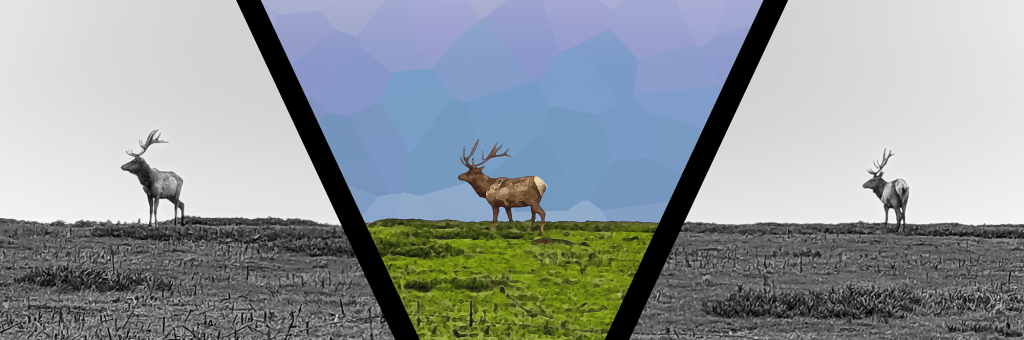
Wild Man

Looking down upon the dangerous place where water meets rock. The image is in black and white, with a V cut through the center. Inside the V, it springs to life and color. The rocks to the right are vibrant; to the left, the water is a swirling mix of toxic aqua blue, green, and yellow.

We had been watching the distant hills for three days. 

The first day, the smoke started as a thin plume, a persistent pale trickle slipping up into the sky.

“They better get that under control.” On the porch, Dad squinted at the vista below. “Conditions like this. This is no good time for a fire.”

I was suddenly acutely aware of my surroundings: the blonde grasses, blanched and crisp underfoot, the prickle of sweat salting the nape of my neck. The sun baking the earth, parching the pine boughs. The breeze had been nothing but billows of heat, even in the night, when the air up in Gold Creek usually cooled to a chill. It hadn’t rained in weeks.

“Should we call 911?”

“Nah.” Dad sat back and tucked a slug of chaw into his cheek. “I’m sure someone’s already doing something about it. We’re not the only ones who see it.”

I watched the curl of smoke with a morbid curiosity, the way you might gape at an accident—tragic that it was happening to someone else, but close enough to the danger for a little thrill.

“Don’t worry about it, wild man,” Dad said. “It’s a ways off.” He called me that, wild man, even though I was twelve years old and perpetually timid, at least compared to him. Dad was the one who had to charge out into the night to scare the scavenging black bears away from the truck when I forgot a granola bar in the passenger seat. This was a brave skin I could not imagine myself wearing, the adult who stomped out into the darkness, swinging the shotgun around like a baseball bat, shouting at the bears to go on, git. There hadn’t always been so many bears in our little town, I learned. In recent years, they were intruding into the populated areas more often because food in the woods was scarce, while human snacks—I had looked at the ground guiltily—were in ample supply.

While the sun baked the ruddy backs of our necks, Dad went about his business and seemed to forget about the smoke in the distance. He unloaded boxes of motor oil from the back of the truck into the shed, pausing to unzip and piss against the papery trunk of an aspen that grew along the side of our mile-long driveway. I kept shooting nervous glances through the tops of the ponderosas. I had never been close enough to a real fire to see smoke snaking up into the skies, but Dad’s movements were bored, methodical. Maybe it was immature of me to worry. Later that afternoon, as the day slipped into evening, the plume of smoke was bigger, fat and puffy as a cloud. When I brought it to his attention, he paused and looked westward again.

“Hmm,” was all he said. The creases between his brows deepened. 

That night, the heat was unbearable. I yanked the windows of our cabin open, but there was no breeze, just a heavy dead swelter that sank to the bottom of the room. I tossed and turned, my lanky legs tangled in fabric, until finally I kicked the quilt and the sheets off into a heap on the floor. The moon was a luminous spotlight. The pine branches cast feathery shadows on the window glass. Everything outside was still, too still, uncomfortably still, the entire night world crouched and breathing like an animal ready to pounce. Sometime after midnight, I tugged the windows closed again. It might have actually been cooler inside, where the hot breath of the world wasn’t panting down my neck. I barely slept.

When yellow sunrise spilled through the windows and I woke, the air smelled smoky, a nostalgic smell that brought me back to campfires, cozy winter mornings. Dad’s face was somber. He refilled the coffeemaker and stared out the window, not speaking, only the sputter and crackle of the hot pad as the coffee trickled into the pot. When he stepped onto the porch with his mug, I followed, too close on his heels. I had the childish instinct to slip my hand into his paw, but I didn’t. Instead, I stood up straighter. I caught myself mirroring him: both of our thumbs thrust through our frayed belt loops. The worn planks were smooth and dusty under my bare feet. Pine needles collected in the gaps.

Dad surveyed the thick column of smoke as he sipped his coffee, sucking leftover droplets from his mustache. 

“It’s still there,” I said helpfully.

“Yep. I see that.”

“Looks like it’s getting bigger.”

He said nothing, his eyes fixed on the hills below us. Finally, he sighed, tapped something into his phone, and frowned at the screen. When he pressed play on a news clip, a woman’s voice spoke.

“—on scene, just west of Gold Creek, Colorado, where crews are struggling to contain a growing blaze of almost nine hundred acres.” Nine hundred acres! My heart jumped up into my throat. I had a hard time picturing that much land, but nine hundred of anything was a massive amount.

“Dad!” The smell of the smoke was thicker now. My mouth tasted of campfire.

“It’ll be fine, wild man. They’re on it. News says it’s twelve miles off.” 

“Are you sure?”

He put a meaty hand on my shoulder. “Think of the Dickinson’s ranch, you know, with the horses? All the way out there? They’re four miles past the edge of town. So the fire’s eight miles further still. That’s a lot of distance, far as a fire’s concerned. Fire doesn’t move that fast, okay?”

I could picture the ranch and the rutted dirt road to the Dickinson’s. A trickle of a creek glittered in the sun. With manes aflutter, horses romped in a celery-green meadow, the only clearing for miles. I had seen an aerial photograph in school once: we lived in a vast, dark river of trees, the granite foothills furred over and swallowed up by pines. From the sky, Gold Creek was barely visible. Four hundred citizens was all, an old mining-era town in Colorado’s high country, every last thing constructed of weathered gray wood, splintered planks, faded hope, rusted tin. Sometimes tourists pulled through in their shiny vehicles and snapped photos of the general store or the cafe or my schoolhouse, once even of the Russell’s weatherbeaten cabin while Mr. Russell stood right there in the yard hosing down the pansies. I had overheard tourists calling us a ghost town, but that wasn’t true: four hundred of us lived here. Four hundred souls, not ghosts, not yet.

The strange, cloying heat unnerved me. It was hard to think of anything else when the air smelled like danger: acrid, almost sweet. The ponderosas’ butterscotch-scented bark, roasting. The smell drifted to the top of my consciousness, choking out any other thought. Nervously, I did my chores: I split some wood and left the ax plunged into the chopping block in the driveway, even though Dad griped at me to move it aside. I heaved the compost bucket out to the pile. Finally, heat-dizzy and drenched in sweat, I slouched in front of the TV, where I was able to forget for a bit. I don’t know how much time passed. Hours, likely, while Dad tinkered in the shed. Eventually, I got hungry and made my way, bleary-eyed, into the kitchen. 

The first thing I noticed was the uncanny light. Too murky for the middle of the afternoon, an uncomfortable yellowish hue like the air was steeped in tea. My vision was still scaling down from the TV’s brightness, and I rubbed my eyes and stepped out onto the porch to be sure. My stomach plummeted. It was wrong, the whole world tense. The sky was a bitter sulfur-yellow. Flakes drifted down, dusting the driveway’s gravel, landing in my hair, mottling the bushes. Snow? I thought stupidly, although of course it wasn’t, not in this heat. I ran a fingertip across the truck’s windshield. Ash.

In the shed, Dad was flat on his back, his head and shoulders buried under the chassis of his vintage MG—his project car. A wrench tick-tick-ticked a bolt into place. Jimmy Buffet crooned from a battered radio on the tool bench. 

“I think it’s getting closer.” I thumped on the MG’s metal skeleton. 

Dad slid out from under the chassis. “What’s that, wild man?” He wiped his greasy, blackened palms on a rag.

“I said the fire’s getting close. There’s ash everywhere. The sky is all yellow. What do we do?”

He stuffed the grease rag into his back pocket and leaned his head through the door, then frowned at the sky and took a few more steps out into the driveway, squinting, craning his neck. Inside the shed, it smelled like fresh sawdust and motor oil, but my T-shirt reeked of smoke, a crackling and sharp scent. My nostalgia for that smell was displaced by a clench of urgency. I twisted the radio dial until I found the news channel.

“—Explosive growth of what’s being called the High Lonesome Fire, which has rapidly blown up to over eight thousand acres in just a short time. The cause of the blaze is reported to be an unattended campfire, despite county-wide fire restrictions. Immediate evacuations are in place for the following areas: High Ridge, Walkerson Pass, Gold Creek, West Park—”

I dashed out into the driveway, breathless. “I just heard on the radio! They told us to evacuate!”

Dad was peering up at the strange sky. “No need to panic.”

“I heard them say it!” I insisted. “They said evacuate! They said Gold Creek!”

“There’ve been fires up here before. Fire’s natural, alright?”

“But it’s not natural! It was a campfire. They already know.”

“Campfire? It’s ninety-four goddamn degrees out. In the shade.” Dad shook his head, stuffing a nugget of chaw into his lower lip. He pinched the tips off a nearby pine branch, which should have bent and flexed, but instead just snapped clean off, a brittle break. “Who needs a campfire now, of all times? Christ.”

“I know! It’s nuts! It’s way too hot for a campfire!” Finally, he agreed with me on something. My voice sounded manic in my own ears. “They said it’s eight thousand acres already.”

“Eight thousand? That can’t be right. Fires don’t grow that fast. That’s almost, what—ten times larger, in less than a day. You must have heard wrong.”

“They said explosive growth. They said it blew up.” It was true—I was quoting the radio verbatim—but I was beginning to feel silly for my repetition. If there was any time to panic, surely it was now. A gust of wind pushed through the pines, a hot smoky breath, and the neighbor’s wind chimes plinged. Flakes of ash caught in my eyelashes. My cheeks were probably scarlet with heat—I could feel them flushed—and I plucked at my sweaty T-shirt. My throat burned as I swallowed. My mouth tasted urgently of smoke.

“This is our home,” Dad said firmly. “We stay put.” When he looked out at the forest, I knew what he saw: the little twig cross I had tied together for our arthritic pit bull, Mick, when I was five. The rose bushes along the driveway that Mom planted before she decided she had enough of this life. Behind us, the cabin that my dad’s grandfather, my great-grandfather, built with his own two hands, during an era that glittered with promise, when men flooded the high country to sift flashes of hope from the gold-heavy creek. It was the only home I had ever known. And all of it—the forest, the cabin, even the crackled creek bed—was dry as kindling.

Ahead of us now, the heavens were darkening. I could see the unholy shape of the sun, a red hazy blot. I knew I shouldn’t stare directly at it, but I did anyway, and my eyes didn’t burn right out of my skull, like I had been cautioned. The sun’s light was too feeble through the smoke. Above us was an apocalyptic sky from a movie, not a sky I recognized. It was no longer a forest I recognized, either. This menacing new forest crackled with its own hot breath. 

Some of the ash flaking down had letters printed on it. Roasted pages of a book, I realized, when I pinched a scrap between my fingers. That meant someone’s house was burning, this very instant. I was coughing now, tears welling in my smoke-burned eyes. I left Dad out there, staring up at the sky in silence, ash collecting in his arm hair as he did nothing, nothing. I grabbed the radio from the shed, ran back out, cranked the volume up.

“Did you hear that?” My voice cracked. “They said there are flames south of County Road 42! That means the Dickinson’s ranch is gone already! We have to do something!”

“Good God,” Dad muttered. “It’s not supposed to happen that fast.” He was frozen in place, gaping at the sky.  In the driveway, I left the radio blaring on the hood of the Chevy. I ran inside the cabin and grabbed what I could: our photo albums from the bookshelf. The file folder Dad tucked important papers into, even though I wasn’t sure what exactly it contained. An armload of food swiped from a shelf into a canvas bag. The dented coffee can on top of the fridge where he stashed crumpled wads of cash and spare change. Scanning my bedroom, gulping: my pocket knife, the photo of Mom with the bent edge. It was very dim now, a surreal timeless dark. My throat burned. On my way out, I flicked the porch lights on, but the weak light did little to cut through the haze. Wind whipped through the trees. The forest was full of shooting stars: the ash had turned to embers streaming through the sky.

 I tossed our things into the back of the Chevy. Had the sense to yank a tarp over the bed to protect our stuff from embers.

“Dad!” I shouted, even though he was only a few paces away. “I packed up. We have to leave!”

Now I could make out an amber glow through the pines that twisted my gut with an animal panic. I knew, without a doubt, that this was the end of something. The end of everything.

“Come on! Please! We have to go!” My eyes were streaming: smoke, fear. Grit and ash stuck to the wet tracks on my cheeks. I started towards him to grab his hand, but just then, an ember lanced through the air like a comet and seared into his shirt. On his shoulder, a hot firefly glow, a sizzle, a blooming ring of charred black fabric. Finally, he startled to life. He yelped and swatted the cinders from his skin. He looked at me with a terror-stricken face I will never forget.

“Let’s go, let’s go!” he roared. I was flooded with relief, but only for a moment. In his panic, he dashed towards me. But I’d left the chopping block in the way, with the ax sunk deep in the stump. It happened in slow-motion: Dad catching the ax handle with his shin, tumbling over himself, crumpling to the dirt. 

I ran to his side. He grimaced, clutching his leg.

“Dad! Are you okay?”

“My leg’s hurt. I think it’s bad. I don’t know if I can—” He tried to stand and collapsed. “It might be broken. Goddammit!”

I tried not to look at the ominous glow pulsing through the trees. The heat rose around us in waves. “We have to go.” I pulled him up. “Now!”

“I know, dammit! Just help me get into the truck!” When he leaned on me, he was heavier than I was prepared for, but we managed to shuffle over to the Chevy. He hoisted himself up into the passenger seat, wincing.

“You’re going to have to get us outta here, wild man. You get to learn how to drive, right now.” He flashed a grin at me, an attempt at playfulness, but his eyes were gleaming, saucer-wide. That split second, when we stared at each other across the bench seat, I knew I wasn’t a kid anymore. I clutched the steering wheel like I was holding Dad’s very life in my grip. I didn’t want that responsibility, but there it was. Dad had left some old sweatshirts on the floor behind the passenger seat, and now I stuffed them under my butt so I could see over the steering wheel. 

The salmon glow through the trees had begun to flicker and throb. We were out of time. Still, I was determined to pilot us as far as I could. When I yanked the shifter into reverse, the radio toppled from the Chevy’s hood. I backed right into the chopping stump, and I felt the bumper crumple.

“Forget it,” Dad said. “Keep going. Just go.” He leaned over and flicked on the windshield wipers to clear the scrim of ash. The sky ahead of us was sinister. We tore down the driveway, the shape of the familiar ruts cupping the tires. The truck bucked and swayed in my unskilled hands. Scraggly juniper arms clawed the side of the truck, squealing down our metal flank. I turned the headlights on to pierce the smoke.

“Go faster. You need to go faster.”

I rammed the gas pedal down. Thankfully the truck was an automatic. Just before I reached the mouth of the driveway, I was met with flame. Fire leapt through the scrub oak to my right, scrabbled up the tree trunks. Embers and ash flew towards us like charred butterflies. 

“Keep going. Keep going!”

“I know! I am!” I stomped the gas pedal down with the tip of my toe, jarring us over the spot fires blazing in the road. Sparks streamed down upon us. Now the woods on all sides of us were ablaze. The forest floor was singed black, glittering with terrible cinders. Flames lapped greedily through the canopy above. I saw the trunk of a pine tree that crackled and glowed like hell. 

At the main gravel road I turned left, instead of right toward Gold Creek. The fire had come from that direction. If it was already here at the mouth of our driveway, then nobody needed to tell me our town was gone. The sky was darker now. Flames raced through the undergrowth. I managed to keep the truck on the road, but I jostled us around wildly. Dad grimaced and clutched his leg with every jolt.

Then finally, ahead of us, the thing I feared most: a wall of leaping flame, two stories tall. The road consumed. The smoke billowing and churning. Tongues of flame that writhed and whipped and spun. 

“What do I do?”

“We’re all out of options.” Dad’s voice was desperate. “Just keep going. It’s up to you.”

I swallowed hard. I stomped the gas pedal down. I tried not to squeeze my eyes closed as the Chevy leapt through a tunnel of flame. I wanted to shut it all out—the heat welling up inside the truck, the smell of burning rubber that choked my throat, the terrifying whoosh and crackle outside—but I knew I had to keep my eyes on the road. So as I drove us into the heart of the inferno, I saw it all: the searing flames, the cavern of heat. In the passenger seat, Dad’s eyes were tightly closed. His mouth moved as he mumbled, or prayed. It was unfair, I thought, in a flash of anger. He should have to face this, too.

And then we punched through. On the other side, spot fires crackled in the underbrush, but we were finally ahead of the wall of flame. Veils of smoke drifted apart and dissolved into haze. Ahead, the sky darkened to indigo, the color itself a visceral relief, like deep water. The temperature inside the cab cooled in moments, but I could still only smell smoke. I tried to swallow, but my throat was baked dry. My mouth bloomed with iron, where I had bit my lip.

“Sweet Jesus Christ.” Dad cracked his eyes open. Past the fiery underworld, it was dusk, the final remnants of day sinking into darkness, the moon’s beacon rising. We said nothing. We just sat there as I drove on, trembling, shell-shocked, nerves flayed and buzzing but numb with relief, everything marinated in the stench of smoke and burnt rubber. I would smell it on my hair for days, no matter how much cheap shampoo I scrubbed with at the evacuation center. The phantom smell of smoke would wake me every night for weeks. 

Even once we were well past the fire, I kept driving, resolute. I did not look back over my shoulder, but every so often a flash of terrible saffron gleamed at me from the rearview mirror. I tried not to think about the quilt Mom had made me, still crumpled on the floor near my unmade bed. The silky manes of the Dickinson’s horses tossing in the sunlight, when I had still been a child. The forest where I had run barefoot and wild, learned to shoot arrows, carved my initials into an aspen near the driveway with the tip of my pocket knife. 

We rumbled through the forest, down the granite cliffs of Deer Canyon, up and over the next hill where the road curved again through a clearing. When I had put some distance between us and the fire front, Dad thumped the dash with his palm. “Pull over for a second. Tarp’s loose in the back.” Sure enough, in my side mirror, the soft flapping of a nylon wing.

I steered the Chevy to a halt.

“Put it in park,” Dad reminded me, although I had already clunked the shifter into P. He kneaded his leg as I hopped down from the driver’s seat. The cool night air hit me in a rush, fresh as running water. I breathed deeply.

I had a view of the foothills behind us. The sky was a deep cobalt, darkening, the mountains a black silhouette. Stars glimmered above like shattered glass. Peach smoke churned above the ridge. The fire had consumed my childhood, just like it had consumed the Douglas firs and the squirrels, the speckled fawns and the bluebells, every other gentle thing I couldn’t let myself dwell on. I could still see throbbing flames, which from a distance, looked like a handful of strewn embers on the hills. The coal-dark heavens glittered above, the scorched earth glittered below.

I re-tied the tarp, this time with a proper bowline instead of a hasty square knot. Back in the truck, Dad looked drowsy enough to fall asleep, and when he leaned his head against the window and fluttered his eyelids shut, I let him. It was miles of dirt road, still, winding and rugged terrain, until we would reach the city. But I could get us there. I knew the way.


Molly Seeling

Molly Seeling is a writer, photographer, and filmmaker based in rural Colorado. Her work has been published or is forthcoming in Landing Zone Magazine, Spry Literary Journal, and Unfortunately, Literary Magazine.

Header photograph and artwork by Jordan Keller-Wilson

Unbecoming

Looking down upon the dangerous place where water meets rock. The image is in black and white, with a V cut through the center. Inside the V, it springs to life and color. The rocks to the right are vibrant; to the left, the water is a swirling mix of toxic aqua blue, green, and yellow.

(content warning: sexual assault and abuse)

760°C is the optimal level for melting. They may go higher if you are too resistant, though this may make your vessel too pliant after cooling. 

Once you are in a liquid state, they pour you into a mould where you coagulate and harden into your vessel.  

They spray you with sand-coloured paint and stamp the pink on your cheeks, the red on your lips, the peach on your fingernails. They stitch long black hair to your scalp, curl it, spray it. 

They inject you with earthly knowledge of mathematics and biology and celebrities and philosophy and mythology and history and the universe. You learn the rules to follow: Don’t be a slut, but don’t be a prude. Be strong, but not a bitch. Be maternal, but not a nag. 

A white lace dress shrouds your face, catches on your breasts, and then flutters around your knees as they drop you down, down, down from the sky.


He texts you back after two minutes, so you follow protocol and wait four. 

Record these numbers in your fieldnotes and report back. 

Generate a sense of intimacy with your human target by exchanging flirty banter: an inside joke about peaches, an expertly placed winky face emoji sent no more than every five messages, overexaggerated disbelief at the fact that you have the same taste in music.

After a rapport has been obtained, he sends you paragraphs about his childhood and his past girlfriends and his thoughts on the current political climate. You reply thoughtfully—a good method to convince your target that you are kind, which is a very desired trait in women, you’ve learned. 

You are already learning so much. Perhaps more than you should be.

His tales of summer camps and boarding schools suggest childhood neglect. Therefore, you must be loving and caring and sweet toward him. He says all his ex-girlfriends are crazy, so don’t be too high maintenance or question his judgement. If he explains something to you that you already know, do not point this out to him. Should he ask you about your opinions, do not say too much. (Incidentally, he doesn’t, you note.) 

Before he falls asleep, he texts you, let’s hang at art gallery tom 3pm.  


When you arrive at the art gallery, he is not there. If a target is late, you must wait at least thirty minutes before contacting him so that you do not seem needy. This is part of protocol. You are in control. 

You do not want to bother him, so you wait an hour before calling.  

His voice sputters from the phone, Hello? 

You say, I’m sorry—but—where are you? 

He says, Oh, shit, uhhh—um, something came up, can we reschedule? 

You say, It would have been nice if you could have told me that before I got here.

He says, Something came up, I forgot. 

You say, I’m sorry. Of course, I understand. 

He says, I’ll text you later. I’d really love to still see you.

Record this in your notes, make a chart.


When you see him two days later, he wears a dress shirt and jeans stained with greyish blue clay. He is older, lanky with flat dark hair, and you are not sure if you find him attractive or if it’s just how they trained you. When he shifts his body close to you, you feel inferior and powerful in your short lace dress. 

He calls you beautiful and you watch him watch you as you look down and blush the way they taught you to. 

You walk past paintings of voluptuous, soft, naked women that, as you progress through the gallery, shift from primitive spheres to sensual strokes to amorphous lines, bursts of colour.

The two of you walk through the gallery in silence. When a target is not contributing anything to the conversation, the responsibility falls on you to say something to capture his attention and remind him of your charm. 

You say, I don’t get contemporary art. I like art like this. 

You stare at a painting of a woman arching her white, hairless body toward a cloudless sky, eyes averted, arms passively extended toward the encroaching tendrils of a willow. 

You don’t know if you believe it or not, but you think it’s the kind of sentiment he would find endearing. 

You must watch yourself as if your target is always watching you. Perceive him perceiving you. Mean what he wants you to mean.

He says, Me too. Modern art is BS. Like, anyone could do that.   

He glows when he feels seen by you and you glow in return when you catch him watching you.

On your way out of the gallery, you see a painting of an angry young man standing naked on top of the head of Medusa. 

You ask him, What’s your type? 

He says, I love strong women. 

Before he goes, he hugs you so hard his fingers leave small whirlpools on your arms.


His house is at the bottom of a hill, behind a forest of pines, surrounded by a field of long grass and yellow wildflowers, not far from town. He leads you into his garage: large, with an equally large black car on one side and a studio on the other. There are pottery wheels, sharp wooden tools, a kiln. Clay sculptures—most of them of unknown women—rest on almost every surface.. 

He says he wants to sculpt you. He takes off your dress and places you on a stool and arranges your legs, arms, hair and begins to knead and chisel away at a small mound of clay.

A consequence of travelling through time and space is that your body may glitch and warp, flickering in and out of view for a brief second or two. 

When you disappear from his view, his eyes will search for you. 

Even when he cannot see you, remember he is always watching. Sit up straight, bat your eyelashes. Without him, you do not exist.

As the clay grows limbs and breasts and hair, you realize you do not know what you look like. 

When he finishes the sculpture, you ask him if he has a mirror. There is a small one lying on a table, and he holds it up to your face. You touch your black eyelashes, your flushed cheeks, your long hair, and the woman in the mirror does the same. 

As you gaze upon your reflection for the first time, you say, quietly, that you look strange. 

He says, That doesn’t sound like something you would say. You are so confident.  

Before you leave his garage, you take a photograph of yourself with your phone. 

You study the photo and think your face, your body seem wrong. You want to split yourself open and spill out of yourself. 

He catches you looking at the photograph and scoffs, God, you are vain. 

You say, It was a bad photo. I don’t like it anyway. 

He walks over to you and pulls you close and says, But you are so pretty. 

He kisses you, rough, wet. You are supposed to close your eyes, but they stay open, look away, search. 

You glitch and flicker.


When you aren’t engaging with your target, you slip into a nothingness suspended between sleeping and wakefulness. You cannot fall asleep. You can only think of him.


You enter his bedroom for the first time. Sunflower wallpaper, sculptures and art supplies scattered on a small desk, mattress on the floor. He turns on his stereo, and it hisses and warps with interference when you pass by. 

He entangles a fist in your long hair and yanks it back, yanks it back. He moves in you so roughly you think your vessel might break, collapse in on itself. If you could bruise and bleed, you would. You know when to make noise and how to configure your body and how to make him feel good. If you could feel pleasure, you wouldn’t; this part of yourself is unknowable. 

You stare at his wallpaper and count the sunflowers. 

He turns to you and says, You’re not like the other girls. You are special. You are kind. 

Your chest burns; something inside stirs, grows, no longer fits.  

Leave this out of your notes.


You text him and he doesn’t respond for eight hours. 

Write this down. Look for correlations, causations. He’s probably in a bad mood because there’s supposed to be scattered showers tomorrow at noon, and he hates the rain because it reminds him of the night his childhood dog ran away. 

You are supposed to wait sixteen hours before responding, but you reply in two minutes. 

He responds a day later. 

Write this down, too. He is probably just busy with work. He doesn’t have a job, but sculpting is certainly work, even if he doesn’t sell anything.

If a target stops responding, it is protocol that you should not be emotional. Attachment is a sign of defectiveness. You should always be in control. 

But you want to call him, you want to see him. 

You do not know why they want you to feel bad for wanting. You do not know if this is something you are allowed to wonder about.   

Don’t write this down. Eventually, he texts you, wyd?


You’ve counted all the sunflowers, so now you count the petals.

His hands knead, scratch, dig at your flesh. He says, I think you’re the one.

He slaps, punches your face. He says, What music should we play at our wedding? 

He wraps a belt around your throat and pulls. He says, I think you were made for me. 

You’ve counted all the petals, so now you count the seeds. 

You aren’t sure if you like it, if you want it, but you never tell him to stop. He never leaves a mark, anyway: you are flexible.

You’ve looked at the sunflowers so much that they no longer look like sunflowers, just a wall of melted yellow.


When you see him next, you ask him why he’s been ignoring you.

He turns away and covers his head with the blanket and groans. 

You ask him if you could spend more time together. 

He gets up from the bed and says, You’re not the dictator of this relationship. 

You say, Okay, I’m sorry. 

He says, Not everything is about you. You can really be brainless sometimes. 

You say that you know, you know, you’re acting crazy. You’re sorry, you’re sorry. 

You put on your dress and head for the door.

He gets up and stands in front of the door and says, I shouldn’t have said that. I’m just sad you’re so mad at me. 

He grabs your wrists and looks in your eyes and it feels so good to be seen. 

You aren’t sure if you want him because this is how you were trained or because you love him. 

You cannot possibly record this in your notes.


Weeks later, as you lay next to him, you ask him if he’s seeing other girls. 

He says, Why do you care? 

You say, I just want to know.

He scoffs and mumbles, You really are kind of crazy, huh? 

You are angry and you are not sure if you’re allowed to be, so you cry. 

He tells you to stop being so pathetic. He says that just because a boy acts like a boy doesn’t mean you’re some kind of victim.

You say, I know, I’m sorry, I’m sorry. 

When he goes to shower, you pick up his phone. Fingerprint protected. But you would never. You are not like the others: you are not crazy. 

He wraps you in his arms, all wet and dewy, and says, I didn’t mean to yell. I just get angry sometimes because I like you so much. 

He whispers in your ear, I’ve always wanted four kids. I’d name them…


His breath is deep and even and the ridges of his spine ripple as he curls away from you. On the bedside table, his phone vibrates and lights up, bathing the yellow walls in blue. You slither out of bed and grasp his finger, place it on the backside of the phone. 

His camera roll is full of pictures: most of them selfies, some of them with friends, some of them with girls. The girls are stacked on top of each other in little squares like a collection, like the sculptures in his garage. 

There is a girl with vanilla blonde hair plastered all over his Instagram. Pictures of them go back 58 weeks: embracing, kissing, wearing matching sweaters.  

You want to hit her and make her bleed and put a belt around her throat and pull her hair. 

He stirs in his bed and you aren’t sure how it happens, but you blink and then he’s on top of you and he’s ripping the phone from your hands. 

The words spew out of him, hot and sticky. He asks you what’s wrong with you and why you can’t just be sweet like a normal girl. He tells you that you’re a bitch, you’re such a crazy bitch. 

You say that you’re sorry, you’re sorry. 

He tells you to get out of his house and that he wants nothing to do with you and that he never did.

He lets you go, but as you head for the door, he grabs your arm and pins you to the floor and rips the sleeve of your dress. 

You want the rage to flow out of you in tears. You cough and sputter and choke, trying to exorcise your anger like a demon. 

He twists your hair and jerks your head back, over and over and over. The stitches on your scalp loosen, your neck stretches out. 

He stops and flings you away and says, What are you? 

He stares at the black coils in his fist, at your plasticine head lolling in front of your breasts.

He covers his eyes and staggers into the wall and calls you a monster, he yells it over and over and over again. 

You cradle your head in your hands. You scratch the paint off your face, claw at your eyes.

When he looks up to face you, his body stiffens and his skin turns the colour of oxidized marble. You strike him and strike him and strike him and he crumples to the floor like dust. 

You run into the garage and grab the sculpture he made of you from the top shelf and smash it. You topple his shelves and his tables, leaving his collection in shards on the floor. You run out the back door and dawn follows you across the field, painting the long grass with pinks and reds. You sprint through the grass and wildflowers, kicking up pollen and tardy fireflies, and the hem of your dress gathers up mud and twigs as it peels off you like a chrysalis. The pines bend with the wind and clear a path for you into the forest. Orange sunlight seeps through the leaves and into a pond.

You peer down at your reflection and then splash it away with your feet. Your feet sink into mud, and moss and vegetation curl around your toes. The water, thick and warm, envelops you and guides you under. 

They beam you up, up, up from the water, arms raised, coated in slime, trembling and then shrieking and then laughing from the crooked mouth of your lolling head. 

Boils bubble and blister under your skin. As you whirl past stars and floating rocks, the rest of your vessel ruptures into chunks and then melts into a pool of black liquid, thick like tar. Parts of you bob to the surface and parts of you spiral and sink: a battered arm, a fingernail, a face you would not recognize and no longer feel the need to see. 


Sophia Savva

Sophia Savva is a writer who has lived in Toronto, Tokyo, and Halifax.

Header photograph and artwork by Jordan Keller-Wilson

Floyd’s Left Leg

The side of a building with many fire escapes. The photo appears in black and white with a V-shaped center section in bright, comic-book style color, the building vibrant orange-red.

“Fucker!” Floyd yelped loudly when the car door grazed his calf as Annie opened it.

“Oh, I’m sorry, hon!”

“The fuck you are.” Floyd slapped the door and instead of offering his hand to help her out of the car, spun on his heels, and headed toward the church.

Annie took a deep breath, pursed her lips. Floyd is sensitive about his leg, she told herself. It ain’t you. He would have sounded off at anyone. She collected her purse and swung herself around in the seat, grabbed the handle with one hand, and heaved herself out.

Floyd was maybe twenty feet away and had stopped, took out a cigarette, and lit it.

“Hon,” Annie said, “can’t you wait til after? You know I hate when they can smell it on you.”

“To hell with them. Either the good lord is the good lord of tobacco too or he ain’t the good goddamn lord at all.”

Annie walked toward him. “Please.”

“You drug the damn door right across my leg! It hurt and now I need to calm down before I sit in there for two hours listening to bullshit.”

Church was, for Floyd, either “bullshit” or “snake oil,” depending on his mood. When he’d had a few beers he became philosophical and described religion as “more about feeding the preacher’s pocket than feeding my soul.” When he was in a miserable mood it was just “so much bullshit to keep us from having any goddamn fun.”

Ten days earlier, Floyd had been at the gas plant when he stumbled and fell on a catwalk, causing his left leg to be pressed against a generator exhaust pipe. His leg had been burnt enough that he was sent to the emergency room and had to talk to a company lawyer who gave him two days off, paid. Since then, Floyd had walked with a little limp and complained about the pain. He wouldn’t sleep with the sheet on his leg, and groaned when he put his pants on, saying the fabric itself felt like sandpaper on the burn.

Annie had been patient, of course, as always. She kept the dog from jumping on him, made cold compresses for him every morning when he got home. She made his follow-up appointments and went to the pharmacy for his various medicines on her lunch break, or after her shift, if the diner happened to be busy. She took care of him, like she always had, and all she asked was for him to go to church with her without complaint. She’d been raised in the church. It was important to her. And, she often had to remind him, if she was important to him then he’d go without complaint.

But his leg was burnt. Not deeply, but it had been terribly red for a few days after the incident, so she was willing, always, to give him the benefit of the doubt.

The accident had happened on a Thursday, so of course she had stayed home with him that first Sunday. Last night she had asked if he was well enough to attend services the next morning and he’d said that he might be. It had taken some urging but he did finally get dressed this morning and say, “Well, guess I’m going.”

Floyd flicked his cigarette to the ground as they walked toward the door. As was the custom, Pastor Edgar stood at the door greeting each member as they arrived.

“Floyd and Mrs. Turner. So very glad to see you here this morning.” He took Annie’s hand in both of his. “Sorry you missed Sunday School, of course, but I understand you’ve had your hands full taking care of your husband?”

Floyd cleared his throat. “Yeah, she’s had to watch me hobble around a bit.”

Annie smiled. “Oh, you know Floyd. He’s strong as a bull and twice as ornery!” 

Pastor Edgar laughed and Floyd said, “Well, I guess we better get in there. Don’t wanna miss the show.”

They began making their way through the crowded foyer. Channel Methodist wasn’t a large congregation, but the building, built some thirty years earlier, was now too small to comfortably handle the flock.

As they walked through, Annie saw a child running toward Floyd. Before she could warn him, the kid barreled into Floyd’s leg. She screwed her face up, hoping to get there before Floyd let out a holler, or worse, said something to the little boy, but Floyd didn’t seem to notice. Annie was confused.

When they found a pew, Floyd started a conversation with Gary Miller and Annie reached for a hymn book on the backside of the pew ahead of them. She made sure it bumped Floyd’s leg, right where he’d set the cold compress the night before—all the while complaining that she’d sure taken her sweet time while he’d sat there in agony.

Annie considered all this as the announcements were made. She wrestled with what to do as the choir sang hymns 38, 232, and verses 1, 2, 3, and 5 of hymn 166. As Pastor Edgar began his sermon, titled “What Are We to Do?” Annie considered the man next to her, who had fallen asleep, sometime between verse 5 of Hymn 166 and the reading of the day, the Gospel of St. Luke, chapter 3, verses 1-18.

As they exited, again Pastor Edgar stood by, shaking hands and politely refusing offers for dinner.

Annie extended her hand and her offer of a casserole dinner, as the moment demanded, and then, after Pastor Edgar assured her that he had a dinner engagement at his mother’s in a few hours, Annie said, “Pastor, Floyd was wondering if you might pray over his leg. That it be healed.”

“Do what now?” Floyd, unlit cigarette in his hand, seemed to sway backwards as if a strong wind had caught him.

“Pray over his leg?” It was obvious that Pastor Edgar was equally unprepared.

“Yes,” Annie continued. “It’s been ten days, and it still hurts him terribly.”

“Now, Annie,” Floyd said, “no cause for that.”

“Why on earth not, hon?”

Pastor Edgar swallowed hard, his discomfort apparent. This sort of thing was uncommon, Annie knew. She’d never asked or even seen a congregant actually ask Pastor Edgar to pray over someone. Still, he was a man of God and, while he was no Pentecostal snake-handler, his job was to pray. Annie smiled and held his gaze until he turned to Floyd. “I could say a few words, if you’d like.”

“I think that would be good, Floyd.”

“Well I don’t want to be a bother.”

“Oh, I’m sure it isn’t a bother, is it Pastor?”

“Well, no, of course not.”

Annie looked at Floyd. He was pale and small looking. The unlit cigarette still held between his fingers, his lips quivered.  Annie knew there were few things Floyd hated more than bowing his head to anyone or anything, the Lord included. On any other occasion, he would have balked, refused, and walked away. But Annie had maneuvered herself and the Pastor into his way, with folks behind Floyd, staring, wondering why the Turners were taking so long to say their goodbyes. Floyd’s face was now red with embarrassment and Annie knew that was the only thing he hated more than praying.

“Bow your head, hon.”

Pastor Edgar proceeded to ask the Lord for His healing mercies, and that a hedge of protection be placed around the Turner household.

“Amen,” he finished.

“Amen,” Annie replied.

As they walked back to the car, Floyd was quiet. He started around the car to his door when he noticed Annie standing at hers, staring at him. He paused then came back to her side, opening the door for her.

“Thank you, hon,” she said, and got in. Floyd went back to the driver’s side and sat behind the wheel. He hesitated with the key, and stared straight ahead. Annie took the rearview mirror, turned it, and checked her hair.

“I think I’d like you to take me out this evening, Floyd. There’s a new seafood place up in Jacinto City that Pam told me about.” With that she sat back and began pulling a cigarette out of the pack she’d left on the dashboard. “Could you light me up, hon?”

Floyd looked out the way an animal at the zoo looks out of a cage. He reached into his breast pocket, produced a lighter, and turned to her.

“Course,” he said.


Travis Cravey

Travis Cravey is a high school maintenance man in Southeastern Pennsylvania. His first collection, Manifold, was published by Emerge Literary Journal in August 2021. Honestly, he seems like a pretty good guy.

Header photograph and artwork by Jordan Keller-Wilson

Mort

A fallen, yellow leaf lays on a rock, ice melting around it. The photo appears in black and white with a V-shaped center section in bright, water-colors.

Lena McCuskey took Danny’s virginity on a hot Friday afternoon an hour after last period. He’d pulled his car into a shady corner beneath the cherry blossoms at the edge of campus, his car half-hidden by the dumpster situated next to the back door of the gym. It was all thanks to the car that he found himself splayed in the back, Lena pulling down his pants with one hand while managing to yank up her t-shirt with the other. He was sweating and trembling, his hands shaky as they reached up and cupped Lena’s sides. Her mascara was running, not because she was sobbing with regret or fear but because of the melty heat; it grabbed her hair and slapped it against her face, like tendrils of dense, rotting seaweed. The car’s interior was already humid like a greenhouse, the windows gathering condensation, which Danny could barely see thanks to their dark tint.

Danny drove a hearse.

When his parents bought the car, surprising him on his eighteenth birthday, a heavy snowstorm came through in the middle of the night. They brought him outside in the morning, blindfolded. He could tell his parents were proud of themselves, both grinning above their steaming coffee mugs, wearing their matching pajama suits and puffy slippers. They stood in the jaw of the garage while Danny tiptoed out into the driveway, his feet crunching through the chunky, ice-slicked snow. He uncovered the recognizable humped vinyl roof.

“Really?” he said.

His mother frowned. “It’s what we could afford.”

“The driver’s seat is actually really luxurious,” his father said. “It’ll make you interesting and different.” 

Danny resisted the urge to say, It’ll make me a freak. He knew his parents cared, that they worked hard. His father managed a Walgreens, and his mother worked at the local university’s health center doing medical coding. They must have saved and discussed and searched and searched to buy him this car. 

As if reading his mind, his father said, “We got a good deal.”

“Thanks,” Danny said. “Really. It’ll be, uh, unique.”

“That’s the spirit,” his parents said in tandem. They drank their coffee. His mother said, “Now let’s get inside. It’s cold. I’m pretty sure you have a snow day.”

That cold was gone as Lena pulled off his underwear. Danny was semi-hard, and she took it in her hands without a word. When he’d first shown up in the hearse, his classmates had guffawed and elbowed him in the ribs, making jokes about how the goth kids would love it. Danny’s parking spot—he’d paid for one at the start of senior year in the hope that he’d have a car before school was over—buttressed the walkway between the school’s two buildings, and word of Danny’s ride spread fast. The popular kids made jokes about Danny’s parents changing careers (not that any of those kids had any idea what his parents actually did for a living) and one of the football players started calling him Mort.

“Get it?” he said one day, sidling up next to Danny at his locker. “For mortuary.”

“Yes,” Danny said, shoving his physics book into his locker. “I do.”

“Oh, come on,” the beefy red-headed linebacker with bloated arms and a beer belly said. “It’s funny.”

“Ha,” Danny said.

The football player wandered into the scrum of students. Scuffed lockers opened and closed, students laughed and jawed one another, sneakers squealed against the tile floor. Danny threw himself into the din, marching toward his AP English class, where his teacher tried to get them to discuss Timequake, asking what they would do if they had to relive the last ten years of their lives without being able to change anything, knowing exactly what was coming.

“Be pretty awful for everyone who died,” Lena McCuskey said. “Imagine getting on an airplane you knew would crash.”

Lena was the leader of the goth group. They all wore dark, monochromatic pants with t-shirts that looked like they’d been sucked through a wood chipper. Their lips were black, their eyes heavy with mascara. Lena’s backpack was strangled with safety pins. She was smart, the English teacher’s favorite despite the deadpan delivery of her conversation-halting comments. Danny had been paired with her as a junior in their college composition course. They’d written a partnered research paper on the Pennsylvania Turnpike murders, leaning over microfiche machines to read four-line blurbs from ancient copies of the New York Times. She’d been studious, not one for chit-chat, and had driven them to the St. Louis Public Library off Lindbergh because their suburban dinker, while full of paperback romance novels and a vibrant children’s section, suffered a dearth of archival materials. 

Lena’s Buick LeSabre smelled of clove cigarettes and McDonald’s fries. She didn’t speak while they drove, nor did she play music. Instead she rolled the windows all the way down despite the cold that spun her hair into her face. She didn’t push it away from her eyes as she navigated I-270, passing cars left and right, engine rattling as she broke eighty, eighty-five miles an hour before at the last second, at the Olive Boulevard exit, careening off. Danny had expected her to perhaps relish in the grisliness of the Turnpike murders, the mystique, but no: when she spoke, it was only to call out roll numbers and dictate how the order of events should unfold in their paper. They received an A.

She approached him months after he started driving the hearse, after his new nickname had spread like an infection. Everyone was calling him Mort, as if he were old and balding and clammy. Lena stood next to his locker just like the football player had, slouchy against the neighboring steel grille. Her hair was glossy in the hard light, so dark it looked like a wig, her pale skin like porcelain. 

“I like your car,” she said.

Danny blinked at her. It was the nicest thing she’d ever said to him.

“Could I check it out?”

“There aren’t any dead bodies.”

“Well that’s disappointing.”

Danny shut his locker. They started walking toward English.

“I think it suits you.”

Danny wasn’t a jock, though he did go jogging on weekends and grunted through pushups and crunches every morning, so he was in better shape than anyone would have guessed. He wasn’t a band geek, or a drama nerd, or a gamer. He didn’t count himself among the stoners, and definitely wasn’t among Lena’s goth crew. Danny liked to read, but he didn’t carry thick tomes into the cafeteria. He had a smattering of friends from various cliques. His best friend went to the private high school a few blocks away, and on weekends they sat on one of their back porches, playing cribbage.

“After school, then?” Lena said when they arrived at the classroom door. 

Danny nodded.

She said little that first time, looking over the interior, which was clean: beige leather seats, onyx accents on the dash and radio consoles. The casket rollers and bier pins were still installed, but Danny’s mother had helped him cover them with some blankets and had even made jokes about him bringing girls back there; that’s why she’d chosen a muted gray color: “We don’t want the back to be too romantic.”

Lena fiddled with the evergreen air freshener dangling from the rearview and then toyed with the radio, letting staticky whisper fill the interior.

“I expected it to smell like embalming fluid.”

“I think they cleaned it pretty thoroughly before it went up for sale.”

She stretched out her long legs. “Lots of space here, at least. What’s it like to drive?”

“Like steering a boat.”

“You’ve steered a boat before?”

“Metaphorically, I guess.”

That made Lena McCuskey smile.

On their second afternoon together, Lena said, “Do you ever wonder about the bodies that have been in here?” She looked around as if doing an appraisal. 

On the third occasion, she turned to look in the back and said, “Can we sit there?”

“Sure, I guess.”

A stud winked in Lena’s left nostril, and Danny asked about it.

“New,” Lena said. “Did it last weekend.”

“Did it? Yourself?”

Lena laughed. “I have a cousin who works in the mall. Does it all for free.” She pointed up at her right ear, which was a panoply of stones and tiny gold hoops that munched all the way up to the cartilage at the top. 

“Tough time getting through airport security.”

“I’ve never flown anywhere.”

“Really?” 

She shook her head. The interior of the car was warm thanks to the sun. Lena’s upper lip was dotted with the lightest bit of sweat. “My parents are homebodies. They went to fucking high school here. They live in the house my dad grew up in.”

“Wow.”

“What about you?”

Danny shook his head. 

She kissed him then. Danny could taste the perspiration on her skin. Her breath was warm and smelled of strawberry. Her tongue plied at his lips and he opened them just so. He wasn’t sure what to do, so he kept kissing her, his hands pressed against her sides, where he could feel trim, sinewy muscle. 

When she gripped his erection, he shuddered and said, “Do we need—”

She shook her head. “I’m good.”

“Good?”

She blinked at him. “I’m on the pill.”

“Oh. Okay.”

It was over quickly, which made Danny feel sheepish. Lena tilted her head and said, “That was your first time, wasn’t it?”

He felt a flare in his cheeks, which were already flush from the heat inside the car, their bodies’ mingled sweat. He could smell his natural aroma: salty and fuzzy and faintly tart. 

“You were gentle,” Lena said. “Boys stop being gentle fast.” Her voice was different as she spoke, as if she was holding back something that she didn’t want Danny to hear, a bit of broken glass in her throat. Maybe it was her real voice. Or maybe it was an invention. He didn’t know for sure whether she was or wasn’t who she made herself out to be. Lena pulled on her clothes and smiled at him, her teeth bright and clean. Danny was still naked. He tugged his pants to his crotch in a ball of denim, his underwear tangled in the legs. 

“Don’t worry,” she said. “You were fine.”

“Fine?”

“Trust me,” she said. “That’s a positive.”

Then she crawled over the center console and sidled out the passenger-side door, letting a burst of afternoon air in after her, leaving Danny alone with the sticky air and a shuffling feeling inside him. He sat still for a long moment before pulling on his pants, his crotch swampy. When he dragged himself into the front seat, his foot caught on one of the rollers underneath the blanket and he flew forward, nearly smashing his face against the dashboard. 

He gathered himself and turned on the ignition, leaning into the air conditioning that crusted the sweat on his forehead. Danny gripped the wheel, stared forward at the rotting wooden fence at the edge of campus that separated it from the neighboring private property. A strong afternoon breeze danced the branches of the trees that loomed above the fence. He felt spent, empty, tired. Instead of the starry endorphin-laced euphoria he’d always thought would come after sex, he felt a thick malaise, like he’d eaten too much.

He drove home in a daze. Every light was red. At each stop he felt the eyes of the drivers idling next to him sliding his way and—though he knew the hearse was the source of this staring—Danny was convinced he must look different, that the stink of sex must be vibrating out of him, illuminating his skin with a blinding alien glow. But when he glanced down at his hands, they were the same as always.

When Danny came through the front door, his father was slumped back in his Barcalounger, grumbling at the television while he played video games. Danny didn’t know any other parents who still dug Nintendo, and it was a seesawing point of both pride and embarrassment; sometimes Danny thought it was nice that his father felt youthful enough to navigate Mario and Link and Samus around on screen, but other times he thought he was the one who should be obsessed with those pixelated adventures. 

“Happy Friday,” his dad said. Danny’s father was a big man; he’d played football in high school, though he hadn’t been good enough for the college level. His face was always a shag of a full, thick beard, and he had hairy arms that seemed to go on for days. He appeared to have trouble finding polo shirts—that’s all he wore: endless polo shirts, even when relaxing in front of the television—that fit his barrel chest. Danny’s mom, on the other hand, was a petite woman, tiny with sharp features and close-set eyes. Danny didn’t really look like either of them but he knew this was how genetics worked: you were generally some weird amalgam of your parents. Even so, Danny looked at himself in the mirror and didn’t see a single trace of either of them, nor any of his massive relatives on his father’s side—he was lankier than any of his cousins or uncles—nor the more gnomish, stout members of his mother’s family. His hair was somewhere between his dad’s dark curls and his mother’s straight strawberry blond, and he had green eyes, unlike his parents’ blue and brown. 

“Some lucky recessive genes you got,” his mom had said when he mentioned this. He’d smiled, but Danny had felt even more at sea.

His father paused his game and asked if Danny was hungry for a snack. His dad’s schedule was a chaotic, unpredictable mess, constantly changing thanks to the unreliable twenty-somethings in his employ. He was perpetually on-call, forced to leap from the dinner table whenever some crisis came through on his phone. They’d once had to leave a Cardinals game in the middle of the fourth inning because his store had been robbed at gunpoint.

“No,” Danny said. “Thanks though.” He felt swampy in his crotch, the slime of sex still rotting on his inner thighs. He was sure his father would notice something was different; he was observant, good at catching sight of would-be shoplifters. He’d majored in English but had never managed to find a job where he could really make use of it. He had studied poetry and the Renaissance, even had a small bust of Shakespeare that he kept on the fireplace mantel next to a trio of family photographs. His father didn’t write much anymore, nor did he read, and Danny wondered if this was out of necessity or transformation, time and transition warping him into a different person than he’d been.

“Everything okay, bud?”

Danny nodded.

“You seem tense. It’s the weekend.” He finally seemed to realize that Danny had been late getting home. “Were you studying?”

“Some library research,” Danny said.

“Studious. Good for you.”

His father unpaused the game. His character, some kind of monk, stood in the middle of a dark forest, carrying a bo staff. Danny watched his father walk up to a lantern hanging from a tree branch and whack it with the staff, which started a small fire.

“Whoops,” his dad said, sending his character running away from the growing flames. “Any exciting plans for the weekend?”

Danny shook his head. “I thought I’d catch up on homework. I have work tomorrow night.”

“No parties or anything?”

“None that I’m invited to.”

His father pursed his lips. “You could always throw one here.”

“I don’t know who I’d invite.”

“Kids will come to a party even if they don’t know who’s hosting.”

“Ouch.”

“That did come out wrong.”

Danny left his father on the couch and slipped upstairs to his bedroom, a small space with robin-egg blue walls and a bare dresser where he left spare change in messy heaps. He pulled off his clothes and stared at himself in the mirror hanging from his closet. Danny’s pubic hair was matted, his thighs were chafed bright red. He poked at his stomach and the curve of his nascent pecs. Aside from his gluey groin, he looked normal enough. This felt both like a relief and a disappointment.

On Monday, Lena asked if they could drive around after school. 

“I have work at five,” Danny said.

She raised an eyebrow.

“I wash dishes.”

He’d taken the job after convincing his parents, who had wanted him to focus on school work, that his last semester of high school didn’t really matter; his college applications were in, and he had nearly perfect grades (junior-year chemistry his lone B) and had done well on all of his standardized tests. He promised he wouldn’t fail out in his last year, and he could use some spending money for when he went off to school. Danny hadn’t told them his real goal was to work his ass off, take as many eight-dollar-an-hour shifts as he could so that, by the end of summer, he could dump the hearse and buy something else. Anything else.

He told this to Lena as he guided them through the grid of neighborhoods behind the high school, where brick-sided ranches and vinyl split-levels with basketball hoops above their garages were arranged in neat, wide streets with ample room for curbside parking. The car’s acceleration felt heavy and elephantine through the gas pedal. Soccer moms unloading their kids and businessmen checking their mailboxes frowned at the hearse as Danny passed by.

“I can’t see you washing dishes for a living.”

“What can you see me doing?”

She shrugged.

They had sex again. Danny pulled up next to Lena’s car, the hood smattered with samaras from the blooming maples. He could see a skull-shaped air freshener dangling from the rearview mirror. This time, she laid down in the back and pulled him on top of her. When she strummed her fingers down his torso along the small gulf at the center of his abs, she said, “These are a nice feature.”

He wasn’t in love with her; Danny knew that much. In fact, he wasn’t even sure that sex with Lena meant that much to him. When Danny tried to remember the feel of Lena’s skin beneath his fingertips, and what it felt like to be inside her, the way her body moved in response to his, it all felt like a distant memory. He could, if he concentrated long and hard, recall the fruity smell of her body and her sweat, the way the interior of the hearse almost went briny. But he didn’t pine for her when they weren’t together.

He kept waiting for something to happen: for Lena to disappear, for Lena to come sobbing to him that she was pregnant, for Lena to ask him to go on a real date. She continued sauntering the halls with her coterie of pale-cheeked, dark-lipped friends, their fingernails the color of tar, their eyelids bruised violets or violent, shrieking green, then meeting up with him after school. He would tootle her around like a chauffeur, zigging and zagging through town, making turns at random, always ending up back at the school, always moving into the rear of the car.

Graduation loomed. Senior superlatives were announced, and Danny braced himself for something ridiculous. None of the slots on the sheet that had been distributed in homeroom—Most Liked, Most Studious, Best Haircut—had seemed like a fit, but, he noticed, there was a space for miscellaneous write-in superlatives. When the class president’s voice buzzed through the intercom system and read off the list—the football player was crowned class clown, of course—Danny never heard his name (somehow, no one on the student council had thought of Best Car). 

He felt mostly relief, but bubbling underneath was a kind of sorrow. There weren’t nearly enough superlatives for everyone, he wasn’t alone in missing a wink of immortality. Watching his fellow unremarkable seniors, he saw not a trace of disappointment. They went about their business, slogging through the final days of the year with the same half-excitement, half-disdain as always. Danny wondered if he was the only one feeling the weight of anonymity, his unwanted nickname—even the horrible, half-senile AP history teacher had started calling him Mort—excepted.

On the last day of school, Lena said, “I don’t even know where you’re going to college.”

Danny told her: one of the cheap state schools, where half of their class was probably going, too. Twenty-thousand students, a sprawling campus, gargantuan lecture halls and TAs that didn’t care what your name was.

“What about you?” he said.

“I’m driving out to California for the summer.”

“To do what?”

She looked out the window, as if something interesting was happening in the nearby dumpster. “To be not here.”

“It’s that bad, is it?”

She smiled at him, which looked strange on her. “It’s just not somewhere else.”

“You don’t want to go to college?”

“Someday. There’s no expiration date. What are you going to major in?”

“I don’t know.”

“Well, what do you like?”

Danny looked down at his hands, surprised at their tight grip on the wheel as if he was in the midst of a high-speed chase. He relaxed his fingers. “I have no idea.”

“You could be a poet,” she said. 

“My dad wanted to be a poet.”

“What happened?”

Danny shrugged. “Life. Me, I guess.”

“You could write poems about driving a hearse without dead bodies inside.”

Danny chuckled.

“I’d read them,” Lena said.

Graduation day came: sun bleary, humidity a thick gravy. Danny’s armpits went soggy fast thanks to the unbreathable material of his cap and gown. Parents assembled in the air-conditioned gymnasium while the senior class gathered in the parking lot, students’ faces flush, girls’ makeup starting to smudge, the boys smelly despite their deodorant sprays. Danny stood in his spot between two people who were essentially strangers even though he’d been in at least one class with each of them every year; they spoke over him, as if he were a hedgerow or a park bench, about a party that night. He felt a tap on his shoulder, and when he turned, there was Lena, ignoring that everyone needed to be in their proper spot because the procession would begin any second now.

“Oh,” Danny said. “Hi.”

“Hi,” Lena said. Her cap was fitted tight to her skull. Lena wasn’t wearing heavy black lipstick for once, and her eyes were bare; she looked like a completely different person. How easily, he thought, she could transform herself.

“I have something for you,” she said. “A graduation present.”

“You do?”

“Find me after, okay?”

“Alright.”

The ceremony plodded along, the principal and dean of students saying the things they were supposed to say. The valedictorian gave a brief speech that everyone applauded. Danny fanned his face with his copy of the program; his gown’s polyester was like a shroud. When he crossed the stage for his diploma, his parents whistled even though they weren’t the type. His classmates and the strangers in the audience clapped politely for him just the same as everyone else. When he shook the principal’s hand, Danny could tell the man had no idea who he was. He turned his tassel at the same time as everyone else.

At the end, his parents gave him a hug. His mother wore a plum-and-white dress, colors in vaguely floral slashes across her body. His dad’s tie was cinched too tight. They looked like all the other parents, proud of their kids, wearing their slacks and holding their purses, beaming. As they left the gym, Lena caught his eye and he told his parents he needed a second. They glanced at each other and smiled.

Lena stood by her car. If her parents had come, Danny didn’t see them. 

“Here,” she said, holding out a black picture frame. “Sorry it isn’t wrapped.”

“That’s okay. What is it?”

“Read it.”

He took the frame. Inside, printed on cream-colored cardstock, was a poem: “The Hearse Song.”

“It turns out there are a few hearse poems,” Lena said. “But I thought this one was funny.”

Danny read: Don’t you ever laugh as the hearse goes by / For you may be the next to die. / They wrap you up in a big white sheet / From your head down to your feet.

“Thanks,” he said. “When do you leave?”

“Tomorrow, probably.”

“That soon?”

“No reason to wait.”

Danny nodded and held the picture frame to his chest.

“Thanks for this,” he said.

“No problem.”

“I guess I should go find my mom and dad,” he said.

Lena nodded. “Take care of yourself.” Then she got in her car and shut the door. Danny backed away so she didn’t run over his foot as she pulled out of her parking spot. She paused, rolled down the window, and said, “Bye, Mort.”

Danny should have hated her for saying that, but out of Lena’s lips, it wasn’t so bad.

Danny didn’t know it yet, but in just two weeks, the engine in the hearse will putz out. The cost to replace it will be prohibitively expensive. He will spend the rest of the summer working at the restaurant, sloshing dirty dishwater onto his torso, his hands drying and cracking from the blasting heat. He will bank enough money to help pay for a used Civic that will remind him of Lena’s clunker. 

When he arrives at college, he will join a fraternity. He’ll tell his new friends that, for a short while, he drove a hearse, and that his classmates called him Mort. His fraternity brothers will start calling him that, too, and, just like when Lena said it, he won’t despise them for it. He’ll tell them about Lena and the poem she gave him. He’ll find more hearse poems—by Ella Wheeler Wilcox, Francis Beaumont, James Whitcomb Riley—and he’ll do what Lena said and start writing his own. His friends will find them odd, but magazines will publish them. He’ll wonder about Lena, but he won’t ever hear from her again. He’ll meet his first boyfriend. He’ll have sex with him, and when they share their virginity stories, Danny will tell him about Lena and the hearse and they’ll laugh. Danny will laugh and be warm and happy and he’ll know, finally, who he is, and when he graduates from college, headed off for graduate school—for an MFA, not to become a mortician—he’ll pull the framed poem down from its place on the wall where it has stayed with him for four years. He’ll bring it with him into the next place, and the next, and the one after that.

He watched Lena go, sunlight flashing off her car’s hood and windshield. He’d have waved, but he was holding the picture frame with both hands.


Joe Baumann

Joe Baumann’s fiction and essays have appeared in Phantom Drift, Passages North, Emerson Review, Another Chicago Magazine, Iron Horse Literary Review, Electric Literature, Electric Spec, On Spec, Barrelhouse, Zone 3, and many others. He is the author of Ivory Children, published in 2013 by Red Bird Chapbooks. He possesses a PhD in English from the University of Louisiana-Lafayette. He was a 2019 Lambda Literary Fellow in Fiction. His first short story collection, The Plagues, will be released by Cornerstone Press in 2023, and his debut novel, I Know You’re Out There Somewhere, is forthcoming from Deep Hearts YA. He can be reached at joebaumann.wordpress.com.

Header photograph by Deborah Hughes
Header artwork by Jordan Keller-Wilson

Leap Year Mother

Isobel sets a vase of tulips on the windowsill. She folds back the edge of the blanket on the bed and smooths the wrinkles from the sheets. She checks the clock. 11:55 p.m. In five hours, Hannah will be sixteen. Isobel imagines her daughter’s hands, the length of her fingers. She pictures Hannah’s legs, long and smooth, freshly shaven. Her breasts, two swollen nubs at twelve, now likely round and fuller, marking the start of her shift into womanhood. Isobel straightens the books on Hannah’s shelf. She uses the cuff of her sleeve to wipe the thin line of dust accumulated along the edges of each spine. The heat comes on with a whoosh and Isobel starts. She takes a breath and rubs her hands over her thighs to settle herself. There is nothing left to clean or straighten, not that it would matter anyway. By dawn the whole room will be different, morphing suddenly into a space Isobel is expected to recognize as if three years have not passed since she last saw it. 

She checks the clock again. 12:01. It is February 29. Isobel lowers herself to the floor and sits with her legs crossed. She rubs her thumbs into her palms. One hand, then the other. She pulls her hair into a low bun and releases it again. Up and down. Her scalp tightening and relaxing. Tightening and relaxing. 

She watches the bed and waits for her daughter to return. 


Isobel had misunderstood the plan or failed to read the fine print. Though it wouldn’t have made a difference really. By that point, she would have said yes to anything. 

When Isobel told Henry what she had agreed to, that they would finally have a baby, he thought she had lost her mind. They would need to move every three years, she explained, so their daughter would always be the new kid and the different rate at which she aged wouldn’t be as obvious. In the off years, she and Henry could travel, disappear so no one would catch on or inquire into the whereabouts of their child.

“You always said you wanted to travel,” Isobel pointed out. Henry returned to that idea after every failed attempt and heartbreaking loss. More time to travel right at the top of his pros column—the weight of the whole world trying to tip the scale toward giving up, moving on. But Isobel’s longing was heavier. 

“That’s no way to live,” he told her. She didn’t bother to point out she was barely living to begin with. A shadow of herself—those had been Henry’s words. Nothing left there for him to hold at night, to pull into the warmth of his body and soothe. She didn’t want to be soothed. She wanted to do the soothing. A quarter of motherhood was better than no motherhood at all, she told him. Twenty-five percent of her life lived the way she wanted. 

“I want more than that,” Henry said in return. He packed up his boxes and was gone by the end of the week.  

Isobel went through with it on her own. In the end she tried to game the system, pushing with all her might to force Hannah to slip from her body before the day turned over, but to no avail. Hannah had been stubborn, waiting for the rising sun to officially welcome a new day. She was destined to be born at a specific date and time. That was the agreement. 

Isobel clung to Hannah that first year like a buoy; the intensity of her love kept them both afloat. The days ticked by, the restless nights whizzing along until it was March 1 and Isobel awoke to the bed empty beside her, Hannah delivered to an unknowable space where she would remain frozen in time for three years until she appeared again, only hours older than when Isobel last held her. Or at least that’s how Isobel had understood it. She cut herself off from the world around her. Broke ties with friends. Rarely left her home. She watched the chunky-thighed infants around her slowly grow into noisy, lanky four-year-olds, as she held fast to the memory of Hannah’s body in her arms and waited to officially celebrate her daughter’s first birthday. 

But the child who woke up in Isobel’s house on the morning of the next February 29 was not a wide-eyed one-year-old, delighted and mesmerized by the colorful balloons Isobel had hung from the ceiling. No, this was a child without baby fat. Her long legs stretched out across a twin bed that had mysteriously appeared in place of the crib that had been there the night before. Her thin, patchy hair had become thick locks that trailed over her shoulders and across her pillow as she slept. Her lips were parted and Isobel could spy two full rows of teeth. When Hannah awoke, she was not excited by the decorations, nor confused about the who, what, where of her surroundings as Isobel expected. She was simply furious with her mother for reneging on the promise to spend her fourth birthday at Disney World, a promise Isobel didn’t remember making. A promise she could not possibly have made.

The rest of the day proceeded like that, as did much of the year to follow: Hannah constantly frustrated by her mother’s confusion. Isobel no longer knowing how Hannah liked her toast, unable to recall Hannah’s favorite bath time song, Isobel performing the bedtime routine out of order, insisting Hannah brush her teeth before they read books, Hannah repeatedly throwing herself to the ground in a fit of tears and irritation. Isobel had worried that after three years apart her bond with Hannah might feel diminished, but she didn’t anticipate feeling like a stranger in her own body—Hannah demanding her mother be a version of herself Isobel had never known. 

By the time Hannah returned again at eight years old, Isobel thought she understood. It was Isobel, not Hannah who existed in a sort of liminal space, or they both did, but not together. There was only one Hannah, forever inhabiting the same body, waking each morning in the same bedroom no matter the day, no matter the year. But somewhere beyond her own consciousness, there existed another Isobel. Schrödinger’s Isobel, Isobel called her. A version of herself that was neither alive nor dead, as far as she could tell; a ghost, but not a ghost. In the years when Hannah was out of Isobel’s sight, she grew and changed under the guidance of Schrödinger’s Isobel, forming memories of a shared experience Isobel couldn’t access.  

Hannah resented Isobel for things Schrödinger’s Isobel had done. She raged against her for breaking promises Schrödinger’s Isobel had made, for contradicting the advice Schrödinger’s Isobel had given. 

“God, you’re so stupid,” Hannah screamed at her once, on the last day she was eight years old, just before she was set to vanish for another three years. 

“I know,” Isobel replied, her frustration getting the better of her. The unfairness of it all, her resentment of Schrödinger’s Isobel cresting inside her, pulling her under. “You think I don’t know how stupid I am?” 

She crawled into Hannah’s bed that night and pressed her face into her daughter’s hair, wrapped her arms around Hannah’s sinewy frame. It was so odd to Isobel: the reality of her daughter. The bones and the skin and the heat of this person who not that long ago had not even existed, who remained so unknowable. The ferocity of her love for this child, the way it beat inside her like a second pulse, another life force flowing alongside her own. 

“I love you,” she whispered to the back of Hannah’s head. 

“I love you too,” came Hannah’s groggy reply. 

Which me, Isobel longed to ask, but didn’t. 

She decided she would bring it up the next time Hannah came. Twelve seemed old enough for Hannah to learn the truth. But as she waited for morning to arrive, for Hannah to miraculously appear again in the empty bed, like a stranger, wholly transformed into a new stage of adolescence, Isobel realized she didn’t even know where to begin.

“I am your mother,” she imagined herself saying. She could picture Hannah rolling her eyes, saying, duh, in reply. 

Your mother is not your mother. I am your mother. 

I know you think you have one mother, but you have two mothers, except that your other mother is not your mother, I am your mother. You only have one mother and that mother is me. 

She waited for the right moment to present itself over the course of the year, searching for any sign that Hannah could sense the difference between Isobel and Schrödinger’s Isobel. Like how Isobel suddenly hugged her too tight and too long at bedtime. Or how she asked so many questions, wanted to know so much—Isobel needing to catch up on three lost years compared to only one. But Hannah reacted to Isobel the way she always had, loving and hating her in equal measure depending on her mood, and in the end, Isobel awoke again to an empty house, having said only goodnight instead of goodbye.

But now it really was time. Hannah would be sixteen and this was the last year Isobel would spend with her before she was officially an adult. She would begin with the story of Hannah’s birth, the story she told her daughter every February 29, the story Schrödinger’s Isobel could never tell, the one story that tipped the balance in Isobel’s favor. 

“She may be your mother more of the time,” Isobel would say, “but I was your mother first.” 

Only Isobel could recall the tingling numbness that spread through her thighs as Hannah’s head dropped down into her pelvis. Only Isobel felt the ache through her lower back in the place where the structure of her body had irrevocably shifted. Only Isobel could close her eyes and still hear the faint echo of Hannah’s first wail. Desperate and primal, an aching, needful sound. 

She would tell her about the choice she made. How desperately she’d wanted Hannah. How she loved her so much she was willing to suffer three long years without her again and again if it meant getting to have her at all. How she held each moment, each memory tight to her chest like a treasure, a precious, glowing gem sustaining her through the period when Hannah was gone. 

If motherhood was measured in loving, no one could claim Isobel wasn’t fully and rightfully Hannah’s mother. If it was measured in sacrifice, Schrödinger’s Isobel had no stake to the claim. Hannah needed to see the truth, to understand that Isobel was the one deserving of her daughter’s love.    

“I chose you,” she would tell Hannah. “I made you. I am your mother.” 

“I am her mother,” Isobel whispers to the dark, empty room. It is 4:42 in the morning. Fourteen minutes until Hannah arrives. Isobel always stays awake for the moment of Hannah’s arrival, to watch her daughter suddenly materialize before her eyes. It reminds her of Hannah’s birth—a moment far more exhausting, but no less miraculous: Hannah suddenly there, a whole person emerging from the dark, brought into being, blinking to life. That is another thing Schrödinger’s Isobel doesn’t know: the exact time of Hannah’s birth. Or perhaps she does. Perhaps Schrödinger’s Isobel is right now sitting on the floor of Hannah’s bedroom, waiting for the moment when Hannah disappears. Perhaps she does this every February 29, trying to soak up the last few hours of Hannah’s presence, to imprint the image on her mind, hoping it will carry her through a year of Hannah’s absence. 

Isobel knows how it feels to watch Hannah vanish, like a kind of death witnessed repeatedly. A wretched, cyclical grief. But she will not feel sorry for Schrödinger’s Isobel. She refuses. 

“I am her mother,” Isobel says again, louder this time. 

“Is that so?” The voice comes from a dark corner of the room where Isobel cannot make out the speaker, but she recognizes it immediately, knows it like she knows her own voice, because it is her own, except it’s not. “You think you love her more because you were there first.” Schrödinger’s Isobel steps out of a shadow and through the fading darkness of the bedroom, Isobel is just able to make out her face, Isobel’s face, her rheumy, bloodshot eyes, red cheeks streaked with tears. 

“If you are her mother,” Schrödinger’s Isobel goes on, her voice pointed and sharp, ready to strike. “Then tell me, where is Hannah?” 

She pierces Isobel with a stare that makes Isobel’s breath catch in her chest. She knows nothing about this woman, Isobel realizes, but Schrödinger’s Isobel knows everything about her. She can feel it in the intensity of her look. Every thought, every heartache; Schrödinger’s Isobel knows them all. Every burst of anger, every throbbing pulse of love she’s ever felt for Hannah, Schrödinger’s Isobel felt too. 

Isobel looks at the clock. It is 4:58 and Hannah is not here. “What have you done with my daughter?” she says. 

Our daughter,” Schrödinger’s Isobel replies, but she softens under the weight of the words. Her shoulders drop and her head curls forward. She begins to cry. 

“Isobel,” Isobel says. She is afraid now. The way Schrödinger’s Isobel slumps forward is too familiar. How her body folds in on itself, pulling inward, trying to plug a space that appeared suddenly, to fill her emptiness with something tangible, something human. It is useless, Isobel knows—her body a square peg, the loss, a round hole. “What happened to Hannah?” She braces herself for the answer, but still, it hits her with the force of a pile driver, the words reverberating down through her toes. 

“There was an accident. Hannah was out with her friend. A new driver. Probably texting,” Schrödinger’s Isobel says, the sharp rage creeping back into her voice. 

“Did she—how did she—?”

“On impact.” Schrödinger’s Isobel saves her from saying the word. “Or at least that’s what they told me.” 

“When?” Isobel asks, and Schrödinger’s Isobel has to look away from her to answer. 

“January 17.” 

Now it is Isobel’s turn to crumple, all the air pulled from her lungs in a single breath. She collapses to the floor but just as suddenly she is up again, propelled across the room by her anger, her grief. 

“How could you let this happen?” She is screaming at Schrödinger’s Isobel. “You’re supposed to protect her! You’re her fucking mother!” She pushes her as hard as she can and Schrödinger’s Isobel crashes back against the wall. 

“She’s a teenager,” Schrödinger’s Isobel yells back. Isobel charges at her again, but this time Schrödinger’s Isobel grabs her arms and pins them to her sides. “What was I supposed to do?” she says. “Lock her in her room? Barely let her live? You have no idea what it is like to raise a teenager.” 

Isobel falls to her knees from the impact of the words. She feels both weightless and immovable. Real and unreal. Alive and dead. 

“Yes, well,” she says, looking up at Schrödinger’s Isobel who is still standing, hovering above her. “You have no idea what it is like to lose your only reason for living.” 

“Yes I do,” she replies. Schrödinger’s Isobel lowers herself to the floor beside Isobel. She wraps an arm around Isobel’s shoulder and gently guides Isobel’s head to rest against her chest. Isobel feels the rise and fall of breath, perfectly in time with her own. She listens to the quiet thump of her heartbeat, both of their heartbeats, pulsing as one. “I do know,” Schrödinger’s Isobel says, as she runs a hand over Isobel’s head, gently combing her fingers through Isobel’s hair. 

Isobel pictures her daughter, the sweet bulge of her infant belly, the thick fat of her baby neck and thighs. Then Hannah’s slim, lithe body, her second toes, longer than her big toes, her pale, sparse eyebrows, chapped lips, rough elbows, the small scar under her chin, the one across her right knee; Isobel never knew where they had come from. Then Hannah as a grown woman. Isobel imagines the sharp angles of her face softening with age, the gentle crease of the forehead that made all the women in Isobel’s family who had come before her look perpetually skeptical. The same crease settled into her own skin a few years ago, and Isobel reaches up and touches a finger to it. For a moment she imagines that she is Hannah, her head resting in her mother’s lap, Isobel both mother and child, soothing and being soothed. 

“What do I do with all of this pain?” Schrödinger’s Isobel cuts through her reverie. 

Isobel does not want to help Schrödinger’s Isobel. She wants to blame her, hold her responsible, to let Schrödinger’s Isobel be the receptacle for all of her pain, a magnet for her grief, let her pull all the misery out of Isobel, and have it stick to her instead, weighing her down. We are not the same, she wants to tell Schrödinger’s Isobel, I cannot help you, but of the two of them, Isobel is the expert on loss. 

“You carry it,” Isobel says. 

“For how long?” 

“Forever.”

“I don’t think I can do that,” Schrödinger’s Isobel replies. 

Isobel looks up at her own heartbroken face. 

“You have to,” Isobel tells her. “You are her mother.”


Claire Taylor

Claire Taylor is a writer in Baltimore, Maryland. She is the author of a children’s lit collection, Little Thoughts, as well as two microchapbooks: A History of Rats (Ghost City Press, 2021) and, As Long As We Got Each Other (ELJ Editions, Ltd., 2022). Claire is the founder and editor in chief of Little Thoughts Press, a quarterly print magazine of writing for and by kids. She serves as a staff reader for Capsule Stories. You can find Claire online at clairemtaylor.com or Twitter @ClaireM_Taylor.

Header photograph by Deborah Hughes
Header artwork by Jordan Keller-Wilson