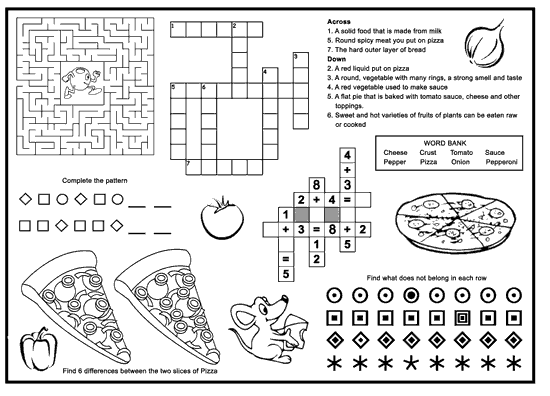
Remember those restaurant placemats from when you were a kid? The ones that came with a handful of crayons (mostly broken) and probably saved your parents from an actual breakdown?
Yeah, like this
That’s what we’re going for with this two-for-one interactive piece.
So, in a world that can be full of wonderful and terrifying possibilities, grab your placemat and your crayon and get to work.
Whenever someone asks Where do you get your fashion inspiration from? without hesitating, I say, My momma.
And, boy, you best believe it. See, my momma knows fabrics. She knows a pattern when she sees one. She travels up and down a rack, the hangers click click a-clicking. She knows when this don’t go with that. She knows a good deal when she sees one. She knows what goes.
See, it’s like this: We’re at JCPenney, looking for my first homecoming dress. Nothing’s quite right at fourteen; my hair’s too frizzy, and stringy, and my god is that a pimple on my nose? But in between me trying on a seafoam dress and a frilly thing that itches, my momma tries on a pair of navy blue pants. Dang, she says, turning, I look good. Now, everyone says I look like my momma. And when she dances in the mirror, wiggling her butt to a pop song, a little glow lights in my chest. A tiny firefly who knows how to dance. I hold up the next dress, swaying to the music. I look good, I think.
See, you better believe my momma looks good. She’s cute-girl short with curly hair and a mouth that laughs. She’s got pretty hands and nice legs and when she looks at you, that’s what matters. She wears sailor stripes, bright shoes, a silky scarf. She’s got wide-pocket pants, heeled boots, pointy church-shoes. She likes long dresses, silver hoops, navy blue, and perfume that smells like nighttime flowers.
I’ve been away from home for years now, my own closet and shoes and way of walking through the thrift store, hangers clicking softly. When I’m back at my apartment, I catch a glimpse in the green mirror over the couch and think, I look good. I FaceTime my momma to show her what I got today. When I pan the camera to where I have the shirt laid out, she laughs and laughs. What? I ask. Hold on, let me show you, she says. She walks to her closet and pulls out the same shirt, a blue-striped button-up.
Trust us to buy the same thing three states away. It’s like her body is my body, looking good. Like I’ve always known I come from somewhere beautiful. Like we’re both fireflies, lit up, dancing to the same song.
Emma McCoy has two poetry books: This Voice Has an Echo (2024) and In Case I Live Forever (2022). She’s been published in places like Vast Chasm Magazine, Stirring Literary, and Across the Margin. She’s the poetry editor of Vessels of Light and reads for Chestnut Review and Whale Road Review. Catch her on Substack: poetrybyemma.substack.com
i would rather not wake with arms of glue and legs of blue numb, drowsy, reaching for hairy chest and crusted eyelashes, swishing my palms across empty sheets
i will pick him up, drive him to his places. he will not know mine, nor will he ask if i changed something about my hair. i did, it’s a half-inch shorter
we will trudge down concrete sidewalks window shopping with empty wallets. i will stop in front of panes of shiny glass. voice quivering, i will say: look at all the diamonds
Orly Berkowitz-Henkin is a senior at Haverford College studying religion and creative writing. She is from Brooklyn, New York and is pursuing a Masters in Social Work. She loves writing, dogs, knitting, and going to the movies.
Wake before the sun. Slip unnoticed past the hiss of your father’s snore. Past the mildew smell inside the closed-up caravan, the floor cold under your socks. Pull the curtain aside. Fog sticks to the windows like breath. Don’t think.
But you do. Just for a minute. No more. About your new friends and if this is what you want. Sneakers caked with dried mud. Hoodie thin at the elbows. Wheels thudding as you drop off the porch.
The road’s quiet. Gravel and split pavement. You push off, coast. The skateboard’s your ticket out of morning silence. Bearings whining. Wind slicing your eyes.
At the harborfront, the ships sleep heavy in their slips. Rusted cranes crane nothing. Gulls wheel overhead, stirred and angry. And there they are—the Kings.
Wren’s perched on the edge of a shipping container, laces undone, hoodie unzipped like he owns the air. “Took your time, Caravan.”
They all call you that. The boy from the trailers. The kid with the off-brand board and hand-me-down smirk. You try to look unbothered.
They nod at you. You’re in. Mostly.
The Kings run the breakers—the rusted-out zone where sea meets metal and salt. They tag containers—rushed crowns, sloppy letters—and bomb the makeshift skate bowl behind the warehouses. Tell stories about cracking bones and breaking rules. You listen, sketch your own tags across a notebook’s pages. Laugh when they do. But sometimes the laughter sticks in your throat. Sometimes you wonder if they’d leave you broken, too.
This morning, it’s a schoolboy in the park. Backpack too big. Shoes too clean. Head down.
Wren steps into his path. “Hey. What’ve you got?”
The kid blinks. Doesn’t run. Doesn’t speak. Just waits like something worse is coming.
“C’mon,” says one of the others. “Be quick.”
The boy opens his bag with both hands like he’s afraid it’ll bite. Pulls out a sandwich wrapped in wax paper. A five-dollar bill. His fingers shake.
You watch. Your chest feels tight. Like it’s laced wrong. Like something inside you wants to get out. You see yourself—before the Kings—walking home with a too-big pack and no one to step in. You remember your father staring at the TV while the world pushed you around.
The bill flutters to the ground. Wren steps on it.
You don’t move. Not at first.
Then you speak. “Leave him.”
Wren laughs. “You serious?”
You nod. Your voice cracks, but not like breaking—like cutting. “I’m done.”
Silence. Salt wind. A gull screeching somewhere above.
“You quit?” Wren says, spitting the word like it tastes bad.
You swallow. The wind slices harder now. You nod, knowing what it costs—your place, your shield, maybe more.
You bend down, pick up the five, hand it to the boy. He takes it without a word. Just looks at you, like you’re a twist he didn’t expect.
The boy hurries away and you push off. Back toward the road. The board rattles under you, steadying. Behind you, no one follows.
Back at the caravan, you don’t bother going in to see Dad still asleep, the TV flickering on mute.
You head to the back of the trailer, where the aluminum skin’s dented and forgotten. You stand there a moment, shoulders loose, breath even. Then you reach into your backpack and take out a Sharpie.
You draw a crown, your hand steady. Lines sharp. You step back. The crown broken. Tilting.
Mathieu Parsy has work published or forthcoming in The Offing, JMWW, The Journal of Compressed Creative Arts, Flash Frog, and elsewhere. His stories have been nominated for Best Microfiction, Best Short Fiction, and the Pushcart Prize. Follow him on Instagram: @mathieu_parsy.
Alice’s mother looked at the airport monitor and cursed. It was under her breath, but still loud enough for Alice to hear over the bumping wheels of luggage carts, the clickity-clack of high-heeled boots. Alice followed her mother’s gaze. She saw the flight number for Cleveland and read across to the letters that flashed Delayed. The butterflies that had been dancing in Alice’s belly all day fluttered anxiously.
Alice’s mother sighed. “Figures I’d get stuck waiting on him. Oh well, it’s just an hour.”
Alice twisted the plastic lanyard that labeled her an unaccompanied minor. Three months ago, an hour wouldn’t have meant anything—Alice was, after all, a child who knew how to keep herself entertained—but with the world of changes that had happened between being nine and ten, it meant one less hour she would get to spend with her father. To remind him how funny and smart she is. To remind him not to forget about his daughter, Alice, who still lived in Chicago with the woman who used to be his wife.
Alice’s mother put her arm around Alice’s shoulders. “Guess we’ll have time to get you something to eat after all.”
Alice squirmed from her mother’s grip. From a nearby restaurant she could smell melting cheese. Pizza, she thought-wished. But she didn’t say it out loud. Alice had made a bargain the night before, whispered in the dark to whatever invisible force controlled her fate, that if she didn’t talk before she boarded the plane, she would make it to her dad’s place safely. Alice had been on an almost no talking kick since her dad left. She even gave herself points for choosing words with the least number of letters when she did have to speak, like a reverse scrabble game. But today there was more at stake. She would not speak one word. Not a yes, no, or thank you. Total silence.
Later, when she saw her dad, she would talk and talk and talk. She’d tell him how things had really been, not the fake answers she’d been putting in her emails as her mother perched by her shoulder reading aloud like some over-lipsticked parrot: Fine. OK. All Good. In his emails back, her dad never mentioned the woman he was living with. She wasn’t supposed to be there while Alice visited. Alice’s mother had agreed Alice could visit, but only as long as that woman wasn’t there.
Alice’s mother fished in her purse. “Let’s try to find something that won’t poison your system.” She pulled out her phone and spoke as her fingers tapped the screen. “David, flight delayed. Will send update.” She dropped the phone in her bag. “Or not.”
Alice’s mother had been talking to herself a lot lately. Sometimes she’d narrate her actions. “I’ll put the milk in the fridge and then get the dishes washed.” But other times—at the store, or in the car, or walking to the house—Alice’s mother would start speaking mid-sentence, as if she’d been having an argument that had gotten too loud for her head.
In line at a smoothie stand, Alice watched the man in front of them swing a young boy onto his shoulders to create a totem pole of red hair and gray t-shirts. The woman with them paused while placing their order to smile. “My two handsome men.”
“Can you see the board?” Alice’s mother asked.
A lump formed in Alice’s throat, but she wasn’t sure if it was from the flight delay, the happy family, or her mother’s not-so-gentle reminder that her glasses should be on her face and not stuffed deep in her backpack in their purple and green storage case. She shrugged.
Her mother stepped forward. “We’ll take two Mango-Madnesses. Small. There’s no added sugar, right?”
Behind the counter, a worker blended drinks. Red, orange, red, orange. The next one will be red, Alice thought. But it was another orange one. Alice felt cheated even though it was their drink order that broke the pattern. Finding patterns made Alice feel like a scientist, like her dad. He worked for a pharmaceutical company, looking through microscopes for patterns in viruses and other small things. Alice used to worry that he would catch a disease at his lab, but he caught a different kind of bug—“the love bug” her mother called it—and now it was almost worse, because Alice felt as if a part of her had died instead.
Alice’s mother led Alice toward the gate, grasping her shoulder again as a honking service cart approached. They watched it pass by like a Royalty float in a parade. An elderly couple perched on the back with crowns of white hair, clutching canes in place of scepters.
When they got to the gate, all the seats were filled. An overflow of passengers sat with their backs against the walls, creating a mismatched centipede of extended legs. Alice’s mother made her way to an open spot on the floor, but a skinny teen in baggy pants and earphones sat down first.
“Prick,” her mother muttered.
Alice pictured the boy deflating into a blue-hooded puddle on the floor, like the balloon she’d gotten at the circus the last time it was just the two of them, her and her dad. The balloon had been as pink as the cotton candy still sticky on her fingers. It had bobbed on its string against the car ceiling. When it floated into the front seat, her father jabbed it too hard; it whooshed around the car as it lost its air. He’d shrugged, not noticing her tears. “It’s all energy, pumpkin. Now that energy is free to become something else.”
He didn’t know that Alice slept with the dead balloon under her pillow. How she’d wondered if its energy had entered her, reabsorbed on an inhale. Imagined it filling her cells, sending her floating above her bed, the house, and out into the night sky. How far would she drift before someone caught her? A few weeks after her dad left, she came home from school and saw the balloon in the trashcan, a circle of pink rubber in a sea of carrot peelings and crumpled paper towels, like a punctured life raft whose passengers abandoned ship.
Alice’s mother scanned the area for another place to sit. “Oh, Brenda, is anything going to go your way?”
Was it Alice’s fault her mother talked to herself? With Alice’s dad gone, there was no one to fill in the other end of the conversation. Alice could go an entire morning without saying a word, not responding to “Do you want toast,” or “Where’s your lunch box?”Her mother filled the silence. “Of course, you do.” “Now I see it in your hand.” Alice wished she never had to talk again. She’d heard the words her mom and dad flung at each other, sharp as daggers. As deadly as poisoned arrows. Words could burst a marriage. Just like that. Prick.
Alice followed her mother’s figure as she made a beeline for a space by the windows. She might have been mistaken for Alice’s older sister, at least from behind. She’d lost a lot of weight since Alice’s father left, claiming her diet helped lower their food expenses, but Alice thought she looked like she’d been filed down into points: shoulder blades, nails, nose. Everything seemed sharper.
Alice’s mother crouched to the floor and sat crisscross applesauce. That’s what Alice’s kindergarten teacher used to call it when they sat on the floor at reading time. Alice’s knees touching the knees of her friends, her hand cupping a laugh before the teacher’s reprimand. Alice felt sorry for the girl she was back then with the stupid pigtails, giggling over who knows what. That girl had no idea what was coming.
Instead of sitting, Alice pressed her face to the window. A plane taxied on the runway. Luggage carts zoomed. Other vehicles carried gas or food to waiting airplanes. But their area of the tarmac seemed abandoned. The passenger tunnel jutted out like an elephant’s trunk. One orange-vested employee leaned against the stacked luggage cart. Alice tried to spot her suitcase. It was new for the trip, pink with black trim and a yellow hair ribbon tied to the handle just in case someone else on the plane had a pink-with-black-trim one too. Money had been tight, but her mother had splurged and spent forty-dollars online. Alice thought of her packed things; her green and white striped T-shirt, her second favorite pair of jeans, her days-of-the-week underwear, Sunday through Thursday. What if the suitcase got lost? Then she would just have Friday and Saturday. Everyday couldn’t be Friday and Saturday.
Alice sucked at the straw; the last of the orange slush worked its way onto her tongue. She counted how long before it melted. Conversion, her father had taught her, is the act of one substance becoming another substance. Ice to liquid. Liquid to gas.
Her mother groaned. Alice turned her attention to a voice coming from the speakers, but only caught “—inconvenience. We’ll update you shortly.”
Around them passengers started to shift and mutter; some moved toward the ticket counter.
Alice’s mother stood. “Delayed again. This is all your fault, David.”
Alice didn’t see what her father had to do with delaying the plane. And why would he? He’d used lots of exclamation points in his last email when he’d written Can’t wait!!!
Her mother shook her head. “At least another hour, kiddo. Hope you brought a book.”
Of course Alice had brought a book. Three in fact. The pages dog-eared andbandaged with tape after too many overeager turns. But the books were for the plane. And for nighttime at her Dad’s place, which loomed in the distance, as strange and unknown as a foreign country.
Alice’s mother moved to a newly emptied row of seats. Alice put the cup in the trash, keeping the straw to chew on. She placed her backpack on the floor and sat next to her mother. To any of the other passengers or the uniformed check-in people behind the counter, they seemed like just two people in the crowd: a brown haired, blue-eyed girl and her mom. But Alice wasn’t what she seemed. No one was. She kicked a wad of dried gum on the carpet until her mother told her to stop fidgeting.
When Alice first asked about seeing her dad, Alice’s mother had sighed and said, “He’s gone, hon, you just need to forget about him.” “But—” Alice started. Her mother had snapped. “You don’t get it. Your father went crazy, okay? He’s not acting like your father anymore.” Alice, as usual, stayed silent. But forget about him? How could she? The memories of him were as much a part of her as breath. At night, under the covers, she’d hold an internal screening of her life, age zero to nine. She could speed up the memories or freeze one image to study it like a photograph. Herself at five, dancing with stuffed animals on the comforter, her father’s hands in tickle position, her toothy smile. Dr. Friedlander was always asking, “So, Alice, is this a real smile today?” But all of Alice’s real smiles belonged to her memories. Now, she’d gotten her way. She was going to see her dad. But she couldn’t shake the feeling in her belly, like she’d swallowed a rock. What if her mother was right?
Alice’s throat tightened. She searched the waiting area for a pattern. Seated across from her a woman with an old-fashioned hairdo read a magazine. Next, a man in trendy square-framed glasses held a phone. Then a person reading a book and the next looking at a phone.
Patterns helped Alice not to panic. Panic was when your heart started racing so fast you thought it was going to push free of your chest, when your face got sweaty and you couldn’t breathe, and it felt as if the passage to your lungs had caved in. The first time she felt it was the night her dad left. She’d been doing homework, her pencil clenched as she tried to ignore the shouting. Then came the silence. A few minutes later, the door to her room creaked open. Her father kissed the top of her head, “I’m going.” She’d scribbled a silent message onto the paper, but he’d turned and left without reading the words caged in lines of loose-leaf. Please stay.
Passengers re-filled the seats around them, complaining into phones or to others in their group. The ones without seats paced like a pack of angry beasts.Alice tried counting her breath. One, two, three. It was on a list Dr. Friedlander had given Alice of what to do when she felt a panic attack coming on. Things like write in a journal, draw pictures, do twenty-five jumping jacks, scream into a pillow. He didn’t know about finding patterns. That was Alice’s secret.
Alice closed her eyes but she could still sense the commotion, as if she were connected to it by live wires. When she opened her eyes, the air was spotted with bright pixels of light. She chewed the end of the straw, played with her lanyard, and noticed her mother had started talking to the man with the trendy glasses. He was older than she’d thought at first, the glasses and blue jeans an attempt to fake his age, like her mother’s dyed hair and tall black boots.
Alice leaned toward them and put on her listening ears. That’s what she had to do at school sometimes when her head got too full of thoughts. Her teacher would notice her looking out a window, or off into space, and would say “Alice, you need to put on your listening ears.” Alice would picture her ear attached to a tube with no other sound in it but the teacher’s voice. Sometimes, though, her other thoughts pushed their way in, crowding her attention like there was something special to see—a meteor or movie star—and she would forget to listen down the tube, missing yet another important teaching fact.
The man with her mother spoke in a rush, his words running into each other as if he were speaking in cursive.
“See, they never give it to you straight, when you check online it says delayed indefinitely, the holdup’s probably mechanical so you might want to get on another flight, but I used miles so I’m stuck.”
“Well that’s a drag, but I’m stuck too. Alice’s mother motioned toward Alice. “She’s going to see her father. Guess the only plus is my ex has to suffer the wait on his end.”
The man flickered a smile. He extended his hand. “My name’s Bob.”
Alice’s mother returned the shake. “Brenda.”
“Two B’s,” he said. “With such a long wait, we’re going to be bored. That’s three. How about we aim for four. Bored Bob’s going to get a beer. Want to come? My treat.”
Alice waited for her mother to say ‘No, I couldn’t possibly.’ It wasn’t like the B’s were even a real pattern; Bob was probably short for Robert. Alice brought the lanyard up to her nose and sniffed. It smelled like plastic report covers. She fought the urge to bite down.
“Well, I guess we have time,” Alice’s mother said. “I wonder if I should text David?” She studied her nails, scraped something off her ring finger. “Screw it. He’s an adult. He’ll figure it out.”
Bob led them to a bar with football games on big screen TVs. Pop music blared through speakers. Alice was the only kid in there. At a table they sat on high stools that Alice had to climb onto. Alice’s mother asked what she wanted and Alice pointed to the pizza triangle on the laminated menu. Her mother didn’t object, but when it arrived she attacked it with a napkin, sopping up the grease that pooled in small yellow puddles.
Bob drank as quickly as he spoke, gulping from his beer bottle as if it contained water. In between gulps he talked about an ex-wife in LA, a fifteen-year-old son, how he worked on “an investment thing,” which probably bored her mother as much as it bored Alice. Not that you’d know. Her mother leaned forward on her elbow and twisted her hair around her knuckles as if weaving it on a loom.
When the second round arrived, Alice’s mother and Bob reached for the same bottle and smiled as their fingers brushed.
“So,” Bob said. “Tell me about you.”
Alice listened to her mother tell a series of half-truths. “Art History major at U of M,” (she never graduated); “Work in medicine,” (she was an administrator for a health care company); “Locked out a philandering husband,” (he’d left, with a suitcase and a box of work files, after taking the recycling bin to the curb). Then her mother repeated phrases Alice had heard so often they seemed scripted. “Middle-aged breakdown.” “Male menopause.”
Bob took off his glasses and swiped the lenses with a napkin. Without the frames, his face looked pasty, like a mound of cookie dough. Alice’s father used to wear glasses. They’d been thin and wiry, always going lopsided on his face when he laughed, but around the same time Alice got stuck with her own awful glasses, he’d switched to contacts.
“It’s kind of funny,” Alice’s mother said, as she twirled her bottle on the table. “David was such a perfectionist, but it didn’t bother him that he’d failed at being married.”
Bob nodded. “I read in an article that most folks get two years tops of a good marriage. After that it’s just a ticking time bomb.” He put his glasses back on and pointed to Alice. “What about you kid? I bet you’re into those bands with the cute boys, right?” He tapped the table to the song on the speakers.
Alice shrugged. She’d lost interest in the pizza and bit down instead on a strand of hair, preferring its soapy taste to the gummy cheese and soggy crust.
“She’s a quiet one,” Bob said. “Cat got your tongue?” He wiggled his at her. It glistened red and pointy under his teeth like a venomous sea creature.
Alice squinted at the hamburger-shaped clock over the bar. The airline worker had said they’d have an update at five o’clock. It was hard to see without her glasses but she thought the hands—two oversized french fries—were perched at the four and ten.
“She’s not talking to me,” Alice’s mother said, and tugged the hair from Alice’s mouth. It dangled wet and matted against Alice’s neck. “I think she blames me for not stopping her father. As if I could have. He was chasing a scent like some overexcited dog. He’d have run me over if I stood in his way. And now I’m the one being punished. Kids.”
Alice thought of her silent plea. Stay. If she’d stood in front of him, blocked the door, would he have run her over too?
“My kid never shuts up,” Bob said with a shrug. “Give me this. Buy me that. I wouldn’t mind him taking a lesson from your girl.”
He held up an empty bottle to signal to the waitress, and scooted his stool so that when he sat back down his arm touched the arm of Alice’s mother.
Alice wished she could say something. There was no time for another drink. She scanned the crowd rushing through the terminal. Was there anyone who’d been at the gate? Maybe the flight had arrived. Alice’s mother didn’t seem to be paying attention to the time. Her face was flushed, her laugh getting louder. What if she did something stupid again?
A few weeks ago, Alice’s mother didn’t show up to get Alice after school. Alice waved off a concerned teacher and said she was supposed to walk home. But she ran most of the mile, feet propelled by a fear that something bad had happened. Really bad. Her mother’s car wasn’t in the driveway and no one answered when she rang the bell so Alice got the key from its hiding spot: a fake rock made of gray plastic that blended in with the other rocks, the overgrown grass, the weeds. Sometimes you can’t tell something isn’t what it seems until you got up close.
Inside, Alice tried calling her mother’s cell phone but it went straight to voice mail. Her mother finally showed up near dinnertime. Alice was on the couch cocooned in an afghan, the wool wet from her tears. She was so relieved that her mother hadn’t been hit by a truck or squashed by a piano that she accepted her mother’s red-eyed, “Sorry, kiddo,” with a rush of happiness that felt like forgiveness. As her mother pulled her into a hug, Alice could smell the alcohol on her breath. Her mother rested her lips on Alice’s head. “This is all your father’s fault,” she’d said before stumbling up the stairs.
Alice’s mother’s phone rang. She checked it and set it on the table without answering. “It’s David. He can wait.”
Alice acted without thinking. With one hand she grabbed her backpack, with the other the phone, and jumped off the stool, running out of the bar as she tapped the screen to answer.
“Hello, Brenda?”
It was her dad’s voice. Alice didn’t know what to do. Should she speak? She had to speak. “Dad, it’s me.” She entered the flow of the crowd, allowed it to propel her forward, like a conveyer belt. She looked over her shoulder to see if her mother had followed but saw only a blur of unfamiliar faces.
“Alice, why aren’t you on the plane?”
Alice’s breath whooshed like she’d been punched. When she tried to speak, her words came in spurts. “Is it here? Did it take off? We’re not at the gate. Mom took me to a bar. With some guy. I can’t believe I missed it.”
How could this have happened? She hadn’t said a single word until now, but it didn’t matter. She stopped in place. A woman pushing a stroller came up short and gave her a dirty look.
Alice fought her way toward the nearest wall, stepping in front of people, stumbling over a cart. She found a gap by a water fountain and squeezed in.
Her father was shouting. “Alice, are you there? Let me talk to your mother.”
Alice tried to read the nearest gate number but tears blurred her vision like a pair of glasses working in reverse.
“Did I miss it?”
“Alice, calm down. I thought they might have you waiting on the plane. It doesn’t say anything on my end. Just that it’s delayed. If you miss it, we’ll put you on another one. Can you please get me your mother.”
“My suitcase.” She twisted the lanyard tighter against her neck. “If they put me on a different plane, won’t it get lost?”
“Your suitcase? Don’t worry. We have stores here. We can buy you stuff.”
Alice thought of her father’s last purchase for her: how she’d clung to the string as the balloon landed by her feet, and how, even though she knew better, she wished for it to spring back to life. After they’d parked, her dad unclipped his seatbelt, turned toward her and said, “Pumpkin, sometimes things break that can’t be fixed. Sometimes you have to let them go.”
“ALICE!” Alice’s mother appeared in front of her, her face pale, her purse clutched to her chest. “How could you run off like that?”
Seeing her mother made Alice go silent again. She faced the wall, found a pattern in the tiles and traced the green and white squares. Two up, three over, two down, three over.
Alice’s mother grabbed Alice’s shoulder and turned her around. “Alice we need to go. Is that your father? Give me the phone.”
Alice passed it to her, keeping her other hand on the wall as she traced from memory. Green, three up. White, two down.
Her mother spit words into the phone, into the air, at Alice. “Of course you can’t help, David. What can you do? You’re three hundred miles away. Why don’t you ask her what she wants? At least she’s talking to you.”
Alice’s mother held out the phone, but Alice turned away again and brought her other hand to the wall. Through it she could feel the vibrations of energy whirring like a thousand fans, or a million bees, their low, steady hum. If only she could transform into that energy. To become as light as the air, riding the energy waves to the spot where her dad was waiting. And when she arrived, what she hoped he’d tell her, what she needed him to say more than anything in the world, was that he would catch her, hold her tightly, and never, ever let go.
Marcie Roman’s work has appeared in Eleventh Hour Literary, On the Premises, Toronto Journal, Driftwood, CALYX, Split Lip, Black Fox, and The Gravity of the Thing, among others, and in Short Edition story dispensers. Her debut novel, Journey to the Parallels, received a Foreword INDIES Best Book of the Year Award. She is a fiction editor for The Baltimore Review and earned an MFA from Vermont College of Fine Arts. A Baltimore native, she now lives in the Chicago area with her family, two rescue dogs, and way more books than bookcases.
Daddy always said our house was a lemon: all waxy and yellow out front but rotten in the back. We had mold on the porch, black widows under the stairs, and water moccasins in the yard where my brother and I played alligator, slithering through the overgrown weeds with both hands poised like jaws, ready to snap at any second. If our mother dared venture across the yard to pick wild berries, we would chomp down on her elbows until she fed us: warm fruit fresh off the vine, old ginger snaps turned to mush in the humidity. One time, the fridge broke down, and she fed us one improbable thing after another: a pickled herring and green bean casserole, mini pizzas made of ketchup and saltines, and something called “swamp pie,” where she whisked up the remaining milk and eggs into a custard, then poured it into a half-baked raspberry pie. We watched it bubble and set in the oven, our alligator hands eager to clamp down on the bloody-looking fruit. It tasted like that pint of ice cream we accidentally left out on the porch one night: all warm and goopy, so sweet we thought it would turn our teeth soft.
We were insatiable after that. Every new disaster was the perfect excuse for swamp pie. If a hard rain turned the backyard to soup, swamp pie. If a storm snapped the top off a pine tree and dropped it through my bedroom window, swamp pie. If Daddy got drunk one night and drove his pickup into the side of the house, doing himself no lasting damage but cracking the foundation in such a way that the basement flooded not all at once but slowly, over months, until we had to bail the mud out through the window, passing buckets down a line while mosquitoes swarmed around us, injecting their filthy saliva into our faces every chance they got, you bet we demanded swamp pie. We ate it at the tiny kitchen table, alternating between scooping up its innards and scratching our bug bites while mean-mugging Daddy through the window. He was talking to a contractor about prices. What we could afford and what we would just have to endure. We put our basement junk up on cinder blocks, made a game of chasing the silverfish and salamanders that wriggled in wet corners, their tails flashing in the slick.
Then the pipes burst. First flooding the bathroom with the cracked tile and the drain flies dotting the ceiling, their wings pasted in place by steam, then the kitchen, under the sink, while the pie shell was par-baking and my brother and I were crouched in front of the oven, alligator hands at the ready. We squealed when the water seeped out of the cupboard and in between our toes, the grimy nooks and crannies where we sometimes forgot to scrub. Daddy was still upstairs, banging around the bathroom, spitting swear words like sinkwater, so Mama tried to fix it herself, turning taps on and off, on and off, to locate the leak: that place where the pipe was rusted and swollen, the metal flaking off like pastry. My brother scrunched his nose up and said, P.U., P.U., while she wrapped the pipe up like a baby that just kept wetting itself. I splashed him with the floor puddle, kicking water toward him in gritty little waves polluted with bread crumbs and onion scraps, and he fought back, using his cupped hands to aim the water at my face. This would’ve escalated into all-out war if the faucet hadn’t exploded.
Water rained down around us like it did that one summer a neighbor tapped a hydrant and let all the children run through the spray until the sun sank down behind the sweetgum and fireflies popped up out of the bluegrass, their butts so bright we thought they looked like candies. Mama hollered for Daddy to get down here before the whole house flooded. My brother and I screamed with joy, slipping and sliding around the kitchen like it was our own private water park. We filled our bargain basket squirt guns with sinkwater, dammed the crack under the basement door with old beach towels, and held umbrellas over the counters so Mama could whisk up the custard and pour it in the pie pan. Once everything was in the oven, we started chanting, “Swamp pie! Swamp pie!” and waving the giant umbrellas around like shields, as if they could protect us.
When Daddy hollered at us to shut our goddamn traps already, my brother said we should build a fort with the umbrellas, layering the translucent panels over each other, until we were like two caterpillars in a cocoon, wondering what the world would look like once we emerged. Mama said something like, I told you not to yell at the kids anymore, and Daddy muttered, Maybe if you stopped coddling them I wouldn’t have to shout to be heard, then she snapped at him, Oh, we can all hear you just fine; everyone in town knows our business thanks to you, but I lost track of their argument because a glittery beetle with a back like an emerald crawled up my brother’s leg, seeking shelter from the flood. I wanted to trap it and put it in a jar, but my brother shielded it from me as if the beetle were a part of himself, one of the little tender bits we only let each other see when our parents were fighting, so I relented and told the beetle not to worry—we would shield it from the storm. When this was all over, we would go out and hide in the jewel grass, wait for the other beetles to rise up out of the muck and grace the world with their beauty.
Any minute now, I said. The pie was almost ready.
Ruth Joffre is the author of the story collection Night Beast. Her work has been shortlisted for the Creative Capital Awards, longlisted for The Story Prize, and supported by residencies at the Virginia Center for the Creative Arts, Lighthouse Works, and The Arctic Circle. Her writing has appeared or is forthcoming in more than 100 publications, including Lightspeed, Pleiades, TriQuarterly, Reckoning, Wigleaf, and the anthologies Not Your Papi’s Utopia and Latin American Shared Stories.
The bite marks on the man in Room 614 were too large for a pitbull.
Wendolyn could feel the current of excitement as she clocked in for her shift. Two nurses had already texted her about it; three more approached her on her way in, grabbing her by the elbow or pinching her scrubs. Apparently there was a betting pool, with the leading guess that the man had somehow crossed paths with the escaped lion from the Detroit Zoo—maybe was the lion smuggler himself!—and was hiding it.
Rumors swirled that someone had called the police. It was all very hush hush, of course, which meant that everyone but the man in Room 614 knew. The halls swarmed with residents, med students, hospitalists, and volunteers, all casually strolling past 614 for a glance at the man who might soon be plastered on the 6:00 news.
Wendolyn declined the three offers she had in her first twenty minutes to take a walk by the man’s room. She couldn’t think of anything less interesting than two seconds of ogling a man under heavy sedation and ensconced in bandages, and besides, she had Peter’s ultimatum to think about.
Wendolyn dug her nails into her palm, trying to fight a wave of nausea.
One of her patients, Mr. Michaels, kept falling out of bed. He was due for surgery at six in the morning to remove the tumor octopused around his brain. Of course that would only buy him time—months, maybe, if he was lucky—but he had signed off on it, and now had only to avoid some catastrophic injury for the five remaining hours before the nurses wheeled him to the O.R.
Wendolyn cursed when his alarm went off again. She didn’t have time to babysit him the whole night, and she didn’t want to deal with the wrath of whatever administrator or family member wanted her head when Mr. Michaels was deemed unfit for morning surgery.
This is the problem, Peter would say. You take all of it on yourself. You don’t see that you’re affecting both of us when you—
“I don’t need a nurse,” Mr. Michaels snapped.
“Of course not,” said Wendolyn brightly, guiding him back into the bed. “There you are, and Mr. Michaels, if you climb out one more time, I’m afraid I willneed to call someone about restraints.”
“I just need to pee.”
“You have a catheter in, sir.” She smiled, feeling it strain across her face. She wanted to grab a chunk of dark hair and bite it, like she did when she was in middle school, feeling the coarse texture string across her tongue until all other thoughts blurred and faded away.
Mr. Michaels grunted and collapsed back into bed. Wendolyn considered restraining him anyway, but settled on a mini-vigil. She could spare a couple minutes.
Always such a martyr, Peter’s voice said, exasperated. It’s like you think you get a gold star for running yourself ragged. It’s because your mom never—
Mr. Michaels snored. Wendolyn jumped. How had seven minutes passed? She hurried out of the room.
Three a.m. stretched into four. The alarm for Mr. Michaels’s bed went off again, and someone called in the order for restraints. After Wendolyn returned from a lengthy post-seizure cleanup down the hall—her nose still burning with the smell of defecation mixed with bleach—Mr. Michaels was snoring again, his mottled cheeks streaked with tear tracks.
Was restraining him really the kind thing to do? He hated it. And if he fell and couldn’t have surgery…wouldn’t it be better to avoid prolonging the inevitable? Let him die on his own terms. And yet, he wanted the surgery. Wanted to cling to life like the rest of them, the petty routines and small indulgences that made all of them believe there’d be something better just around the corner, some grand finale that life was building toward, the dream they’d always deferred come to life.
“They’re moving him.”
Wendolyn jumped. One of the other nurses hung in the doorway, green eyes blinking at her.
“Mr. Michaels?” Wendolyn said. “But—”
“No, the tiger guy,” the nurse said impatiently. “Prepping for surgery. Debridement of the wound, probably. They said he’s yours now until the surgeon gets here.” She paused, and when Wendolyn just stared at her, uncomprehending, she added, “If you need any help…”
Wendolyn clocked the woman’s phone in her right hand, fingers twitching. You cling to the rules, Peter would say, like it makes you morally superior to everyone else. When you just use them to judge people.
Three days. Three days to decide if she’d take the hospice job, the reduced hours, the easier lifestyle. Accept Peter’s vision for their new life, one without the stress of night shifts and hospital infections, one where he could “see himself marrying her and having a baby—if she’d only slow down and take care of herself.” A prospect that would be much more appealing without his exasperated voice echoing in her mind.
“There he is,” the nurse said, a thrill of excitement in her voice. “Wendy, I—”
“Wendolyn,” Wendolyn said firmly. “Get off my floor.”
“I—”
“Now.” Wendolyn brushed past her and crossed the hall just before the hospital bed wheeled past. She got her first glimpse of the man from Room 614, one side of his face swollen and blue, his torso bandaged and bloodied, skin a sickly white. She wondered if people would still try to ogle him at the morgue, if that’s where he ended up. Probably. An image flashed in front of her: Mr. Michaels and the man from 614, walled up in adjacent metal shelves in the morgue, still at last.
Five a.m. came and went, then six. Four more hours on shift, then home to sleep. By the time she woke up half her ultimatum time would be gone. Peter was staying at his friend’s for the weekend to “give her space,” something he had never done during an argument before.
He was serious, she could tell.
She thought of all the little hints he had given her over the past year, the half-muttered comments, the tight-lipped denials that anything was wrong, the gentle suggestions followed by frustrated sighs.
Had she caused all that? Certainly he had been happy in the beginning. They had talked about getting married three months in. That was two years ago. Had he been happy at all recently, truly happy? Could she make him happy? Maybe he had seen the real her, finally, the kind of person that wasn’t down to go watch a last-minute sports game or play corn hole for hours on a random Saturday. The kind of person who was lazy with dishes, and liked rather trashy television, and who derived most of her self-worth from a job that didn’t give very much back, even when someone like Peter—a lawyer from a large family whose worst vice was his predilection for video games—wanted more from her, wanted to start real life.
Mr. Michaels was taken back for his surgery, and the man in Room 614—who was now the man in Room 603—was taken soon after. Wendolyn felt strangely relieved he had not woken up.
“Excuse me.”
Wendolyn jumped. A police officer stood in front of her, a nondescript young man with his thumbs hooked into his belt, looking a bit like a boy playing dress up. “I’m looking to talk to the man with the bite marks. Someone said you could help me.” He smiled, half-shrugging his shoulders like, isn’t this a strange world. Wendolyn wondered who had called him. The surgeon would be angry, and Wendolyn knew for a fact that the charge nurse would want everyone’s head for a HIPAA violation. When you had money and power, you liked to keep control of your domain.
“He’s still in surgery,” Wendolyn said curtly. “I would come back in a few hours. The anesthesia will take some time to wear off.”
“When does he get out of surgery?”
“I don’t know.”
“Will he survive? If he dies—”
“I don’t know,” Wendolyn said. “I’m so sorry, that’s an alarm. Excuse me.”
Mr. Michaels returned. Wendolyn swept her gaze over him as she scribbled the new medication list on the whiteboard. He looked shriveled, like someone had squeezed out half his juice and discarded the rind.
Wendolyn’s phone buzzed. The charge nurse had seen the police officer. Three separate nurse chats had popped up about it. Someone said they heard the man, who was named Ed, was not going to make it. Someone else said he’d confessed to housing a baby hippo. He wasn’t crushed, he was mauled, someone wrote back, and screenshots of AI-generated summaries of different animal bites began pinging back and forth.
Peter hadn’t texted. Wendolyn began typing.
I’m sorry I got so upset last night. I just—
Delete.
Hey. Hope you had a good night. I’ve been thinking, and I—
Delete.
I want all the same things you want. I can’t stand it when we fight. You can’t just make it seem like I’m some horrible person that doesn’t care about you. I forgave you last year, I wasn’t—
Delete, delete, delete.
A low buzz filled the air. Wendolyn looked up. Ed was back from surgery.
The police officer hovered outside the door for the first two hours. Wendolyn alerted her superior, who alerted hospital management. The charge nurse had a go at him, citing all the regulations that the police officer was violating while the young officer grinned in his face. Management sent one of the younger nurses to ask him to wait in the cafeteria, giggling apologetically. He obliged.
“Get his full name and address when he wakes up,” Wendolyn’s boss told her, acrylic nails wrapped around the room’s door handle as she poked her head inside. “He was talking about a kid.”
Wendolyn’s stomach clenched. She glanced at Ed, who was stirring now, wiry hands moving fitfully beside his bandaged ribs.
She delayed by checking on her other patients. Mr. Michaels had a visitor, a woman in her mid-forties who looked tired and grim. She gave Wendolyn only the polite nod of a veteran visitor.
Wendolyn’s phone buzzed. She jumped and checked it. Just one of the nurses again, asking about the police officer. Someone joked about whether he was single.
Wendolyn took a deep breath.
“Ed, is it?” Wendolyn said, breezing into his room. His eyes blinked. “Ed, can you tell me the names of your children?”
Ed’s forehead crinkled under the pale hospital room lights. “Kids,” he croaked. “No…” He cleared his throat. “Just…a nephew.”
His face brightened and his gaze grew more focused as he took Wendolyn in, sweeping over her body once, twice. She guessed he was still on the good pain meds from surgery; the agony would come later. It was the best time to chat.
“A nephew,” Wendolyn said, bracing. “And, he lives with you?”
“No.”
Her shoulders slumped in relief.
“Not anymore. I mean, not all the time. My sister comes to my place sometimes when she…” He shrugged his shoulders. “Family stuff.”
“Ah,” Wendolyn said. She hesitated, then sat in the chair next to Ed. She didn’t have time to interrogate him, and it wasn’t part of her job. Still, if there was a kid… “Ed, you’ve been in the hospital more than a day now. Is your nephew home right now? At your place? With the animal?”
She saw the gate crash over his expression, the defiance and denial snap into place. “Everyone’s fine,” he said. “I know what I’m doing.”
“That’s not what I asked.”
“I’m not going to let anything happen to her,” he said fiercely. “It’s not anyone’s business but my own. And I got land up north, I just need to close on it, if the bank would get it together. She gets frustrated, not having the space. Tigers aren’t—” His mouth snapped shut again, brain catching up with his tongue. “Never mind,” he said. “I want some water.”
The police officer would be back soon, and Ed would connect the dots on the kind of trouble he might be in. Wendolyn herself didn’t fully understand it, but she knew enough to know that whatever information was to be had from Ed was to be had before he spotted the uniform.
“That’s fine,” Wendolyn said. “I don’t care about what you’re doing with her. It’s none of my business. I’m a nurse. I just want to know if your nephew is going by the place. Does your sister know you’re in the hospital?”
Ed’s mouth opened and shut. Wendolyn knew he had provided no emergency contacts, had been aware enough and cagey enough during intake to not give any identifying details, including insurance.
“Look,” Wendolyn said, glancing at the door and pulling out her phone, “just call her, okay? I just want to make sure the kid doesn’t go there.”
Ed looked dubiously at the phone. After a moment, he took it.
“Can I…uh…privacy?” he said. Wendolyn moved to the door. She heard the ringing as she shut it behind her.
After a minute, Ed signaled to her, and Wendolyn came back inside. He had looked calm throughout the conversation, but Wendolyn could see now his jaw working, the way he handed back the phone with something like disdain.
“Everyone okay?” she asked.
“Fine,” he said. “Your boyfriend texted.”
Wendolyn glanced down. She hurriedly typed in her passcode. She had barely identified the swell in her chest as hope before she opened her texts and it was dashed.
Well, I have my answer, I guess, Peter began. Can’t say I’m surprised. I’m going to come get my stuff. I’ll be fully out by the time your shift ends, and you won’t have to deal with me anymore. Have a nice life, Wendolyn.
Her stomach dropped. That wasn’t the agreement. The ultimatum gave her time, precious hours to think things through, to make a decision. She was going to apologize. She needed Peter to understand her side, to see how she thought about it before they both just blew up their life. It wasn’t fair.
Another text. Wendolyn fled to the hall, frantically swiping back to her messages. But this one wasn’t from Peter. It was from a local number, not saved in Wendolyn’s phone.
I don’t think I can make it another couple hours.
Another buzz.
Uncle Nathan, I’m scared.
Rage, white hot, shot through Wendolyn, drowning out all other thoughts. She called the number.
“Hello?” she heard. It was impossible to make out the age of the voice; it could have been four or twelve. Mostly it was drowned out by rattling and thumping in the background. “Uncle Nathan?”
“What is your address?” Wendolyn said.
A pause.
“This is the police,” Wendolyn said, realizing as she spoke the words that she was violating some sort of law, but not having the brain space to worry about it. “I need your address so we can get you safely out of there.”
Another pause. A snarl, and a scream. Wendolyn jumped. Her hand began to shake. “Um,” the voice said, and her knees buckled. The kid was still there. “Will you kill her?” He began to cry. A second later he began, “317 West…”
She had him repeat it twice as she wrote it down on her hand and told him to stay on the line. The other nurses had noticed something amiss. Her supervisor offered up her phone, which Wendolyn dialed 9-1-1 into and handed back, along with the address and a scribbled note. She felt as though she were moving in a dream.
At some point, the police officer was back, looking red-faced and disoriented. He took Wendoyln’s phone from her and began talking in jovial, clipped tones.
Wendolyn collapsed onto a nearby bench. One of the techs asked her something, but she didn’t even have the energy to listen.
A kid. A kid alone in an apartment with a tiger.
Rage roused her again. Wendolyn stood and strode back into Ed’s—no, Nathan’s—hospital room. He took one look at her expression and scrambled ineffectually to sit up.
“Hey,” he said, eyes narrowing, “I checked and everything is fine, it’s—”
“He’s alone in there.”
“You tricked me,” Nathan said. He winced. His swollen face had turned a deep purple-black, making him look cartoonish and not quite human. “He’s been there before. He knows what to do. Zelda won’t bother him.”
“He texted me that he’s scared.”
Nathan grew still and very quiet. Wendolyn watched as he processed this information, thoughts racing plainly across his face. When he spoke, he merely said, “Are they going to arrest me? Will they kill her?”
“No questions about your nephew?”
Nathan scowled. “He’ll be fine. He’s been with her before. Zelda knows him.”
“Zelda knew you too, didn’t she? Before you got mauled?”
“That was my fault. She was hungry, and I got held up, missed a feeding. I fed her before I came to the hospital. She’s bored, that’s all.”
Never in her life had Wendolyn been so tempted to strike someone. A smart slap upside the head, like her grandmother used to do when she watched them all in that leaning ranch in Monroe while her mother worked.
“If anything happens to that kid,” Wendolyn said, leaning down lower, “I will personally inject you with the most painful, lethal cocktail of meds I can find in this hospital.”
“I’m telling my lawyer that,” Nathan snapped.
“Good.” She was shaking. A small part of her conscience whispered that she was being stupid, playing vigilante to feel big instead of powerless. But a bigger part of her didn’t care. A bigger part of her just wanted Nathan to feel the weight of what he had done, to feel some sliver of the terror he had inflicted on his nephew.
“They’re going to kill her, you know that?” Nathan said. His fists balled up. He began grabbing at the white waffle blanket draped over him, kneading it between his hands. “I raised her since she was a baby. She didn’t have anybody. Just chucked in a cardboard box. The guy I got her from said he was going to smother her, you know that? If no one bit.”
“You mean if no one bought her.”
“What would you have done?”
“Give it to a zoo. To a sanctuary.”
Nathan’s face pulled back in a snarl. “I nursed her. I fed her milk for months by hand. Bought her meat when she was bigger, made toys she could play with, kept her mind active. I was going to get her a place up north, somewhere she could roam free. I did everything right. I studied all about raising them.” He plunged his finger into his knee to emphasize the point, one time, two times. “No one could have done it better.”
“You raised a tiger in an apartment.”
“I loved her. She loves me. I’m the only family she knows.”
“You kept her locked up in a tiny room and pretended that was what was best for her,” Wendolyn said. She wanted to wipe that stupid, pugnacious look off of his face. She hated that he was so convinced of his own truth, of his own righteousness. “How’d you control her? You put her in restraints? A cage?”
“Never.”
“So you just put your nephew at risk whenever he was over. He could’ve gotten scratched, or bitten, or—”
“She’s declawed.”
He smirked when Wendolyn went still.
“Declawed,” she said slowly.
“Yup. Like I said, not a threat to anyone. She’s a sweet girl. She—”
“You remove part of the toe to declaw,” Wendolyn said. “You get a vet to do that?”
The expression on Nathan’s face turned vicious again. His fingers twitched. “I was more gentle than a vet could ever be,” he said. “She wasn’t in pain, I made sure of that.”
Wendolyn spun, to see two officers in the doorway. She felt the blood pulsing just beneath her skin. She was ready to strangle her patient. Maybe they sensed that.
“The boy?” she said.
“Safe,” the officer on the right said. She stood, legs shaking. Nathan said something she didn’t catch and didn’t try to as she stumbled from the room.
“My God,” Wendolyn’s supervisor said. “What a night. Glad this shift is over.”
Feeling like a zombie, Wendolyn floated out to the parking lot. Peter was leaning against her car.
Wendolyn’s purse grazed her hip as she stopped short.
She watched, almost as through a television screen, as Peter straightened, one hand smoothing back his hair. He pulled a crumpled bag off the top of her car.
“Breakfast,” he said gruffly. The I’m-open-to-making-amends-if-you-are voice. “Figured you’re probably hungry.”
That was her cue. Take the bagel and make some innocuous comment about the weather, or their plans that weekend, or something from the store they needed to pick up. Get back into the rhythm of a relationship, and address the fight later, when cooler heads prevailed, and they could each give an apology that spared their egos. I’m sorry, but…
“You alright?” Peter said. “You look exhausted. Here, take it. I’ll make dinner reservations for us later—”
“No.”
Now Peter froze. She watched the emotions flit across his face as she waited for herself to go back to the script. As they both waited for her to. The silence stretched on.
“Look,” he said, “I’m an idiot. I love you, and—”
“That’s not love,” Wendolyn said. She got in her car and shut the door. As she gripped the wheel, she flexed her fingers, imagining claws extending and retracting.
Stephanie Bucklin is a writer based in Michigan. Her work has been published in NY Mag, Nocturne Magazine, Live Science, and more.







 Vast
Vast 