
How to Play
Click the button below, make a few choices, end up with your own sweet treat experience using pieces in this issue. Maybe the answers will tell you something.

Header photograph and artwork by Jordan Keller-Wilson
How to Play
Click the button below, make a few choices, end up with your own sweet treat experience using pieces in this issue. Maybe the answers will tell you something.
Header photograph and artwork by Jordan Keller-Wilson
In the time it took for Troy to realize I was truly pissed and finally leaving him, I’d already rammed my car into the side of his brand-new, jacked-up, man-confirming, white-knuckle Dodge Ram.
In the second it took to dent the passenger-side door hiding the purple-lace thong I’d found wadded into the seat crack where I thought I’d find my lip gloss, Troy screamed like I was actually cutting off his balls. His hands clawed at his face, which was as red as a boiled lobster, and I never craved tender flesh so bad in my life.
In the moments it took for me to back up and crash into that truck again, gravel rocketing like bullets off the wheels of my car, Troy had sworn at me using all those names women are called when they have a mind to do what they want. But those names were nothing I hadn’t heard before. None I hadn’t heard him call me before. But I didn’t stop. I kept battering that door, waiting for him to jump off the porch and throw himself between me and his truck, desperate to save what was left of everything I’d ever done for him—loaning him thousands for some crazy get-rich-quick bullshit scheme after I worked overtime cleaning rooms at the roach motel out on the highway, all while saving up so I could go to school to be an x-ray tech; covering for him when the cops wanted his whereabouts the night enough Oxys were stolen from the local pharmacy to drown everyone in that godforsaken town; cutting off Daddy when he asked me to come back home, telling him I needed to make my own choices, even though I knew I was making all the wrong ones, and Daddy knew it too.
In the minute it took for me to do enough damage to that truck to get Troy’s grease monkey buddies riled up when they saw, I imagined all those dented edges fighting them, white flakes peeling off in ribbons like Troy’s sun-burnt skin when he went blast fishing with those assholes, those self-professed good ol’ boys who drank beer in our living room and ordered me to get them another cold one during commercials starring better looking versions of themselves. They’d have to work real hard to hammer and suck my rage out of the body of that truck. But they’d try. And they’d probably imagine me as they did it, blaming me for their failure, calling me all those names again, names that made me want to trash everything Troy ever owned or cared about. When I drove away, I saw him in my rear-view mirror kneeling beside twisted metal like he was praying at an altar for some kind of miracle, bargaining to take it all back. Like somehow, he’d become a better man.
In the hour it took for me to get my shit together in the Dairy Queen parking lot, I’d jerry-rigged my bumper back on and sat on the trunk of my cherry-red Chevy Cavalier dreaming of going home, of starting over and living up to that potential everyone told me I had, and I realized I’d had in me all along, regardless of what Troy and every other boyfriend tried to convince me of. I guzzled that peanut-butter milkshake like I was dying of thirst. Because I was. For salt, for sugar, for piercing cold. For that brain-freezing focus. For that thick creamy fat on my tongue. It all melted into such warmth, such sweetness, that I couldn’t help feeling a tiny bit like me again.

Melanie Maggard is a flash and poetic prose writer who loves dribbles and drabbles. She has published in Cotton Xenomorph, The Dribble Drabble Review, X-R-A-Y Magazine, Five Minute Lit, and others. She can be found online at www.melaniemaggard.com and @WriterMMaggard.
Header photograph and artwork by Jordan Keller-Wilson
My junior prom corsage was big and wet as an open mouth. A decadent purple. My high school boyfriend liked to give me decadent things. When he asked me out for the first time, for example, he gave me four squares of cake with frosting shiny as lip gloss.
There’s a long-standing association between the flower and the vagina. I don’t understand the resemblance, though in fairness I don’t spend much time staring at vaginas. I prefer to dive in tongue-first and get to work. Still, I do wonder if my boyfriend was thinking about pussy when he looked at the flower he gave me. Based on my interactions with him I’m pretty sure he was thinking about pussy ninety percent of the time.
I never had sex with him. He asked me, shortly after we started dating, if I wanted to “you know.” I told him that if he was not going to say the word “sex” then we were certainly not going to have sex. He didn’t think I was funny.
We spent our dates in my basement, curled up on a pale green beanbag with his hands skimming my surface like water striders. He would always ask, “Do you like this? Is it good?” which at first I thought was nice, but he got so upset with me when the answer was “no” that lying was just easier. So, I let him touch me, because I didn’t want to be a bitch. But I was still just enough of a bitch to keep my pants on. Mostly I made encouraging noises while trying to subtly crane my neck so I could see the TV over his left shoulder. In retrospect, this was maybe the meanest thing I ever did as a teenager.
Since I couldn’t offer him sex, I offered him secrets—even my biggest secret of all, that I too was thinking about pussy ninety percent of the time. Though, while I can’t speak for him, I was also interested in the person attached. Back then, I was sort of Catholic, in that my parents told me to attend Catholic school and I preferred to avoid conflict when possible. I knew some of my teachers wouldn’t like me anymore if I came out as bisexual, so I resolved to stay in the closet for the time being.
My boyfriend liked this secret very much. Especially when I gave him permission to fantasize about me with other women. Pussy times two. Three, if he was feeling devilish. All I needed to do was occasionally contribute more secrets to flesh out his dirty talk. Which girls in my class I liked. What I wanted to do with them. There was an odd irony to it, finally giving voice to my most fervent teenage longings only to watch them transform into material for someone else’s wet dreams before my eyes. But they say a good compromise leaves nobody happy.
On prom night, my friend hosted an afterparty in her basement, featuring games, plastic bowls of chips, and absolutely no alcohol. My boyfriend and I came early, and the four of us waited on the tattered brown couch for everyone else to arrive. He pulled me close to his body and gripped me tight, ran his hands up my thigh. My friend and her date sat in silence, unimpressed by our shameless PDA. Sorry, I thought. If it helps, I don’t like this any more than you do.
“You should kiss her,” my boyfriend said to me, indicating my friend with his head. He did not whisper, or even mumble. I looked at my friend and thought, would she know? Would the knowledge pass from my body to hers? I looked at her date, who was practically a stranger. I wondered who his friends were, and what kind of stories he might tell them. I looked at my boyfriend, and there was nothing in his eyes but hunger. A rotted hunger, brown and wilted and wet, and it stank. Like a corsage left lying in the trash after a prom night when no one had any fun and no one got any pussy.

Annie Schoonover is a queer writer from Minneapolis. Her work has appeared in Mycelia, Barnstorm Journal, Thimble Literary Magazine, and other publications, and has been nominated for the Pushcart Prize. She is the associate prose editor at The Chestnut Review.
Header photograph and artwork by Jordan Keller-Wilson
The week I resigned myself to break up with him, I had to wait until Thursday to tell him in person. There seemed to be an inordinate number of deer carcasses along roadsides that week, one especially haunting, its ribcage visible, most of the flesh having been consumed by vultures. The red sinews of each meat-lined rib were seering, vibrant against the dreary wet winter afternoon. I slowed the car as I passed, mesmerized, torso aching in response: a world in which people slow down to stare at a creature splayed open, exposed, one second living, the next devoured.

Nicole Wilson is the author of the collection Supper & Repair Kit (The Lettered Streets Press) and is a graduate of the MFA Poetry Program at Columbia College Chicago.
Header photograph and artwork by Jordan Keller-Wilson
In the cobwebbed eaves of the house on Fig Street, the third pigeon drops dead.
I hear her struggle from the front lawn, where I am deadheading the roses. My hand goes up to shield my eyes from the sun. At this point, I am expecting the fall. Her feathers iridesce green, blue, purple, with each twitch of her little head. She twists almost gracefully to the very edge of the roof. To linger on the precipice, body limp but briefly suspended, brings to mind something beautiful: a ballet dancer about to fall into her partner’s arms, Anna Karenina on the train platform. A papery brown blossom flutters from my gloved hand to the ground. Then the pigeon topples into the rain gutter.
I am the only person in this neighborhood who knows how to garden. I walk four blocks to the bus stop every day, and every day I notice another thing left to fester. Ivy gnawing at an exposed brick facade. Mistletoe snared in the boughs of a slowly graying tree, drinking the living from it. Squashed plums on the sidewalk, crabapples rolling into the gutter. The whole scene stained syrupy and sickly-sweet.
I know I cannot reach the rain gutter with the only ladder at my disposal, a squat A-frame left in the garage by a handyman Aunt Nell briefly courted. Still, I cannot become another keeper of rotting things.
Aunt Nell was a collector. She collected forever stamps and uranium glass dishware and ceramic Precious Moments figurines. She collected stray cats, left them bowls of dried up kibble on the white oak porch. She collected me from the train station when I first arrived in town. Most importantly to my current predicament, she collected long lists of phone numbers. Magneted to the fridge, overlapped by a 10% off coupon for the pizzeria downtown and a postcard from the Vatican, is her list of pest control companies, scrawled out in her looping hand on the back of a Salvation Army receipt.
The third number on the list picks up.
“Greenbriar Wildlife Services, how may I help you?” A voice—smoky, feminine—tins from the receiver.
I explain the situation. Dead bird in the rain gutter. Can’t reach it on my own.
“I’m sorry to hear that,” she says. “But it sounds like an easy fix. I could come out tomorrow afternoon?”
I almost laugh. Stupidly, I realize, I hadn’t imagined that this woman would be the one to come and take my bird away. I figured they would send a wiry twentysomething, a former high school track star. A burly quarterback with dark hair on his forearms and coffee on his breath. I adjust my mental image of the woman on the other line, from a cream-bloused secretary to a coverall-wearing, slick-haired androgyne.
“Yes,” I say. “Tomorrow afternoon works.”
I cup the handset to my cheek—warm from the mist of my breath. I give her the address.
The first dead pigeon I blamed on Rocky, Aunt Nell’s only surviving stray. It was lying in front of the door like a gift, something dark oozing onto the daffodil-colored welcome mat. I wrapped the body in the doormat and put it in the compost bin. When Rocky next trotted up the driveway, I shook my head at him and clicked my tongue. He only rubbed his head into my hand, purring like a locomotive. Cats can’t tell when you’re mad at them. Cats have no sense of shame. Cats are not born guilty.
The truck pulls into the crook of the cul-de-sac. Greenbriar Wildlife Services, it says on one side, green and yellow like a parakeet. Humane Solutions for Pest Problems. A grinning cartoon raccoon stenciled next to the lettering, cheekily fanning out its burglar hands. No man with an oversized mallet. No panicked line of rats or termites. Just a raccoon, who looks like he knows something I don’t. This cools my nerves some, quiets the thudding of my pulse. I don’t like brutality. I like cleanliness. I like English mystery novels. I like strict teachers. I like solitaire.
The woman who gets out of the truck does not look how I pictured her. Her hair is pulled into a short ponytail at the top of her head, jagged ends spiking out like a crown of thorns. She wears a faded gray Laguinitas t-shirt, tucked into a pair of straight-leg work pants. Her face is studded with sterling silver, piercings above her lip, notched into her eyebrow. A tool belt weighs down her hips, swaying with each step.
I startle out of my position at the window, suddenly aware that I am watching her, aware of the way my hair feels on the back of my neck, the chappedness of my lips. I open the door before she has the chance to knock.
“Hey,” she says, “You the one with the dead bird?”
“Yes, yes I am.”
“My name is Syd.”
“Florence.” I accept her proffered hand. Her palm is dry, her grip strong.
I found the second dead pigeon tangled in the neighbor’s fence. Caught on the ragged hole in the chain-link gnawed by the neighbor’s portly rottweiler, the bird’s feathers embroidered with metal. She must have fallen and gotten stuck. Wings spread, head limply bowed, a suburban martyr. I cleaned that one up too, hurrying across the cul-de-sac with a newspaper-wrapped bundle tucked under my arm.
Syd sets up her ladder where I direct her. While she pulls thick gloves onto her hands, her eyes wander around the yard, taking in the greenery. She compliments my roses, although half the blossoms are severed at the stalk and the other half are brown and withered, the ground at their feet still heavy with fallen petals. I haven’t found the time to rake them up.
“Thank you. Lots of people don’t know how to tend to them properly.”
Syd smiles. Her canines are slightly sharp, giving her the look of a wily fox. “But you do.”
“Yeah,” a laugh buzzes my lips. “I suppose I do.”
“Any plans for the holiday?” She’s halfway up the ladder when she asks this. I find myself wishing she would remain at ground level, where I can watch her eyes flit from the bed of clover by the windowsill to the poplar fanning its branches over the lawn, the dandelions polka-dotting the grass.
“Housewarming party,” I lie. A sweet-sounding frivolity for the long weekend. In actuality, I will be working all three days. Nametag clipped to the collar of my shirt, corralling escaped shopping carts back into their pens. I don’t mind. The holiday pay is nice.
“You just move in?”
“Yes.” It is easy to imagine that I’m new to the neighborhood. Aunt Nell wrote me into her will but it still doesn’t feel like the house is mine. I brush dust off the furniture, but my fingerprints don’t leave a mark. I’m a groundskeeper. A haunting.
Syd rests her elbows on the edge of the rain gutter, and looks in. There’s a rustling as she digs around for the fallen bird, and a few dislodged dead leaves twist languidly down to my feet. The ladder creaks. I can see her bicep muscles moving under her thin t-shirt, dark halo of sweat blooming under her arm. My stomach tightens. Worry, for her balance.
“Yep,” she calls. “Found it. Good thing you called me when you did, things could have gotten real smelly up here.”
She whips a rag from her back pocket, a matador with his cape, and scoops the creature out. She descends the ladder gingerly, with her cotton-wrapped bundle kept close to her chest.
As her boot hits the ground, the pigeon’s head lolls back, the makeshift burial shroud flapping open around it.
“Sorry,” Syd moves to cover the bird’s fragile head with her big gloved hand. “If you’re squeamish.”
“No.” I drift closer.
Syd makes a humming noise in the back of her throat, cups the pigeon’s neck gently, like she’s holding a baby. “Sad, I know. But whatever it had, it probably wasn’t avian flu. See, no swelling, no discoloration.”
In fact, the pigeon looks like it might start flapping at any moment. Gray feathers collaring her neck, eyes glassy but open.
“She’s beautiful.” I lean forward. Bergamot and cedar tangle with the earthy smell of early decay.
“You can look, but, uh,” Syd swipes her tongue over her lip, the ball of her piercing bobbing as she swallows. “Don’t touch. It’s good to be careful. We don’t know what killed this thing.”
“Of course.” Heat pools in my cheeks. I take a step back.
Silence cools the air. I try to think of something to say.
“Did you know that, genetically, pigeons are no different from doves?” Syd offers. “But one we call pests, the other we… release at weddings.”
I smile, imagining a magician flourishing a pigeon from his sleeve. People used to keep pigeons as pets, train them to carry our mail, take messages for us. It’s no wonder they stay at our sides, nest in the awnings of our skyscrapers, even when we decided there’s no use for them anymore.
“I’m worried about them,” I blurt out. “The pigeons, I mean. I keep finding them dead.”
She makes a humming sound in the back of her throat, considering. “I don’t know what to tell you,” she says eventually. “If it’s a disease, it doesn’t look like anything I’ve ever dealt with. Sometimes things just die.”
The nervous, feathered creature inside me lurches, a half-hearted attempt at flight. Syd turns to go. I am sorry for standing mutely as she walks away. I am sorry I could not save them.
After the drivers-side door thunks shut and the engine of Syd’s truck sputters to life again, I walk up the stairs of the house. I keep expecting Aunt Nell to emerge from around a corner, chiding me for moving her leather recliner, throwing out her empty shampoo bottles. As the sounds of the vehicle disappear down the street, I kneel at the side of my downy, quilted bed and pray the rosary. It’s the first time since I was a child. Aunt Nell kept an expensive, pearly one hanging off the side of her old mahogany bureau, and I never had the nerve to move it from that spot. Now I slide my fingers along the beads. My hand still buzzing from where Syd pressed it, the warmth of her palm on my palm, I duck my head and pray. Hail Mary Full of Grace. Hail Mary Full of Grace. Hail Mary Full of Grace.
It is December now. The plum and crabapple trees that once infuriated me with their useless plenty now fruit nothing. The stickiness and rot-stench of summer has given way to fog and frosted windshields in the morning, bitter sun in the afternoon. I still walk to the bus stop every day, a flannel coat and knit gloves over my maroon polo shirt.
The pigeons have stopped dying. At least, they have stopped dying where I can see them. This is fine by me. I trim the birch tree in the backyard. Pruning shears for the thin branches, pole saw for the thick ones. I wrench stinging nettles out of the flowerbed by the roots. I keep myself busy.
At the grocery store I stack boxes of cereal, rearrange displays of organic almonds and pistachios, mop the linoleum tile when someone drops a carton of oat milk.
Four hours of my shift have crawled by when I see her across the produce section. Syd. Wearing a heather gray sweater with a moth-hole just below the collar. Testing the skin of an orange with one finger. I set down the box of Medjool dates I’ve been arranging on the endcap. Although her gaze is leveled at the display, yuzu and grapefruit and tangerines, I am certain she can feel my eyes on her head. Look up.
The disease that laid waste to the pigeons has not gone away. It hides in the intestines of the dead ones’ broods, settled and waiting. Disease is a patient thing. Intent on survival, on procreation. It will lay dormant until it is time to fell another one of its hosts. Until it is time for another pigeon—on Fig Street or any of the identical streets branching outward through the endless suburban grid, on another eave of another roof—to drop dead.
I imagine Syd splitting an orange down the center, burying her thumbs in the flesh, citrus juice stinging rivulets into her knotty wrists. I imagine her laughing, mouth open, head tilted back.
I swallow, my heart battering the inside of my throat. The air fizzes between us, carbonated by dust and light. She looks up. I look away.
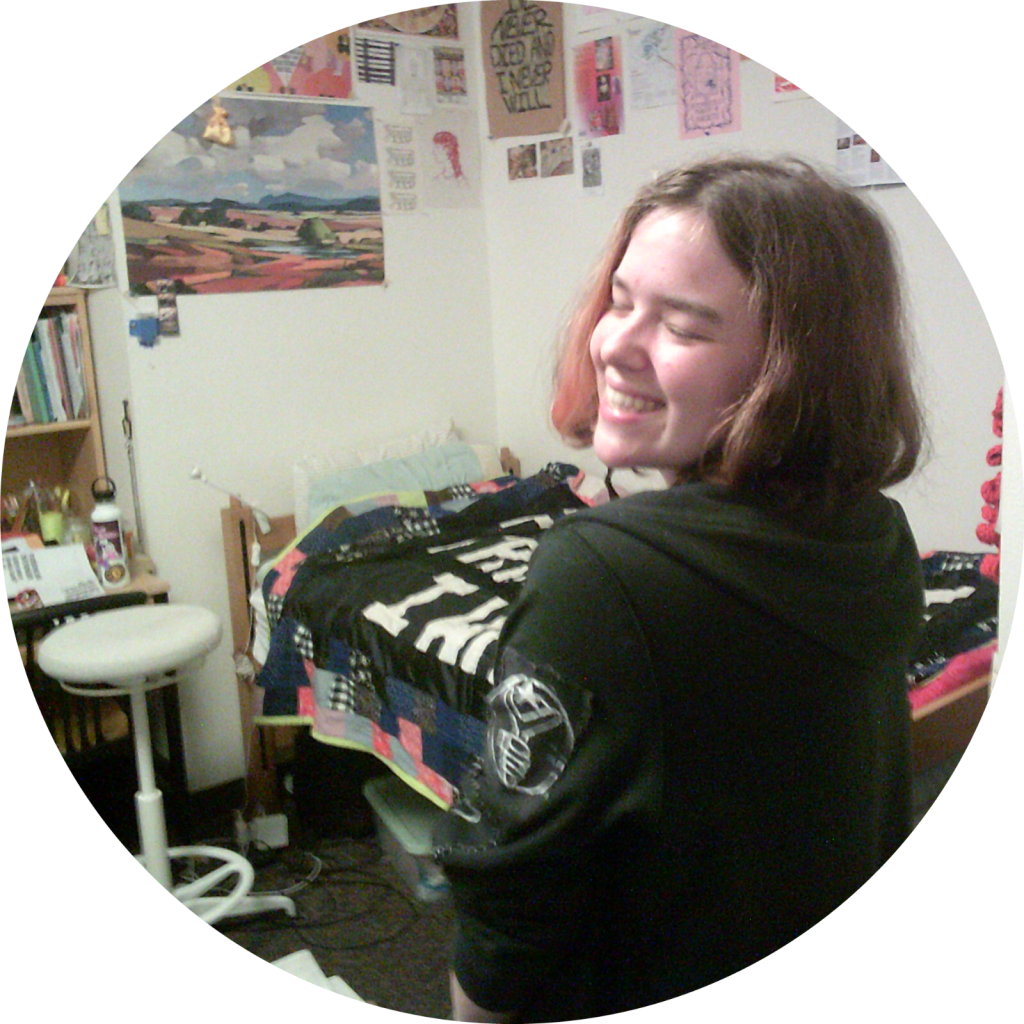
Charlotte Bruckner writes about bureaucratic dreamscapes, martyrs and their wounds, and repressed queer longing. His short fiction and poetry have appeared in TOWER Magazine, Vagabond City Lit, Broken Antler Magazine, Nowhere Girl Collective, and elsewhere. When not writing, he works in theatrical costume design.
Header photography and artwork by Jordan Keller-Wilson
The kids want to know what it feels like to be killed by lava.
I tell them many would have retreated to the countryside, or run to the sea, thinking it wouldn’t reach them there. I tell them most would have suffocated before the lava reached them.
I point at an image on the screen, What’s this?
A statue!
I affect a grimace, Not a statue.
They cock their heads, thinking. Murmurs travel through the classroom; I tune into one, Dead body.
I nod, This is a person frozen by lava. I don’t have better words. Mummified by lava? Fossilized?
One boy gets back from the toilet and looks over his shoulder at the white board, God, what’s that! I tell him to tuck his shirt in and take a seat.
They ask if any animals died too, so I close out of the slideshow and Google the Pompeii dog. I tell them to cover their eyes if they don’t want to see something too sad.
They erupt, they ask, Why does it look like that!
It’s contorted into a ring shape, limbs flailing and mouth open just enough.
Because it was in pain.
They squirm. They don’t want to look at the dog anymore. I return to the original slideshow, where we see the face of the “statue” turned to the black sky and its knees gathered to its chest, a final protective gesture.

Madeline Crawford lives, teaches Latin, and writes in London. Her poetry and fiction have appeared in or are forthcoming from Paloma Magazine, The Mantelpiece, Vast Chasm, and Die Quieter Please, among others. She has worked as a reader and editorial assistant for A Public Space. She went to Hunter College and received her MA in Classics from University College London.
Header photograph and artwork by Jordan Keller-Wilson
I hold grievances grown so old they are
calcified, rounded, smooth-pearled possessions—
each tucked away in its own bitter sphere.
I know each by feel, by weight, by passion—
I know where they’ve been lodged and exactly
why I keep them there. I’ve grown used to their
presence, to the collected gravity
of each and every ancient reminder
of who and what and why and when rotten
things happened. I’ve kept them all. Kept them all
this time. Felt their sharp angers dull, soften
into me, felt them become mutable
as I held them, shaped them perfectly.
And when I die I will take them with me.

Juleigh Howard-Hobson’s work can be found in Think Journal, Mezzo Cammin, Able Muse, The Alabama Literary Review, Birds Fall Silent in the Mechanical Sea (Great Weather for Media), Under Her Skin (Black Spot Books), and many other venues. She’s been nominated for Best of the Net, the Pushcart Prize, the Elgin and the Rhysling Awards. She was a Laureates’ Choice prize winner in the 2024 Maria W. Faust Sonnet Contest. Her 6th and latest book is Curses, Black Spells and Hexes (Alien Buddha Press).
Header photograph and artwork by Jordan Keller-Wilson
 Vast
Vast 