Visiting Hours

Hundreds of discarded bikes are heaped in a pile, their frames and wheels disfigured but recognizable. The image is in black and white, with a V cut through the center. Inside the V, the bikes appear to be painted in vivid colors.

Tell me a bedtime story in which I don’t float away this time. Kiss my stained glass lips and let me be young again. Don’t say that the crow will gnaw off my kite strings, that God will pump me full of helium. Tell me a story that anchors me to the roots of your laughter, to the doorknob of your attic. It doesn’t have to have a happy ending. I promise not to cry when the monsters creep out of my lungs, or scream when the climax is empty. I just want to imagine myself tethered to your vocal cords, entwined in your thick arteries like a tender knot. Only then can I fall asleep nestled safely in machinery. Only then can I wake up in the morning, and look at the milky sky with a jitter of hope. 


Elena Zhang

Elena Zhang is a Chinese American writer and mother living in Chicago. Her work can be found in HAD, Ghost Parachute, Exposition Review, Your Impossible Voice, and Gone Lawn, among other publications, and has been selected for Best Microfiction 2024. You can find her on Twitter @ezhang77.

Header photograph by Jen Ippensen
Header artwork by Jordan Keller-Wilson

Is the universe laughing with me or at me?

Hundreds of discarded bikes are heaped in a pile, their frames and wheels disfigured but recognizable. The image is in black and white, with a V cut through the center. Inside the V, the bikes appear to be painted in vivid colors.

Funny how
it was in the hospital waiting room –
the stiff seat cushions, white lights, and
September’s Women’s Health magazine –
where, despite the nurse at reception, 
I first felt like a real person.

We’ve given so much up already
and we keeping handing out more:
innocence and virginity,
bravery and youth,
teeth and hair.

These poems are lists of my grievances.
I don’t want to have been beautiful
only when in a hospital gown – or in memoriam.
We both know the gay bar is the only place
where it’s hot to have your ass out –
even for me.

Do me a favor,
tell me how beautiful I am,
in this moment, in this light, 
in this ignorance.

Funny how wounding it is
to become sick. There’s no way to recover
from something like that. I presented a piece of myself
as if I was presenting a pearl.

How funny.


Patrick Schiefen

Patrick Schiefen (he/him) is a United States writer who currently lives and writes in Argentina. His experiences as a nomadic LGBTQ+ artist informs his writing as much as music, politics, and art. His work has appeared in High Shelf Press, Ample Remains, From Whispers to Roars, Literary Shanghai, and elsewhere.

Header photograph by Jen Ippensen
Header artwork by Jordan Keller-Wilson

Some Opposites Are Easier to Understand

Hundreds of discarded bikes are heaped in a pile, their frames and wheels disfigured but recognizable. The image is in black and white, with a V cut through the center. Inside the V, the bikes appear to be painted in vivid colors.

I fail the antonyms quiz. One question asks if my father is absent or present. I circle both. Another asks if my mother is kind or unkind. I write, “I don’t know.”

My teacher’s eyes narrow behind her black-framed spectacles. She tosses my paper on my desk. “Your answers are not funny.”

“It’s the truth. My father is mostly absent,” I tell her.

Her nostrils flare and she snorts. “Just because he’s gone temporarily doesn’t mean he’s absent.”


After Appa calls to say he’ll be late returning from work, Amma says we’re going to Kavi Aunty’s. She asks me to wear the purple-and-yellow-checked pinafore―an outfit she sewed using a magazine picture and her trusty Singer―because the lady is foreign returned. Amma also instructs me to be on my best behavior.

Aunty shows me her golden-haired, blue-eyed doll. When I pull on the string attached to her back, the doll blinks her dark lashes and sings, “I love you.” I pull-pull on the string. The doll repeats the words, again and again, until the string comes off in my hand and she doesn’t speak any more. Amma watches me through narrowed eyes, clenches and unclenches her fists. 

On our way home, she mutters through tight lips, “You were so good today. Such a well behaved girl. Of course Kavi will invite us again.”


Some opposites are easier to understand. For up and down, our teacher puts a book on top of her desk and then on the floor. For short and tall, she makes the tallest student in the class stand next to the shortest one. She taught us the opposite of responsible is irresponsible with the story The Ant and the Grasshopper. I like that opposites are also called antonyms.


I’m coming home after returning a book at my friend’s when I see the fox―beady eyes gleaming, teeth bared in a snarl―just inside our door. 

“Amma, there’s a scary animal in our house,” I scream.

She smacks her forehead, then picks up the animal; she, who doesn’t even like our neighbor’s little Pomeranian.

In the living room, Appa’s glued to the news.

“What a wonderful gift you’ve brought your daughter,” Amma says. “A stuffed animal! Just perfect.”

Appa turns up the volume. “There’s talk of rain and floods,” he says. “They say this one will be big. I must go to my mother’s.”

Amma walks into the kitchen, turns the faucet on full force.

Appa spends weekends helping my grandmother. He takes her shopping. He helps her find a plumber or an electrician, waits while they repair things. On Fridays, he goes to her place from work so he can take her to the bank and then stays over.

Amma rushes out of the kitchen. “Of course, you should go to your mother’s. She’s important.” She drops a pan. It clangs against the floor.

I want to ask Appa why he hasn’t learned about Amma’s opposites. But he’s listening to the news.


Sudha Balagopal

Sudha Balagopal‘s writing appears in CRAFT, Split Lip, and Smokelong Quarterly among other journals. Her novella-in-flash, Things I Can’t Tell Amma, was published by Ad Hoc fiction in 2021. Most recently, her novella-in-flash, Nose Ornaments, was chosen runner up in the Bath Novella in Flash Contest. She has had stories included in Best Microfiction, Best Small Fictions and the Wigleaf Top 50.

Header photograph by Jen Ippensen
Header artwork by Jordan Keller-Wilson

Because you didn’t hit me.

Hundreds of discarded bikes are heaped in a pile, their frames and wheels disfigured but recognizable. The image is in black and white, with a V cut through the center. Inside the V, the bikes appear to be painted in vivid colors.

Because you didn’t cheat on me. Because I didn’t know that I could live my life and raise our kids without you by my side. Because I had been with you since I was twenty-three. Because you said you loved me. Because you said you saw me—saw what my mother had not seen or loved in me. I stayed.

I followed you away from her home, her abuse, and let you lead me into your home and your abuse, crowded with loving words and promises of a future where I would continue to be seen and heard and loved. Until I wasn’t. 

At fifty, I found myself stranded in a strained marriage with a man whose words stung and stripped me of the confidence you once grew in me. Until the day you grabbed our son, only sixteen then, and pulled him to you by the loose fabric of his t-shirt and pointed your thick finger in his face, your neck red, your nose touching his nose, your breath hot against his pale cheeks. Until you threatened to kill him because he disagrees with your politics, because he believes in Black Lives Matter, believes in gay rights, because he’s gay and you continue to vote for politicians that promise to deny his rights. 

Until he said, “I’m your son. Why are you doing this?” and your only response was, “Because you’re just like her. Just like your mother.”


Marina DelVecchio

Marina DelVecchio, Ph.D. is a writer and college professor who teaches literature, writing, and women’s studies. In addition to her online publications in MS Magazine, Huffington Post, and The New Agenda, her book publications include Dear Jane, The Professor’s Wife, The Virgin Chronicles, and Unsexed: Memoirs of a Prostitute’s Daughter (July 2024). She lives in North Carolina with her two children and three feral cats.

Header photograph by Jen Ippensen
Header artwork by Jordan Keller-Wilson

Things We Do for Loved Ones

Hundreds of discarded bikes are heaped in a pile, their frames and wheels disfigured but recognizable. The image is in black and white, with a V cut through the center. Inside the V, the bikes appear to be painted in vivid colors.

The writing jobs have been slow and cash flow is tight. The wife takes matters into her own hands to cut expenses. She’s talking to herself out loud and curt enough for me to hear: Eating out, gone. Unused gym membership, gone. Cable, gone. We adjust to this simpler way of life, which is more time at home, without cable. What she failed to consider was the effect on our donkey. Law & Order is on cable. We try to appease him with daytime network shows with a court-like environment: Judge Judy. Judge Mathis. Judge Joe Brown. None of them do the trick. Our donkey becomes unruly, kicking the back door each day around three o’clock, then taking his frustration out on the aluminum siding. I estimate the damage. It’s two-plus years’ worth of cable in repairs.


I restored the cable for our donkey. I know the math doesn’t work in my favor in this hard season, but it’s not about the math. That small gesture also restored our internet service, which prompted me to purchase a discounted box of Dutch Masters cigars online. I thought about writing our donkey a note, suggesting he might want to share them with the foxes and other wildlife who find their way to our firepit. But our donkey has never been a strong reader. Instead I left them without the cellophane wrapping by the remote control, which was another gesture worth more than words.


Thad DeVassie

Thad DeVassie is a writer and artist/painter who creates from the outskirts of Columbus, Ohio. His collection, Splendid Irrationalities, was awarded the James Tate Poetry Prize in 2020 (SurVision Books). His recent chapbook, This Side of Utopia, was published in 2023 by Cervena Barva Press. Find more of his written and painted work at www.thaddevassie.com

This piece was selected for Best Small Fictions 2025

Header photograph by Jen Ippensen
Header artwork by Jordan Keller-Wilson

The Only Eternal Peace I Dream Of

Hundreds of discarded bikes are heaped in a pile, their frames and wheels disfigured but recognizable. The image is in black and white, with a V cut through the center. Inside the V, the bikes appear to be painted in vivid colors.

I want to rot.
I want to decompose.
I want the furnace of my crumbling organs to burn
so hot that it kills the grass above my grave.

Then I want it to grow back,
slowly, around the edges.

Until tender shoots nestle against the downy pelt of a rabbit.
Until velvet lips of a deer tear me out by my roots.
Until the water in my stalks dissolve into its bloodstream
and I spill through the chambers of its heart.

Thrumming as my petals unfurl and face the summer sun.
Thrumming with wild, vibrating insects harvesting the pollen from my buds,
dripping, sticky and viscous, down waxen walls.

Not the moldering sleep of the dead,
but the explosive cacophony of an afterlife.


Laura Marden

Laura Marden (she/her) is a speculative and weird fiction writer. Her work has been published in The Chamber Magazine, Creepy Podcast, and The Q&A Queerzine. Her short story “Until Prophecy’s End” can be found in the Seers and Sybils anthology from Brigids Gate Press. This is her first published poem. She lives in Maryland with her family and finds that the best time to write is when they’re all asleep.

Header photograph by Jen Ippensen
Header artwork by Jordan Keller-Wilson

Foreign Body

Hundreds of discarded bikes are heaped in a pile, their frames and wheels disfigured but recognizable. The image is in black and white, with a V cut through the center. Inside the V, the bikes appear to be painted in vivid colors.

Peel each piece of clothing off as if it was chainmail: heavy, protective. Look at yourself in the mirror and think about the person you were. Wonder who you are becoming.

Make the water hot, so you feel it, but not too hot. You are still trying to keep physical pain at bay. Step in and notice how the water’s spray feels on your skin. Feel a moment’s pleasure. Feel guilty.

Soap your hair with lavender shampoo. Hope it calms the column of despair between your womb and the hollow in your throat. Wash your swollen breasts gently. Wonder if they’ve realized they can stop making milk. Decide they have. Change your mind. Linger on the small curve of your stomach as you lather. Wonder why its stillness didn’t occur to you before.

Make a mental list of things to do: clip your six-year-old’s fingernails; clip your own; call your best friend. She doesn’t know yet. You are afraid to call her because the membrane is thin with her. But she will understand the mix of grief, anger, confusion, relief, and guilt. Feel grateful for your fortune in friends. Feel ashamed that you haven’t called yet.

Rub soap on your limbs. Hope you can rub away the film of fear, the dust of grief. Wash the shadowed spot between your legs. Soon someone will have to reach in and take death out. Consider the irony of being able to birth both life and death. 

Remember, as a teenager, seeing the carved stone Sheela-na-Gig in the National Museum of Ireland. Recall your disgust at her ugliness, the rudeness of her gestures—open mouth to take in, open vagina to push out. Soak in the discomfort of unwanted understanding.

Flash back to yesterday, the 18-week ultrasound. Feel your husband and daughter huddled around the table, excitement and hope rising from your skin like steam. Six years since you were there before, giddy, with just your husband. Remember your living child saying, “I hope the baby doesn’t decide to die,” then your own twinge of intuition. Wonder whether telling her about the possibility was smart. Remember the screen, the absence of sound, movement. Remember the face of the technician, the doctor, the woman at the front desk. Let the moment of knowing wash over you. Lean your arm against the shower wall and allow yourself to weep.

Lather your face, while gravity pulls at you. Wash the tears away. Feel the words bubbling up in you, begging to be born. Wonder how it is that you can choose to pour words and not blood. Feel the burn of fear. Imagine the blood, red and hot, pouring into the water at your feet. Rinse the soap away and turn off the water.

Take a deep breath. Step out. Wrap yourself in numbness. Pump cocoa butter into your hands and spread it over your aching breasts and quiet belly. Wonder if your body will still bear the marks of pregnancy. Berate yourself for your vanity.

Pull on your clothes quickly, covering as much skin as you can. Know the sense of protection is a placebo. See yourself in the mirror and immediately look away. The reflection does not tell the story. Shake your head at the inadequacies of sight, of language.

Think about the dark and borderless space inside you. Absorb your lack of control. Feel the tears well again. This time, don’t let them spill. Instead, tell yourself you can replace sadness with anger. Tell yourself you are made of stone. Tell yourself you were made for this. Turn toward the world, taking in, pushing out.


Lauren Harr

Lauren Harr earned her M.F.A. from the Naslund-Mann Graduate School of Writing and her writing has appeared in The Daily Lobo, 3Elements Review, and elsewhere. A former independent bookseller turned publishing professional, she lives in Western North Carolina with her husband and daughter.

Header photograph by Jen Ippensen
Header artwork by Jordan Keller-Wilson

Micro Mashup by Vast

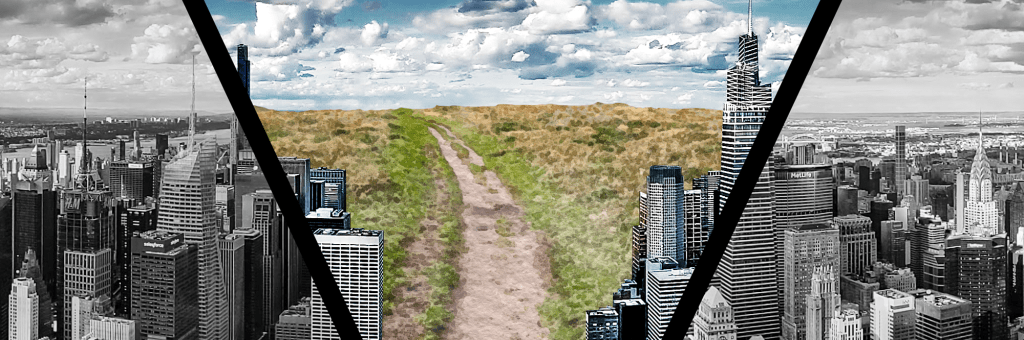
One of the bridges of Madison County, alive with brush-stroked colors, is framed in a bold V shape. Outside the V, the black and white photograph reveals the snowy landscape.

In the spirit of compaction, of mashing worlds together and making something new, we invite you to roll two dice and form a new micro story.


Die 1 Result
1. as our brains ramp up and spiral down
(“Just Chill Out, Okay”)

2. As they scarf down bits between running food
(“Easter Sunday”)

3. In her cubicle
(“Naked Protest”)

4. when the long sleep comes
(“The Love That We Have Been”)

5. next to the Italian place
(“When You Share a Small Town”)

6. the compaction forms something new
(Issue 9 Editor’s Note)
Die 2 Result
1. we can’t believe our bodies can feel so high and so low
(“Just Chill Out, Okay”)

2. the servers have prepared a feast
(“Easter Sunday”)

3. the women swerve, swoop, resettle, a flock of starlings
(“Naked Protest”)

4. I hope you are with me
(“The Love That We Have Been”)

5. I watch the sunrise
(“When You Share a Small Town”)

6. It is, all of it, a condensing
(Issue 9 Editor’s Note)

Header photograph by Holly Pelesky
Header artwork by Jordan Keller-Wilson

Easter Sunday

One of the bridges of Madison County, alive with brush-stroked colors, is framed in a bold V shape. Outside the V, the black and white photograph reveals the snowy landscape.

Sara sneaks to the bathroom, washes the beer off her hands, adjusts her apron, and calls her son. She asks if he found his Easter basket. “Dad didn’t even give me one hint!” his smiling voice rings out, echoing across the tile. Ten years ago, when he was stretching her belly and the daffodils were slowly threatening to penetrate the dirt, she got up in front of her congregation and begged for forgiveness. Today, she apologizes to nobody. 

Peter is using a thermometer on burgers, something he hasn’t done in years. The young ones on the line cannot stop laughing about it. Peter had woken up at three that morning to smoke the ham, and, despite her tie-dye hoodies and John Lennon posters, was completely flabbergasted to find his daughter up too, slouched on the front porch with a joint and a Fanta. So, there they were, one up too early and one up too late, both there to smoke, neither of them saying what they wanted to say. 

Laila stripped in her car, throwing off her dress and tying up her hair, racing time and humming that Alleluia, Christ has risen today. When she gets to work, a pastor that lives in a 2 million dollar house looks at her with eyes somewhere between the scornful ones that stared at Sara from the pews and the glazed ones of Peter’s daughter. It is as if Laila has sinned in every plate she serves, in every cup she fills. The pastor tips her 10%. 

In the back of house, where the hordes of after-church-diners can’t reach them, the servers have prepared a feast. There are casseroles that were assembled after close the night before, cakes soggy with melted frosting that didn’t have time to cool, and enough deviled eggs to feed a small militia. 

As they scarf down bits between running food, between wiping tables, between stirring sauces, they laugh and praise and forget, for just a moment, that everyone hates them for working Easter Sunday. Sara tells Laila why this is the one day a year she doesn’t mind leaving her son to work. Peter eats a piece of cake before sneaking a piece into a to-go box for his daughter. Mike, the dishwasher, catches him and says nothing. 

Janey, who never messes up anything, accidentally doubles three separate tickets. “I must need new glasses!” she says with a wink as she walks out from behind the line and plops buffalo wings next to an assortment of cookies. 

For these people, today is a celebration. Today is a gathering. Today is a communion. 

Today they are serving others, today they are late on their rent, today their daughters are smoking weed and their tables aren’t tipping and their babies are opening baskets without them. But today, Easter Sunday, they share a holy understanding. Today, they are all indisputably aware that they are not alone, and that they have each other.


Lilia Anderson

Raised in the land of snow and lakes, Lilia Anderson mainly writes about stubborn people in stubborn towns. She currently lives in Denver with a lot of books and a very handsome man. Her work can be found in 86 Logic, Feels Blind Literary, Blood & Bourbon, and more.

Header photograph by Holly Pelesky
Header artwork by Jordan Keller-Wilson

When You Share a Small Town

One of the bridges of Madison County, alive with brush-stroked colors, is framed in a bold V shape. Outside the V, the black and white photograph reveals the snowy landscape.

I’ve always loved the way the witch alders,
studding the bypass shoulders by the airport,
grow red in the fall, their scarlet tentacles the shade
of afternoon. It’s too bad they belong to you.

The black gum trees across from the police station
crawl like wooly tarantula legs into the pale sky,
but I rarely see them now, the way I don’t see
the fog-breathed gas station beer cave, the red sushi sign.

I have the grocery store that never had your pretzels,
the car wash with the spidering palm tree logo,
the small manmade lake near the gas company
that in late fall collects ducks like misshapen stars.

I can’t go to the bigger hardware store,
the one cottoned with spring flowers on the sidewalk
next to the Italian place. You could be there,
although you weren’t one for fixing things.

I gave up the library; you gave me the new liquor store.
I know you shop at the supermarket lined with evergreens;
you may as well live there, so I never go.
Instead I watch the sunrise, knowing the sunset will become yours.


Devon Neal

Devon Neal (he/him) is a Kentucky-based poet whose work has appeared in many publications, including HAD, Livina Press, The Storms, and The Bombay Lit Mag, and has been nominated for Best of the Net. He currently lives in Bardstown, KY with his wife and three children.

Header photograph by Holly Pelesky
Header artwork by Jordan Keller-Wilson